






Oversight of parental evaluators has been lacking for decades
For decades, critics have urged Colorado’s judicial branch to do more to ensure the quality of court appointed evaluators, but the judiciary has been slow to regulate the profession.
An investigation by The Gazette found dozens of cases of incompetent, inaccurate and biased custody evaluations by court-appointed evaluators, several of whom put children at serious, even life-threatening risk.
In 2002, a blue-ribbon judicial branch commission on families in the Colorado courts urged the judiciary to “develop an assessment process” to ensure those receiving appointments in divorce cases are “meeting established standards.” That commission also urged the judiciary to create a system that “allows for removal of individuals who are not competent” and develop an “appropriate process for identifying individuals who are not performing competently.”
Michael Bender Photo by
In 2012, Michael Bender, then-chief justice of the Colorado Supreme Court, rejected a recommendation from a judicial committee urging “creation of additional regulatory oversight” at the state court administrator’s office for child and family investigators, though he agreed to create a statewide roster among other changes. “The costs associated with expanding regulatory oversight are undefined and the current economic climate limits the availability of resources,” Bender wrote in a letter explaining his reasoning.
The judicial committee had recommended a centralized complaint office or “super board” for child and family investigators because judicial district administrators reported “they do not have the requisite skill or expertise” to investigate complaints of mental health professionals serving in that role. In addition, officials at the Colorado Department of Regulatory Agencies, which licenses mental health professionals, reported at that time that they dismissed roughly 60 CFI complaints annually due to lack of jurisdiction, expecting court officials would handle those complaints.
Jim Smallwood
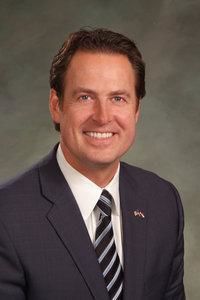
It wasn’t until this year that the state court administrator’s office adopted standards or oversight for parental responsibility evaluators. The court administration finally acted because legislators demanded it last year by passing HB 21-1228, sponsored by Froelich, the Democrat from Greenwood Village, and Sen. Jim Smallwood, a Republican from Parker.
The law requires the judicial department to establish a complaint process for parental responsibility evaluators. The legislation also required evaluators and child and family investigators to complete six hours of training on domestic violence and six hours of training on child abuse. Every two years thereafter, they must complete an additional four hours of renewed training on domestic violence.
The law also required the state court administrator’s office to create an eligibility roster for parental responsibility evaluators, standards for their court practice and a new complaint process. Still, the system the court administrator’s office adopted this year has hurdles for those wanting to file a complaint. Complaints won’t be investigated without a finding from a judge that the evaluator failed to follow a court order or violated a standard of practice, though there are exceptions to that requirement for pressing cases where an evaluator committed a crime or failed to keep up with the new training.
“The rationale for requiring judicial officers and judicial districts to monitor the work of CFI and PRE is because the court is responsible for managing the case and the trial processes,” said Rob McCallum, a spokesperson for the State Court Administrator’s Office, in a statement.
“The court and local officials are in the best position to understand the facts of the case, the credibility of the parties, and best positioned to understand the demographic, economic and geographic realities in their communities.”
However, studies suggest that the state’s new minimal training requirements won’t solve all issues. A guidebook the State Justice Institute developed for the National Council of Juvenile and Family Court Judges noted that expertise in the mental health field does not automatically make a parental evaluator competent to assess the presence of domestic violence.
“Even though some jurisdictions are now requiring custody evaluators to take a minimum amount of training in domestic violence, that ‘basic training’ by itself is unlikely to qualify an evaluator as an expert, or even assure basic competence, in such cases,” the guidebook states.
The guidebook recommends that court jurisdictions have designated evaluators with expertise in domestic violence issues available for appointment in custody cases with allegations of violence.
Two studies funded by the U.S. Department of Justice, one in 2011 and one in 2012, found evaluators often discount violence, with one review finding they ignored documented evidence in roughly one out of every five cases where such documentation exists. “Even in the presence of severe violence and controlling behavior, evaluators reported they would most likely recommend unsupervised visits for the father,” the latter study found.
And, in 2019, a study published in the Journal of Child Custody of 27 custody cases that were reversed due to later reports of child abuse found flawed parental evaluation reports that “pathologized” mothers when they reported child abuse played a significant role. “The abuse often became increasingly severe and the children’s mental and physical health frequently deteriorated,” the study found.
