






Sen. Mike Lee fends off 2 opponents to win Utah GOP primary
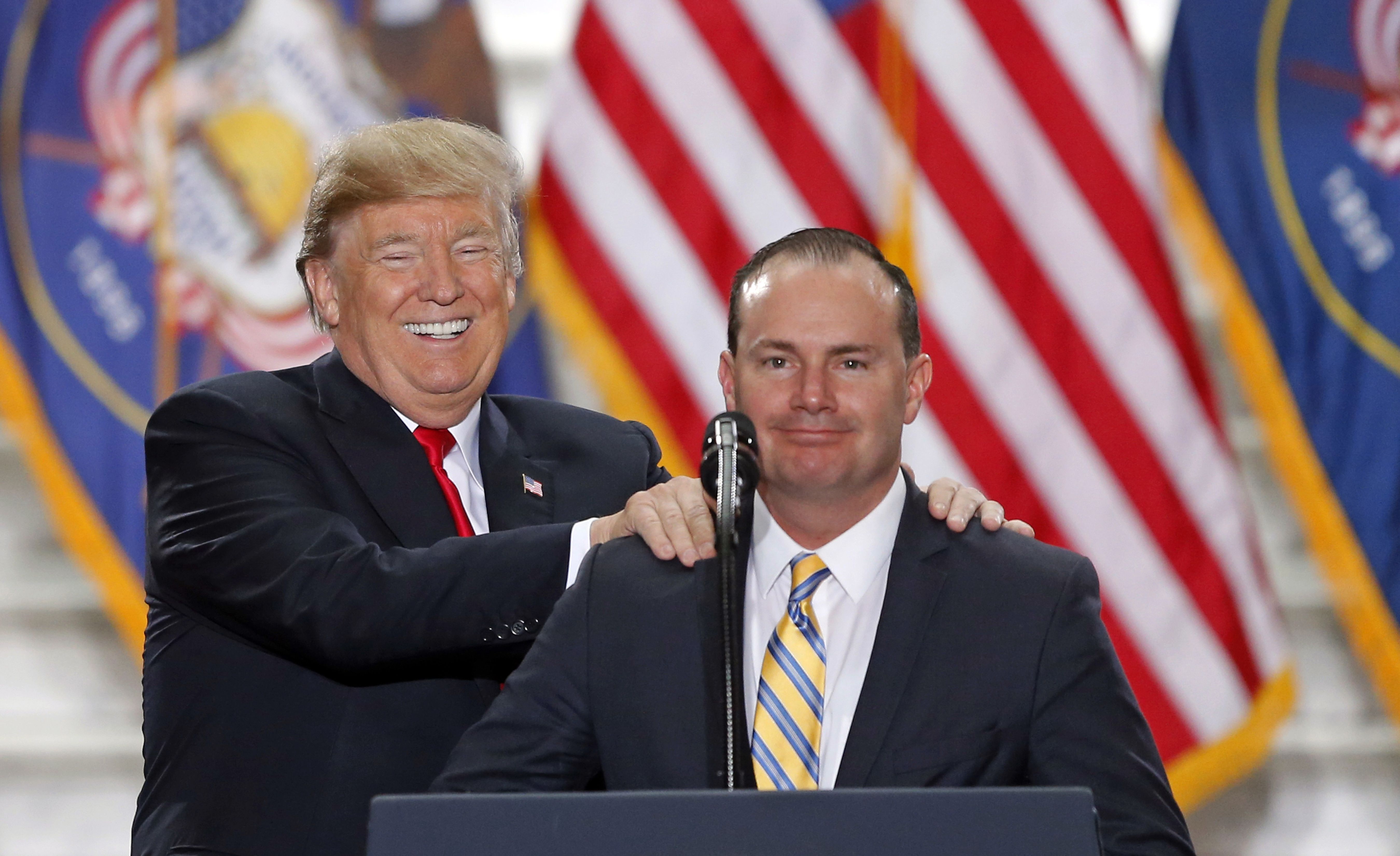
SALT LAKE CITY • Sen. Mike Lee won Utah’s Republican primary Tuesday, fending off attacks from two challengers who criticized him for his unwavering loyalty to former President Donald Trump and uncompromising lawmaking style.
The second-term Republican and Trump loyalist now advances to the November election, where he’ll face off against independent candidate Evan McMullin who in 2016 received more than one-fifth of the state’s presidential vote in Utah running as a conservative alternative to Trump. McMullin left the GOP after Trump’s ascendance and won backing from the state Democratic Party this year. McMullin has kept pace in campaign contributions with Lee in this year’s Senate race.
Lee defeated former state lawmaker Becky Edwards and political operative Ally Isom, two well-funded opponents who attempted to appeal to voters disillusioned with the direction of the Republican Party. They tried to frame Lee as a divisive politician who cares less about governing than he does television appearances and his allegiance to Trump.
On the campaign trail, they called Lee an obstructionist and drew attention to the leak of post-election text messages he sent to then-White House chief of staff Mark Meadows. The messages, they said, showed his early involvement in efforts to overturn the 2020 election.
Lee has responded to criticisms saying that he merely encouraged Trump’s team explore available legal avenues, noting that he ultimately voted to certify the results on Jan. 6, 2021.
He’s mostly remained above the fray and not responded to other intraparty attacks, instead focusing on tried-and-true rhetoric about the U.S. constitution and criticisms of federal overreach.
This contested primary was a drastic departure from Lee’s first reelection campaign in 2016. That year, no primary challengers came forward to challenge him in arch-conservative Utah, after the one-time Tea Party insurgent successfully consolidated support from both grassroots conservatives and establishment Republicans.
In New York, nine months after she stepped into the job of New York governor as a relative unknown, Democrat Kathy Hochul easily locked up her party’s nomination, setting her on an expected glide path to win the office in November.
Hochul was serving as an under-the-radar lieutenant governor under the shadow of former Gov. Andrew Cuomo until last year, when he resigned amid sexual harassment allegations, catapulting her into office.
Hochul beat back primary challenges from New York City’s elected public advocate, Jumaane Williams, and U.S. Rep. Tom Suozzi, a moderate from Long Island. She now turns her eyes to becoming the first woman to win election to the New York governor’s office this fall.
In a nod to the barrier-breaking campaign, Hochul gave an election night speech Tuesday on a stage underneath a glass ceiling at an event space in Manhattan.
“I’m also here because I stand on the shoulders of generations of women, generations of women who constantly had to bang up against that glass ceiling. To the women of New York, this one’s for you,” Hochul said.
Hochul enters the general election campaign with a big advantage, running as the incumbent with a heavy fundraising advantage in a state that has more than twice as many registered Democrats than Republicans and has not had a GOP governor in 16 years.
She faces U.S. Rep. Lee Zeldin, who won the Republican Party’s nomination. Zeldin is a staunch ally of former President Donald Trump and was among the Republicans in Congress who voted against certifying the 2020 election results.
In other primary races:
• A Mississippi congressman facing questions about misspending campaign funds lost a rare Republican runoff.
Mississippi Republican Rep. Steven Palazzo, a six-term incumbent, was defeated by Sheriff Mike Ezell. That came as his Republican House colleague, congressman Michael Guest, won a runoff race in that state — despite defying former President Donald Trump and voting to create an independent commission to investigate last year’s insurrection at the U.S. Capitol.
• In Illinois, Democratic Rep. Sean Casten beat progressive Congresswoman Marie Newman for a seat in suburban Chicago both competed for after a declining population cost the state a House seat.
JB Pritzker won Democratic nomination for governor in Illinois primary election. Pritzker will face Darren Bailey, who won the Republican nomination for governor in Illinois primary election.
• Republican Markwayne Mullin advances to primary runoff election for U.S. Senate in Oklahoma. Also, Joy Hofmeister wins Democratic nomination for governor in Oklahoma primary election. Kevin Stitt won the Republican nomination for governor in Oklahoma primary election.
• Steve Sisolak won the Democratic nomination for governor in Nevada primary election.
• Michael Franken won the Democratic nomination for U.S. Senate in Iowa primary election.
President Donald Trump stands with Sen. Mike Lee, R-Utah, in December 2017 at the Utah state Capitol.
