






Putin gas cutoff shakes up Europe at little cost to Kremlin
BRUSSELS • Cutting off natural gas to Poland and Bulgaria cost Russian President Vladimir Putin very little — but it is adding stress on European countries wrestling with how to reduce the energy imports feeding the Kremlin’s war chest and how to keep a united front on the war in Ukraine.
European Union officials say yielding to Putin’s demand to pay for gas in rubles would violate Western sanctions imposed over the invasion. Poland and Bulgaria were cut off after refusing the demand and say they will manage because they were already working to end their dependence on Russian energy supplies.
Analysts say there is enough ambiguity in the European stance to allow the Kremlin to keep trying to undermine unity among the 27 member countries — even if an implied threat to cut off major customers such as Germany and Italy may turn out to be an empty one because it would cost Russia heavily.
The cutoff sent a chill through EU officials wondering how their utility companies will heat homes and generate electricity next winter. Putin got maximum disruption of what he regards as a hostile alliance for minimal costs because Poland and Bulgaria are relatively minor customers who were about to end their contracts at year’s end anyway.
Poland’s entire gas import was only 10 billion cubic meters per year, out of total European imports of 155 billion from Russia. Gas in roughly that amount is already flowing to Poland from other European countries pitching in to help.
Russian energy giant Gazprom has lost relatively little revenue but opened a new front in its confrontation with Europe.
Putin is creating “a system where he can basically divide countries — as we are seeing — for the ones that don’t want to comply with this new scheme will be cut off, while others will try to comply and essentially go against the European Union indication,” said Simone Tagliapietra, an energy expert and senior fellow at the Bruegel think tank in Brussels.
European payments for Russian oil and gas amount to $850 million a day even as governments condemn the war. It’s the result of decades in which Russia was regarded as a reliable supplier of cheap gas despite warnings from Poland and other central and Eastern European countries that Russia could use energy as a weapon.
John Lough, an associate in the Russian and Eurasia program at the Chatham think tank, said Russia’s cutoff of Poland and Bulgaria was meant as a signal to Germany and Italy, which both get 40% of their gas from Russia.
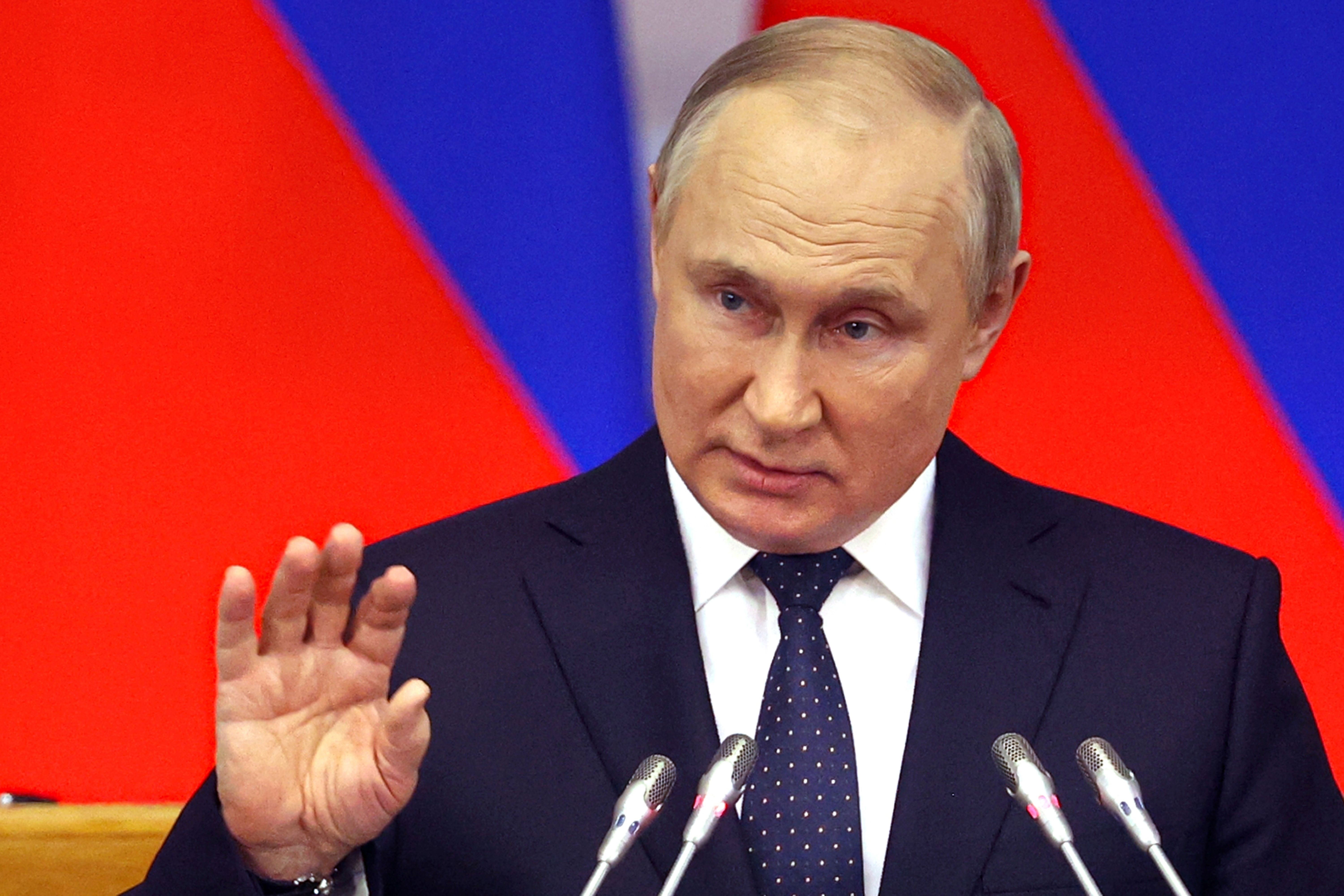
Russian President Vladimir Putin gestures Wednesday while addresses a meeting of the Council of Legislators in St. Petersburg, Russia.