






Outdated? Marshall fire area mitigation plans more than a decade old
The wildfire mitigation plan for the area where the Marshall fire ripped across a suburban landscape on Thursday hadn’t been updated since 2010, predating heavy population growth in the area.
The plan, managed by the Rocky Mountain Fire Protection District, includes evacuation routes for the area, the designation of subdivisions in hazardous locations and places where proactive mitigation work should have taken place, all of which were 11 years out of date.
The area where the Marshall fire burns straddles the edge separating some of the most prone-to-burn areas of the state and more urban areas where wildfire risks are lower. And while the wildfire spread from house to house through neighborhoods, leaving thousands of Coloradans to deal with tragic loss, it mostly followed wildfire risk predictions.
To the west, in the Front Range mountains of the Boulder Open Space & Mountain Parks, wildfire risk is considered very high, according to U.S. Forest Service wildfire hazard potential data.
Northwest of where the fire burned, most of Boulder is largely considered to be “non-burnable,” in terms of wildfire risk. The same is true to the east and northeast of the fire’s scar, in Broomfield and the center of Louisville.
And although three-quarters of the area burned by the Marshall fire is classified by the same data as a “moderate” wildfire risk or less, on the western edge, where the fire began, a combination of powerful winds moving east and “very high” wildfire risk zones combined to devastating effect. About one-sixth of the area burned by the fire was considered “non-burnable” by the federal estimate.
Like much of Colorado’s Front Range, the area saw significant growth in the past 10 years, increasing in population by 17%, according to census data.
A Gazette investigation from August 2021 found fewer than one out of every six of the 242 wildfire protection plans in Colorado were updated or created in the last five years. Roughly half of the plans are older than 10 years.
Colorado, unlike some other western states, does not require wildfire mitigation plans to be updated over regular intervals. In Idaho, for example, counties must update their protection plans at least every five years and state officials annually review the plans to determine areas eligible for federal grant funding for mitigation work.
The Marshall fire struck an area mostly considered to be “low” and “moderate” wildfire risk, but bordering areas are in “very high” wildfire risk zone.
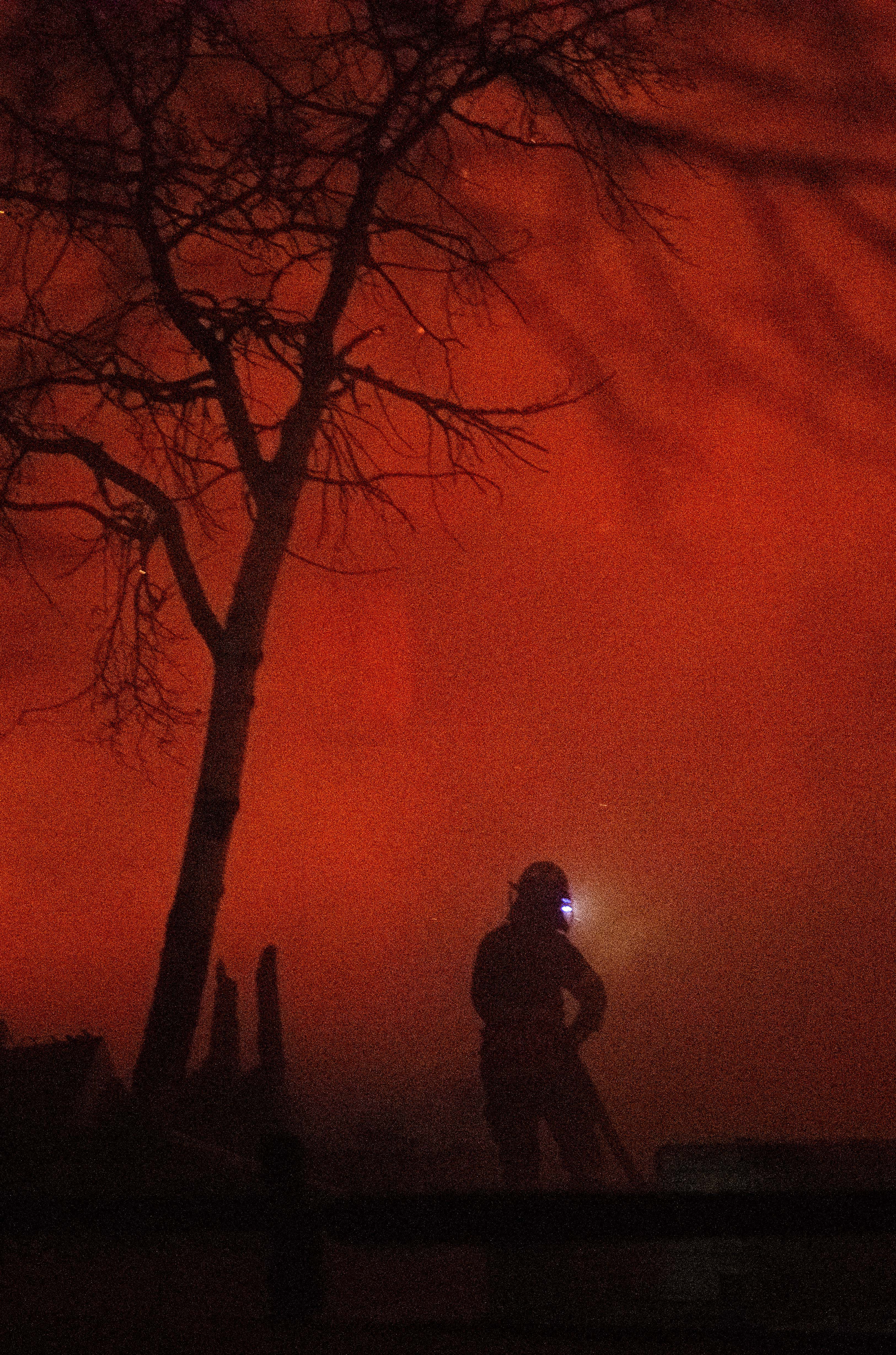
A firefighter battles a blaze in a neighborhood in Louisville, Colo., Thursday, Dec. 30, 2021, as crews work through the night combating the Marshall fire that started earlier in the day. The fire, fueled by high winds, burned through Boulder County, destroying nearly 1,000 homes and businesses. (The Gazette, Christian Murdock)
Carl Glenn Payne II, special to The Gazette Emergency personnel close down roads near 96th and Dillion Road after the Marshall fire spread rapidly through grasslands. The wind-driven fire moved east through Boulder County damaging and destroying homes as it burned 1,600 acres in Superior and Louisville.
People walk though the destruction across from Davidson Mesa Open Space in Louisville on Dec. 31. The Marshall fire ripped through Boulder County, fueled by winds of more than 100 mph on Dec. 30 and destroying more than 1,000 homes. About 35,000 people were evacuated in Louisville and Superior.
Men survey the remains of a home destroyed by a pair of wildfires, Saturday, Jan. 1, 2022, in Superior, Colo. Officials say that 991 homes were destroyed in Boulder County and 127 more were damaged in the Marshall Fire, which may have also been fatal, as the blaze, which was driven by hurricane-force winds, roared across two northwest Denver suburbs. (AP Photo/David Zalubowski)
The aftermath of the Marshall fire in Louisville, Colo., on Friday, Dec. 31, 2021. The Marshall fire ripped through Boulder County fulled by high-winds on Thursday, destroying over 500 homes. The number of destroyed homes will likely increase as approximately 35,000 people were evacuated in Louisville and Superior.(Chancey Bush/ The Gazette)
The aftermath of the Marshall fire in Louisville, Colo., on Friday, Dec. 31, 2021. The Marshall fire ripped through Boulder County fulled by high-winds on Thursday, destroying over 500 homes. The number of destroyed homes will likely increase as approximately 35,000 people were evacuated in Louisville and Superior.(Chancey Bush/ The Gazette)
The aftermath of the Marshall fire in Louisville, Colo., on Friday, Dec. 31, 2021. The Marshall fire ripped through Boulder County fulled by high-winds on Thursday, destroying over 500 homes. The number of destroyed homes will likely increase as approximately 35,000 people were evacuated in Louisville and Superior.(Chancey Bush/ The Gazette)
The aftermath of the Marshall fire in Louisville, Colo., on Friday, Dec. 31, 2021. The Marshall fire ripped through Boulder County fulled by high-winds on Thursday, destroying over 500 homes. The number of destroyed homes will likely increase as approximately 35,000 people were evacuated in Louisville and Superior.(Chancey Bush/ The Gazette)
People walk though the destruction across from Davidson Mesa Open Space in Louisville, Colo., on Friday, Dec. 31, 2021. The Marshall fire ripped through Boulder County, fueled by high winds on Thursday, Dec. 30, 2021 and destroying nearly 1,000 homes. Approximately 35,000 people were evacuated in Louisville and Superior.(Chancey Bush/ The Gazette)
The aftermath of the Marshall fire in Louisville, Colo., on Friday, Dec. 31, 2021. The Marshall fire ripped through Boulder County fulled by high-winds on Thursday, destroying over 500 homes. The number of destroyed homes will likely increase as approximately 35,000 people were evacuated in Louisville and Superior.(Chancey Bush/ The Gazette)
The aftermath of the Marshall fire in Louisville, Colo., on Friday, Dec. 31, 2021. The Marshall fire ripped through Boulder County fueled by high-winds on Thursday.(Chancey Bush/ The Gazette)
Aftermath in the neighborhood between Harper Lake and S Centennial Parkway in Louisville, CO following the Marshall Fire that spread rapidly into Louisville and Superior, CO on Dec 31, 2021. (Photo courtesy of Carl Payne)
