






Space Symposium: Colorado aerospace industry the Mall of America for all things in orbit
Sights and sounds from the 36th Space Symposium, the world’s largest space show, held at The Broadmoor in Colorado Springs. (Video by Skyler Ballard)
If you are shopping for space technology, Colorado is the Mall of America for all things in orbit.
If traffic is light, you can buy your rocket and satellite, hire staff to manage it in space and ink a contract with space tracking experts to keep it safe in orbit in a sunny Colorado afternoon.
From satellites probing the far reaches of the solar system to television from space, Colorado leads the way.
The state is also the home to the bulk of the new Space Force, with four of its bases and its most important missions.
The Global Positioning System signal that puts bombs on target, keeps your car on the right road and allows banks and the Internet to keep functioning comes from Colorado Springs. Buckley Space Force Base tracks missiles around the planet and stores satellite data for intelligence agencies.
The National Space Defense Center, the Aerospace Data Facility, U.S. Space Command and Army Space and Missile Defense Command are all here, and those are only the ones without cool acronyms.
We also house Space Operations Command, which goes by SPOC, along with Space Training and Readiness Command, which is … drum roll .. STARCOM in military parlance.
Colorado Springs Republican U.S. Rep. Doug Lamborn put it simply: America wouldn’t be in space without Colorado.
“We have the highest per-capita aerospace work force in America,” Lamborn explained. “If Colorado dropped out, this country’s space efforts would be in the world of hurt.”
Some Colorado aerospace industry facts from Colorado’s Office of Economic Development and International Trade:
- Colorado ranks first in the U.S. for its concentration of private aerospace employees.
- Aerospace employment here increased by 10% in 2020, outpacing the national rate of 3.7%.
- There’s more than 290 direct aerospace related business here, with 33,110 employees earing $4.3 billion in annual payroll.
- The state houses more than 500 companies and suppliers that indirectly support its aerospace industry.
- Colorado sports a robust research environment, with more than 34 federally funded scientific research labs and institutes.
- The University of Colorado Boulder “receives more NASA funding than any other public university.”
Industry rooted in military background
Colorado became a hub for space in the 1950s, with the defense sector leading the charge. It continued as the Cold War dawned and satellites played a growing role in the military standoff between the Soviet Union and America.
“At the end of the day that’s built up around the military operations are here,” explained Iain Boyd, who heads the University of Colorado at Boulder’s Center for National Security Initiatives.
The Pentagon for decades along with NASA pumped billions of dollars into space programs. Buckley and Peterson Space Force Bases were initially built for missions with wings but took on space roles. They were joined by centers dedicated to space at new installations Schriever Space Force Base east of Colorado Springs and Cheyenne Mountain Space Force Station, the Cold War-era bunker nestled underneath a half-mile of Rocky Mountain granite.
A factory to build intercontinental ballistic missiles led to what is now the United Launch Alliance in Centennial.
The Ball Corp., best known for jars and cans on the shelves of America’s new-fangled supermarkets, joined the race to orbit in 1956, landing a contract to build one of NASA’s first spacecraft, the Orbiting Solar Observatory. Since those days, Ball has built satellites that have helped mankind understand the Earth and the universe it inhabits.
Industry grows, flourishes
From weather and environmental satellites to space telescopes including the James Webb Space Telescope that’s set to launch this fall, Ball led the nation on its journey of discovery.
From big players like Lockheed Martin and Boeing, to smaller entrepreneurial outfits like Sierra Nevada Corp., aerospace companies have set up shop on the Front Range by the dozen.
Seth Harvey, co-founder of one of the newest newcomers, Bluestaq, said his company is in Colorado for the same reason as the old timers.
“It’s the perfect collision,” he explained. “Colorado is a great place to live and Colorado is a phenomenal community for supporting the space industry.”
Harvey should know. His company is a broker for space data and builder of an online marketplace that connects space vendors to the military. It has gone from four people who weren’t taking paychecks from the startup to dozens of engineers. They inhabit a ground floor space of a downtown Colorado Springs office tower that’s so hip even the steely-eyed missile men from the 1950s would have to loosen their narrow black ties.
“Colorado and Colorado Springs have a long history of supporting this industry,” Harvey said.
Reggie Ash, chief defense development officer at the Colorado Springs Chamber & EDC, said the city’s military history goes back to pre-World War II days when a group of city business leaders lobbied the War Department to locate Camp Carson there. The city also gave its airport to the war effort, creating Peterson Field, now Peterson Space Force Base. After the war, when the Army spun off its air arm into a new service, Colorado leaders again came together to get land for the Air Force Academy.
Now Colorado is home to 8 of the 9 U.S. Space Force deltas, a the service’s name for a wing-sized unit.
“The global economy doesn’t happen without the State of Colorado,” Ash said, noting most all the GPS satellites are controlled out of Schriever. “Those GPS satellites are built on the front range (many at Lockheed Martin’s Waterton campus southwest of Denver) and launched by ULA rockets.”
Colorado Springs-based Boecore develops, operates and maintains missile defense, space and cyber systems.
“The commercial space work that we have going on in the Denver and Boulder areas is merging with the decades of military space development work in Colorado Springs and Denver,” said CEO Kathy Boe. “Combine that with the aerospace education within the CU system, our capability in military and commercial space across the state is second to none.”
Veteran talent
And in all things space, Colorado has an advantage no place in the country can boast: A self-replenishing well of well-trained Space Force veterans leaving the service and hunting for civilian work.
Republican Colorado State Sen. Bob Gardner said that ex-military workforce has been a gift that has kept giving.
Gardner, an Air Force Academy graduate and former Air Force missile officer, said what drew him back to Colorado is what keeps the lifeblood of the state’s space industry pumping.
“Many satellite operators and space experts have found a home here and it’s a wonderful place to live,” he said. “It’s as simple as that.”
Dan Jaworowski, president of Infinity Systems Engineering, said there are two critical factors fueling the aerospace talent pool, and they are both tightly coupled.
Number one is the Department of Defense’s commitment to Colorado, and particularly Colorado Springs.
“What that ultimately affords us is that Colorado Springs is such a pristine place to live that a lot of the service members who get stationed here …. more frequently than not it seems, they ultimately want to call Colorado home when they retire,” Jaworowski said. “They come back and when they come back, they are such a rich, rich part of our labor pool to draw from. Who better to service the military than a prior military member?”
There are more than 85,000 veterans in El Paso County, and 40,000 active military personnel, Ash said.
“The aerospace defense culture here is what makes Colorado Springs, and the Broadmoor, the perfect environment for the Space Symposium,” he said.
What’s Next
The federal money nurtured the space industry here even as corporate America made it first forays into orbit with communications satellites. Now, everything is changing.
“The military is the backdrop but what is happening in Colorado and around the world is the evolution of New Space,” CU’s Boyd said.
New Space is the term used to describe the swashbuckling billionaires who have revolutionized rocketry in recent years and triggered a commercial rush to orbit.
With companies like Elon Musk’s SpaceX and Jeff Bezos’ Blue Origin competing for launch contracts, flying to orbit got cheaper and the satellites used there — some as small as cellular phones — plummeted in price, too.
With reusable rockets offering regular bus service to the stars, the price of flying to space tumbled from $10,000 a pound to $1,000 a pound and is expected to keep falling.
The goldrush to orbit is on. Eight years ago, there were fewer than 1,200 satellites orbiting the planet. In the first six months of 2021 alone, more than 1,200 satellites rocketed to orbit.
“It’s just getting closer to the point where businesses can make more money,” Boyd said.
Retired Maj. Gen. Jay Lindell, who serves the state’s Aerospace and Defense Industry Champion for the Office of Economic Development and International Trade, said there are other new horizons for Colorado space businesses.
NASA is working on a return to the moon and plans are in place to leap from the moon to Mars.
“We’re continuing to grow,” he said.
The key reason for the growth: Colorado grows and attracts the nation’s top space talent.
“We have built an economy based on the skilled, talented people in Colorado,” Lindell said. “And people love to come to Colorado. Our mountains still sell.”
Ash said the Colorado Springs Chamber isn’t working solo when it comes to attracting and retaining aerospace companies in El Paso County.
“It’s a year-round process. We work with OEDIT and we work closely with the Metro Denver EDC (Economic Development Corp.) and the Denver Chamber. … If we find out we’re talking to the same company, we’ll let each other know,” Ash said. “We both benefit from Front Range moves. The fact that we have Denver and all it has to offer, helps attract companies to Colorado Springs. (They) believe the same thing about Colorado Springs.”
Lt. Gov. Dianne Primavera, who heads the Colorado Space Coalition, said the state is poised to maintain its place atop the space industry.
She said the state stands out because of the wide variety of space businesses here, most of them small, nimble firms that can adapt at the light speed pace of the industry.
And those businesses have learned to work together to accomplish the nation’s goals in orbit, creating “the opportunity for collaboration across sectors,” she said.
If that isn’t enough, Colorado has a final advantage no other state can match, Primavera said.
“In Colorado we’re a mile closer to the stars.”
• Staff writers Dennis Huspeni, Jessica Snouwaert and David Bitton contributed to this report.
Three local military bases have changed their names to omit the word “Air” and add the word “Space.” A ceremony was held at Peterson Space Force Base name change as well as for Schriever Space Force Base, and Cheyenne Mountain Space Force on Monday, July 26, 2021. (Photo by Jerilee Bennett, The Gazette)
Radomes, golf-ball shaped protective chambers that house satellite dishes and other crucial space equipment, stand in a line at the Buckley Space Force Base in this photograph taken Friday, July 9, 2021,in Aurora, Colo. (Philip B. Poston/Sentinel Colorado via AP)
Senior leaders with the Air Force and Army participate in a groundbreaking ceremony in May on Peterson Air Force Base. The new building will house the 138th Space Control Squadron, which is part of the Colorado Air National Guard.
{span}Col. Marcus Jackson, right, incoming Buckley Garrison commander, receives the guidon from Lt. Gen. Stephen Whiting, left, Space Operations Command commander, during the Buckley Garrison Assumption of Command Ceremony at Buckley Space Force Base, Colo., June 4, 2021. The passing of the guidon is a symbolic tradition accomplished in front of the unit so all can witness the new commander assuming the position. (U.S. Space Force photo by Senior Airman Danielle McBride){/span}
U.S. Senator Angus S. King, Jr., I-Maine, chairman of the Senate Armed Services subcommittee on Strategic Forces, speaks with Chief of Space Operations Gen. Jay Raymond during a tour of key U.S. Space Force and U.S. Space Command missions at Schriever Air Force Base on May 14.
U.S. Air Force Chief Master Sgt. of the Air Force JoAnne Bass, right, speaks with Space Force Lt. Gen. Nina Armagno after a presentation for the Air Force Association Virtual Air, Space & Cyber Conference 2020 at the Pentagon.
The first group of officers for the new Space Force are commissioned by Gen. John Raymond on April 18, 2020, during the Air Force Academy Class of 2020 graduation on the terrazzo of the Air Force Academy.
Chief Master Sgt. Roger Towberman displays his insignia during a presentation of the U.S. Space Force flag in the Oval Office of the White House in Washington in May.
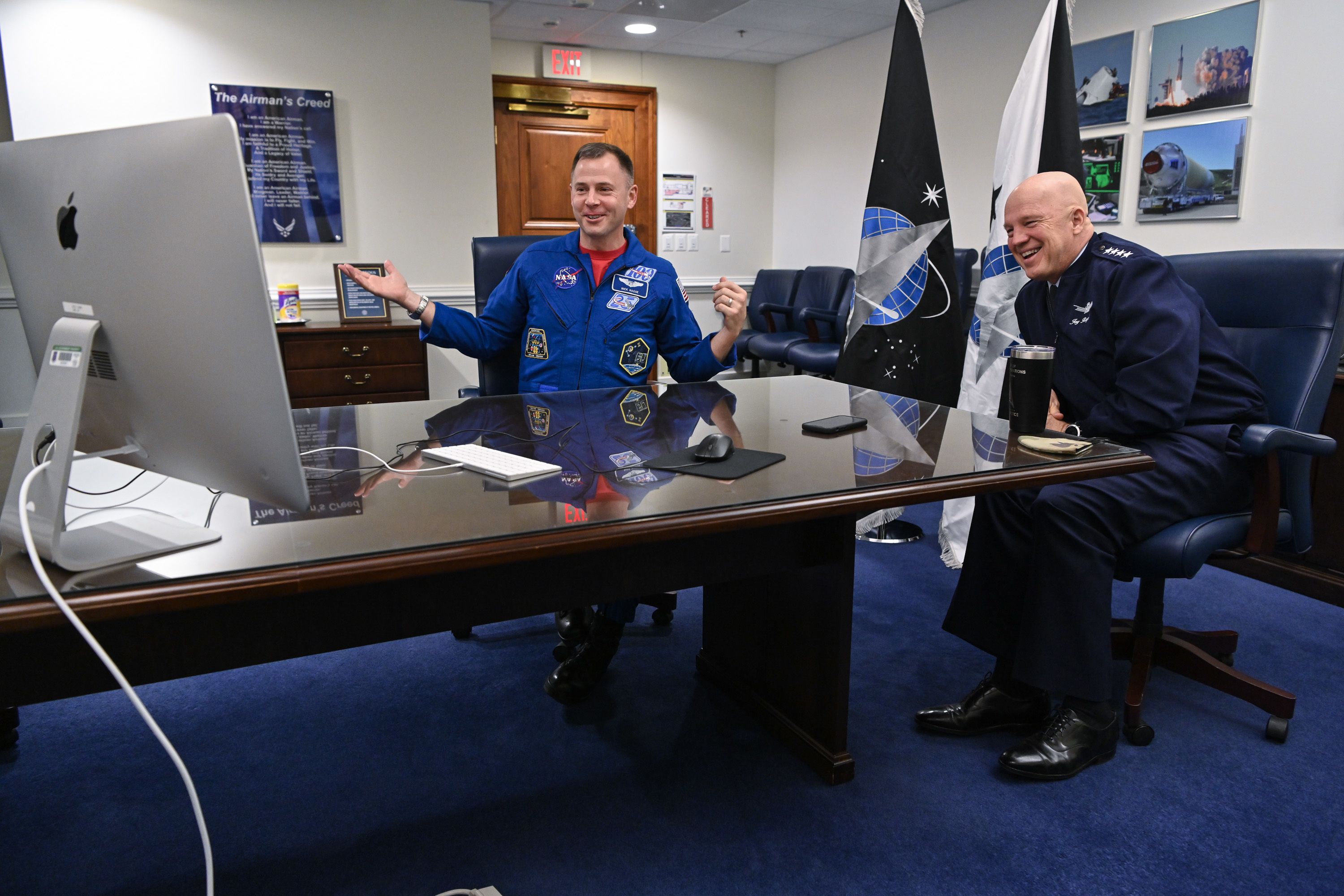
Space Force Chief of Space Operations Gen. John W. Raymond, right, and Air Force astronaut Col. Nick Hague speak with third grade students from Desoto Intermediate School in Adel, Iowa, during a virtual call at the Pentagon, Arlington, Va., Dec. 16. The call was part of “DeSTEMber” events, an initiative to engage children in science, technology, engineering and math.
Lockheed Martin employees watch the solar arrays unfurl on NASA’s spacecraft Lucy at Lockheed Martin’s Waterton campus southwest of Denver.
This is a model of NASA’s spacecraft Lucy with the solar arrays fully deployed.
Bluestaq Chief Operating Officer Rebecca Decker, center, during a leadership development session with interns and mentors at Bluestaq’s office in downtown Colorado Springs on Tuesday, June 22, 2021. Bluestaq employees returned to their offices June 14. (Chancey Bush/ The Gazette)
Bluestaq Chief Operating Officer Rebecca Decker, center, during a leadership development session with interns and mentors at Bluestaq’s office in downtown Colorado Springs on Tuesday, June 22, 2021. Bluestaq employees returned to their offices June 14. (Chancey Bush/ The Gazette)
Simon Nunn, chief architect and cofounder of Bluestaq, plays a video game in the historic arcade section of the company’s offices in downtown Colorado Springs.
wayneh@gazettedev.gazette.com