






Gender inequality the topic of virtual Colorado Springs celebration of International Women’s Day
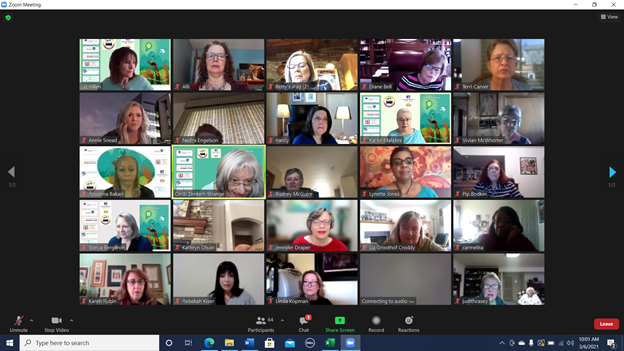
The Colorado Springs celebration of International Women’s Day was a virtual one last week, with 81 participants.
To kick off the local celebration, which offered the audience a chance to hear from three women speaking on the topic of gender inequality, Cindi Zenkert Strange, Colorado Springs IWD Committee chairwoman, quoted American abolitionist and women’s rights advocate Sojourner Truth saying, “Life is a hard battle anyway. If we laugh and sing a little as we fight the good fight of freedom, it makes it all go easier. I will not allow my life’s light to be determined by the darkness around me.”
The first speaker was Michelle Duster, author of “Ida B. the Queen: The Extraordinary Life and Legacy of Ida B. Wells,” which was published in January.
Duster, an adjunct professor of economics at Columbia College in Chicago, spoke of Ida B. Wells, her father’s grandmother whose “determination to agitate to help others led to many knowing the truth of racism.” Wells was a journalist, suffragist, community organizer and NAACP co-founder.
The oldest of eight children, Wells was born into slavery in Mississippi during the Civil War. By the time she was 3, the country was recovering from the war and changing economically. Her father worked as a carpenter and her mother a cook. She was part of the first generation of formerly enslaved people to be educated.
At the time, many in Wells’ family and town couldn’t read, so she often read the newspaper aloud to her father and his friends. “I believe this gave her confidence to speak in public situations,” Duster said of her great-grandmother.
Tragedy struck in 1878, when both her parents died within a day of one another due to a yellow fever epidemic. Wells was 16.
“Her childhood ended right then and there,” Duster said. Wells was forced to take care of her five younger siblings.
In 1883, Wells was forcibly removed from a lady’s train car by three men after she refused to move to the colored car. After a similar incident in 1884, Wells sued the railroad “because the cars were separate and unequal.” She won the case, but it was overturned three years later.
Back then, many felt that Black people could not get justice in a court of law.
Wells, co-owner of two newspapers in Memphis, wrote about what she felt was unfair treatment. “She encouraged people to boycott white-owned businesses and cripple the system that ostracized them,” Duster said.
Wells moved to Chicago in 1895, married and had four children. In 1913, as a suffragette she defied the rule that she as a Black woman had to walk in the back of the suffragist parade with the other Black women. Instead, she marched in the front of the line. When the YMCA refused to accept Black men coming from the south during the great migration of the early 1900s, Wells helped to find jobs for them.
“She was investigated by the FBI as a ‘dangerous negro agitator,’ for criticizing the government. She never accepted the second-class citizenship she was handed,” Duster said.
But Wells felt “the way to right wrongs is to shine the light of truth upon them,” Duster said, calling Wells a “Shero.”
The second presenter was Danielle Shoots who calls herself a “proud member of the millennial generation.”
“My generation has a huge responsibility to move us forward,” said the Colorado native is Vice President and CFO of the Colorado Trust, a foundation dedicated to achieving health equity. Shoots is also known for her 2018 TEDxMileHigh Talk, “Millenials Were Born to Lead – Here’s Why.”
As the youngest CFO in the history of any Colorado state agency and the only African American at times throughout her career, Shoots said she sometimes felt shame about her age. Now 35, she had her son Kai when she was 16 years old. She struggled with co-workers knowing she became a mother so young, until at some point she told herself, “Enough.”
“I am the leader I am because I was a teen mom … It gives me a toughness that I never could have gained in the workforce. Nothing I’ve been through at work is never going to be as hard as what I went through at 16,” she said, encouraging all women to bring their authentic selves to the table.
Her mantra became, “If you’re going to go down, you’ve got to go down being yourself.”
She explained why the typical work environment feels uncomfortable to most women, “If you don’t feel like you don’t belong in the environment it’s because it wasn’t built for you.”
Shoots said it makes no sense why she as a Black woman would need to find a way to conform in a white man’s world. The average pay of Black women compared to white men is ridiculous, she noted.
According to the American Association of University Women, “on average, Black women were paid 63% of what non-Hispanic white men were paid in 2019.”
She reminded the audience to stay vigilant. “We may not see the efforts of our labor, but our daughters will and their daughters, too. That’s our legacy,” Shoots said.
Liz Kellen, an audience member said, “It’s tragic that most women don’t realize how conforming is not letting them bring their ‘best selves.’ And even worse that organizations have no (or little) awareness of the potential they are leaving on the table. My hope is that everyone can be in an environment where they feel safe to be their true, authentic selves.”
The final speaker was Isabel Harris, a senior at Simpson University in Redding, California.
The native Coloradoan and member of Generation Z said, “My mom is also a teen mom. She always told us we could take the world if we wanted to.”
Harris played tackle football with the boys, was always on the basketball court, and says in general she had a naivety with regard to the differences between genders. It wasn’t until she was older and entered male-dominated spaces that she noticed the gender gap.
As a first-generation law student, Harris hopes to pioneer the way for her younger siblings. “We have to be conscious of how we are portraying ourselves,” she said.
“All women in all forms should be given automatic respect,” Harris said, noting that she finds it interesting that some women struggle with confidence but aren’t given the space to perform.
To break habits that stop forward motion, Harris suggested the 2018 book, “How Women Rise: Break the 12 Habits Holding You Back from Your Next Raise, Promotion, or Job,” by Marshall Goldsmith and Sally Helgesen.
Zenkert Strange closed the program by saying it was wonderful to spend the morning while listening to these challenging and hopeful topics.
The Colorado Springs IWD is organized and underwritten by eight partnering women’s organizations: AAUW Colorado Springs Branch, Colorado Women’s Hall of Fame, League of Women Voters of the Pikes Peak Region, Rocky Mountain Women’s Film Festival, The Woman’s Club of Colorado Springs, Women’s Educational Society of Colorado College and Zonta Club of Colorado Springs.
Screenshot by Allison Robenstein
The Colorado Springs International Women’s Day celebration went virtual this year with three expressive speakers.
Dr. Rosenna Bakari, last year’s emcee, read an original poem, “Natural and Normal” during the virtual Colorado Springs IWD program. She read that what is considered natural and normal leaves “out so many voices, so many choices.” “When we raise our girls to assume the responsibility for the feelings of boys while we fear them and protect their egos … legacies must be reborn,” she said. Watch a video of Bakari reciting the full poem at bit.ly/3qIMiSD.
Intl6.jpg
Michelle Duster, a writer, speaker and adjunct professor of economics at Columbia College in Chicago, spoke of her famous great-grandmother Ida B. Wells during the virtual International Women’s Day event March 6.
Danielle Shoots spoke during the International Women’s Day program about generational equality for women.
Screenshots by Allison Robenstein
Isabel Harris, a senior at Simpson University in Redding, California, talked about women and confidence Without it, she said, many can be passed over for promotions simply because they don’t think they are good enough.
Courtesy of Ent Credit Union
The emcee for this year’s virtual Colorado Springs IWD celebration was Annie Snead, storyteller for Ent Credit Union’s Internal Communications Department. During the program she wore a T-shirt that read, “As strong as the woman next to me.”