






Stephany Rose Spaulding leads Colorado Springs AAUW discussion about ending racism
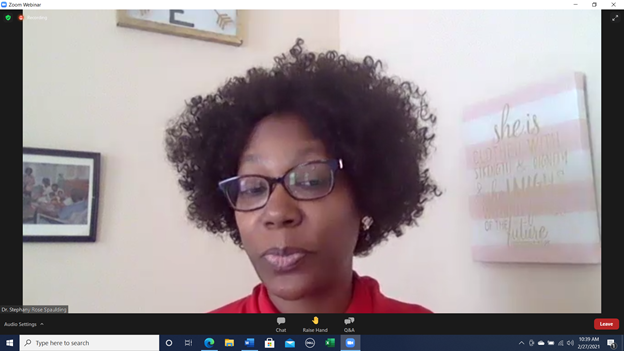
During a recent program held virtually by the American Association of University Women Colorado Springs Branch, local pastor and author Rev. Dr. Stephany Rose Spaulding explained the language of racism.
The program, “Recovering from Racism: Conversations We Need to Have,” was held on the Zoom platform Feb. 27 for the branch of the national organization that has a mission “to advance gender equity for women and girls through research, education and advocacy.”
Their 170,000 members and supporters do this by building community and programs and advocating for legislation.
Spaulding, pastor of Ebenezer Baptist Church in Colorado Springs, is the author of “Recovering from Racism: A Guidebook to Beginning Conversations” (2015). She’s is also Interim Associate Vice Chancellor for Equity, Diversity & Inclusion and Associate Professor of Women’s and Ethnic Studies at the University of Colorado at Colorado Springs.
In her book, Spaulding wrote, “We will never dismantle the heinous institution of racism in our society if we can’t talk in everyday conversation about how race is constructed and impacting our lives daily.”
In the past year, with the rise of the Black Lives Matters movement, “we’ve found ourselves having to directly engage in conversations about race and racism,” she said.
During the AAUW program, Spaulding said racism “… is an idea that carries tremendous social, economic and political power.”
Throughout the United States, there is disparate understanding of what racism is, she said. Many believe its origins are in the differences in peoples’ biology, but this isn’t true. Instead, Spaulding claims racism is a social construct, an idea perpetuated since early in America’s history.
The American Anthropological Association has stated “physical variations in the human species have no meaning except the social ones that humans put on them.”
There must be a marrying of racial prejudice and power for racism to exist, Spaulding said. “In North America white people have institutional power,” that affects non-whites in negative ways, she added.
In his album “Fear of a Brown Planet,” Comedian Aamer Rahman highlights how racism works by suggesting he could be a “reverse racist.”
“All I would need would be a time machine. Now what I’d do is I’d get in my time machine and go back in time to before Europe colonized the world, right? And I’d convince the leaders of Africa, Asia, the Middle East, and from South America to invade and colonize Europe, right? Just occupy them, steal their lands and resources, set up some kind of like, I don’t know, trans-Asian slave trade, where we exported white people to work on rice plantations in China.”
Rahman, who is of Bangladeshi descent, frequently speaks out against racism. Spaulding pointed to Rahman, as well as professional golfer Tiger Woods, former President Barack Obama and current Vice President Kamala Harris as examples of people who are multiracial, yet “still relegated to a legal and social structure that articulates their beingness as black.”
She said categorizing humans into groupings based on how they look limits our understanding of one another.
As an exercise during the discussion, Spaulding put five letters on the screen: a, p, p, l and e. She said after looking at these letters, some in the audience they might think of the fruit, while others might think of the technology company. “This is the power of an idea,” said Spaulding. These ideological constructs are created and stored in our minds and are difficult, but are not impossible to change, she said.
In her poem, “What Shall I tell my Children who are Black,” Dr. Margaret Burroughs said American children learn early on that black is the color of villains while white is pure and decent.
Spaulding said, “If the idea of blackness is consistent with symbols of evil imagine how that is impacting those who are known as Black.”
To counter this archetype, Burroughs suggests they look to their heritage, when, “Kings and Queens who ruled the Nile/ And measured the stars and discovered the/ Laws of mathematics.”
This may help Black children to see themselves as beautiful, but doesn’t change the minds of those who discriminate, Spaulding added.
Day-to-day jokes or harassment of people of color hinder our ability as a society to erase racism, she said. “The ideas we hold about others manifest in the ways we relate to one another,” said Spaulding.
Racism can permeate our lives even at institutional levels, such as in schools and employment practices, where Spaulding said an intricate system upholds the constructs of racism. No matter how much education or social achievement Blacks reach, “they will never be able to move out of the position,” society has put them in, she said.
One solution is to find a new funding mechanism in public education, Spaulding said. If it continues to be based upon property taxes, there will always be inequities, she said, encouraging mixed zoning districts where affordable housing is interspersed with higher valued homes.
Another is to level the unemployment playing field. The Bureau of Labor and Statistics claimed in January that while unemployment among whites decreased to 5.7%, unemployment among blacks remained stagnant at 9.2%. Citing arguments in Isabel Wilkerson’s 2020 book, “Caste: The Origins of Our Discontents,” Spaulding said, “not only are we dealing with race, we are dealing with the inability of people to ever move outside the status or social positioning they are relegated to.”
She described her experience growing up near Chicago, where residents of certain neighborhoods were not given jobs for which they were qualified and were unable to secure bank loans
To dismantle and recover from racism, Spaulding suggests “We have to shift the narrative of how we use language.”
People who represent all races and colors of the American population should be making the laws from the local level all the way to the federal level, she said. The Pew Research Center argues there are currently 58 Black members of the House of Representatives (out of 435), and only three Black senators (out of 100).
“As AAUW women, education is primarily an area in which you can have great influence” making these changes, Spaulding told the audience. She encouraged those in attendance to show up at city council meetings to make our voices heard.
Screenshot by Allison Robenstein
Rev. Dr. Stephany Rose Spaulding speaks to the AAUW Colorado Springs chapter during the program “Recovering from Racism: Conversations We Need to Have” on Feb. 27. She discussed the language of racism and suggested ways to remove it from society.
Screenshots by Allison Robenstein
During the “Recovering from Racism: Conversations We Need to Have” program for AAUW Feb. 27, Rev. Dr. Stephany Rose Spaulding asked the audience what they see when she put five letters on screen: a,p,p,l,e.
In her poem “What Shall I tell my Children who are Black,” Dr. Margaret Burrough, said American children learn early on that black is the color of villains, while white is pure and decent.