






Colorado Springs’ only independent movie theater fights to survive amid pandemic | Lives Left Behind
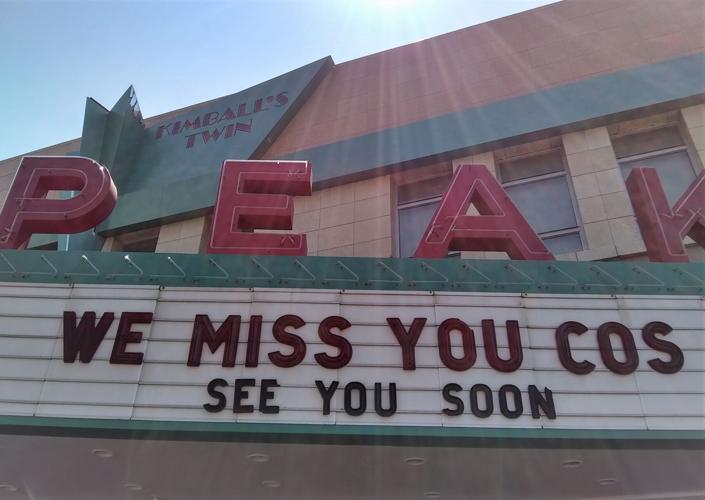
Bill Radford/The Gazette
The end almost came two decades ago.
The fate of Kimball’s Twin Peaks Theater in downtown Colorado Spring seemed sealed. “Curtains for Kimball’s: Movie theater to close in August,” read the headline in The Gazette on July 22, 2000.
“It was when Cinemark came to town,” owner Kimball Bayles recalls. “They really hurt us.”
But, at the last moment, as three other local theaters closed their doors in the face of the new competition, Bayles decided to hang in there.
And he has done so for the 20 years since, with Kimball’s surviving as the only independent movie theater in town; it became Kimball’s Peak Three with the addition of a third screen in 2009. It has withstood the arrival of more new theaters and the birth of streaming services.
But 2020 brought even more extreme challenges, thanks to the pandemic, which closed theater doors, drove more people to those streaming services and saw Hollywood grind to a halt for months.
Kimball's Peak Three Theater starts virtual movie screenings
And Bayles isn’t sure the magic of movies will be enough to overcome this latest crisis.
“I don’t know. It’s sketchy,” he says of the future of Kimball’s and perhaps the future of movie theaters in general.
He’s not alone.
“Cinemas are an essential industry that represent the best that American talent and creativity have to offer,” the National Association of Theater Owners said in a letter to congressional leaders in September pleading for a relief package. “But now we fear for their future.”
History of The Peak
The downtown theater was known simply as The Peak when it opened in the summer of 1937 in a former State Bank building at 115 E. Pike Peak Ave.; it was touted as “a fully up-to-date picture house.” It survived as other downtown theaters, such as the Ute and the Chief, closed over the years. But the end came in 1989 as The Peak, by then a dollar theater, shut its doors, as well.
Then along came Bayles. A former English professor, Bayles managed and then bought Poor Richard’s Cinema, a tiny art house theater that was part of Richard Skorman’s complex of businesses on North Tejon Street. In 1994, Bayles moved the operation to The Peak after a major remodel.
“It was in bad disrepair,” says Bayles, who has fond memories of watching movies at The Peak as a teenager and, as he recalled in a 2008 interview, “taking high school dates there and trying to get a kiss.”
While it has had to contend with competition from larger, newer, shinier theaters, Kimball’s has followed its own path. The theater boasts a full bar serving liquor, draft beer and wine by the glass; it was the first in town to get a liquor license. “We kind of broke the ground for that,” Bayles says.
Kimball’s shows a mix of independent and foreign films and the occasional Hollywood blockbuster in a lineup determined by Bayles.
“I’ve always done my own theatrical booking,” he says.
Colorado Springs theaters going bigger, fancier and foodier
But independent theaters can find it tough going against goliaths such as Regal, AMC and Cinemark.
“Confronted with aging audiences, competition from streaming services and theater chains boasting recliner seats and other amenities, many of these exhibitors balance precariously on a knife edge between popping more popcorn and being forced to turn off the marquee lights,” a Variety article said of indie theaters last year, long before there was even a whisper of coronavirus.
Now, theaters large and small are in crisis. Regal has closed its U.S. theaters for now; AMC, which warned back in June that it might not survive, continues to struggle to stay in business. Meanwhile, according to the National Association of Theater Owners, “Without relief, almost 69% of our country’s small and independent theaters say they will go bankrupt or close entirely by the spring.”
‘Roll of a dice’
David Lindsay was assistant manager at Kimball’s from 2007 to 2012; he returned as general manager in December of last year.
This year did not provide the welcome back that he had envisioned.
“We started hearing about COVID, I think it was around Christmastime, but we didn’t think anything of it,” Lindsay says. Then came reports of the virus reaching the U.S. And then the governor’s stay-at-home order in March.
The theater was closed for 5½ months. During that time, Lindsay’s full-time job became finding other sources of revenue and funding. The marquee was rented out for $100 a week for people to post birthday wishes and other messages. Kimball’s teamed up with several studios to start a “virtual cinema,” with independent and foreign films available for viewing on the theater’s website. Loyal customers bought gift cards in anticipation of the theater reopening. The theater got help through the federal Paycheck Protection Program and grants from the county and elsewhere.
In September, Kimball’s reopened.
“It was a roll of a dice whether we should reopen or just stay closed,” Bayles says. “Once you open up, you have all the overhead back and payroll and everything else.”
Ahead of reopening, he worried whether moviegoers would return or stay at home and continue to watch movies on Netflix and other streaming services.
“The real unknown is who’s coming and if they’ll come back,” Bayles told The Gazette then.
The answer? They didn’t — at least not anywhere near full force. Theaters were allowed to open at 50% capacity, but the audiences at Kimball’s never approached that level. There was a bit of a surge the first weekend or two, and another in October when Kimball’s showed the original “Halloween,” Lindsay says, but business overall has been dismal.
“We had one day,” he says, “when five people showed up the whole day.”
In Colorado, the Rural Theaters COVID-19 Support Initiative is aimed at providing financial assistance to remote theaters in rural areas of Colorado. But that won’t help theaters like Kimball’s, which is closed again as El Paso County has moved to Level Red. Kimball’s is trying to secure a grant from the state; in the meantime, Lindsay is frustrated by the lack of assistance at a higher level.
“Between Congress and the White House, they’ve got to get off their ass … I don’t care what their political standing is. I don’t care who they’re fighting politically. This pandemic is hurting businesses, it’s hurting workers.”
Lindsay, though, was worried about the future of movie theaters even before the pandemic. He points to the lure of those streaming services; in the latest blow to the industry, Warner Bros. announced this month it would debut its 2021 releases on HBO Max on the same day they arrive in theaters.
“People have changed,” Lindsay says. “People just don’t care to to go into a building and watch a movie any more at the level they used to.” As a result, he’s been looking for ways for theaters to diversify, such as offering live music at the bar at a theater he worked for in Texas.
“We have to figure out other ways to make income that has nothing to do with people coming in to see a movie, because the writing is on the wall.”
Bayles is worried that “people get used to a certain way; during this whole COVID period, I think they’ve just gotten used to just sitting down and streaming.”
But that, he says, doesn’t capture the magic of watching a movie in a theater with others.
Will coronavirus ignite revival of the movie theater experience? | David Ramsey
“It’s a shared experience. It’s so much the fabric of our lives, going to the movies and date night and all that. … There’s something larger than life in a movie theater.”
