






In 2020, voters showed their independence | Vince Bzdek
No matter what side you were rooting for this election, it’s hard not to see the 2020 vote as a vote for independence.
Voters didn’t let the parties, or cable TV bloviators, pollsters or pundits do all their thinking for them this year. They actually appear to have thought for themselves on this one, showing a stubborn streak of independence from all the prognosticating and party pressuring and trumpet calls for partisan warfare.
For example, voters have handed President Trump a loss at the same time they gave Republicans better than-expected wins in Congress, handing between seven and 12 Democratic seats to Republicans in the House.
In the Senate, Colorado Republican Sen. Cory Gardner lost. But so did Alabama’s Democratic Sen. Doug Jones . And Republicans like Susan Collins (Maine), Joni Ernst (Iowa) and Steve Daines (Montana) managed to beat expectations and win, the last two by larger margins than forecast.
Latinos showed their independence as well. Latinos in Florida helped give the state to Trump; Latinos in Arizona helped give the state to Biden.
While voting blue nationally, for president, voters voted more red locally, keeping their state legislatures predominantly Republican, 59 chambers compared to 39. Democrats failed to flip a single state legislature, according to the Washington Post.
Even in the dark blue state of California, voters bucked party orthodoxy by rejecting a return to affirmative action in hiring and admissions, shooting down rent control and rejecting tax hike on commercial landlords.
The same streak of independence can be seen in Colorado, only more so.
The biggest, most powerful bloc in the state refuses to be branded Democratic or Republican. Unaffiliated voters, continuing their trend of dominating turnout, cast 1,246,120, ballots, followed by Democrats with 997,835 ballots and Republicans who turned in 928,993 ballots
Unaffiliated voters made up about 39% of the votes cast this election, compared to 32% four years ago.
The implication of that trend: Candidates and ballot initiative proposers will increasingly have to cater to the interests of independents, aiming their appeals more broadly than one party or the other. Heck, they may have to appeal to all of us.
I think you can see that independent spirit at work in the ballot initiative voting this year. Our reporter Marianne Goodland points out that Colorado voters generally like less taxes but aren’t afraid to approve higher ones if the time is right.
Voters on Tuesday approved an initiative to reduce the state’s income tax rate from 4.63% to 4.55% at the same time they voted to increase taxes on tobacco products and a first-ever tax on vaping products. While they were increasing those “sin taxes,” they were voting to make it easier to gamble at Colorado’s casinos, loosening the betting limits.
Walt Whitman said it best: “Do I contradict myself? Very well then I contradict myself, (I am large, I contain multitudes.)”
If Colorado is a true bellwether state, as my colleague Hal Bidlack believes, then you’re gonna see this independent streak go national in the future even more than it did this election. More and more young people entering the political system tend to avoid party affiliation altogether, I’m told.
“I think the two parties have created a lot of the problems we have today,” former Denver Elections chief Amber McReynolds told me.
I wouldn’t be surprised to see candidates in the future run for major Colorado offices as unaffiliated candidates.
My theory — or maybe call it a hope — is that this independent streak is a reaction to the extreme polarization the parties have forced the American conversation into.
New research from Northwestern University shows that U.S. political parties are becoming increasingly polarized due to their quest for voters — not because voters themselves are becoming more extremist.
“The two major political parties have been getting more and more polarized since World War II, while historical data indicates the average American voter remains just as moderate on key issues and policies as they always have been,” said Northwestern’s Daniel Abrams, a senior author of the study.
“The moves to the extremes can be interpreted as attempts by the Democratic and Republican parties to minimize an overlap of constituency,” the study found. “Test runs of the model show how staying within the party lines creates a winning strategy.”
I’m thinking the 2020 vote is loud yawp from voters that they will not be pigeonholed by their parties’ desire to turn everything into a black-and-white dogfight to the death.
We Are Nuanced! is the battle cry I heard this November. We Will Think for Ourselves! We are Not Datapoints, We Are Complex Human Beings!
Most importantly, in the end, voters appear not to have heeded the battle cries for all-out partisan warfare and even violence in the streets.
On that note, let us close with a reflection from those deepest of political thinkers, the Monkees, from their great song “Zor and Zam”:
“They met on the battlefield banner in hand.
They looked out across the vacant land.
And they counted the missing, one upon one,
None upon none.
The war it was over before it begun.
Two little kings playing a game.
They gave a war and nobody came.
And nobody came.
And nobody came.”
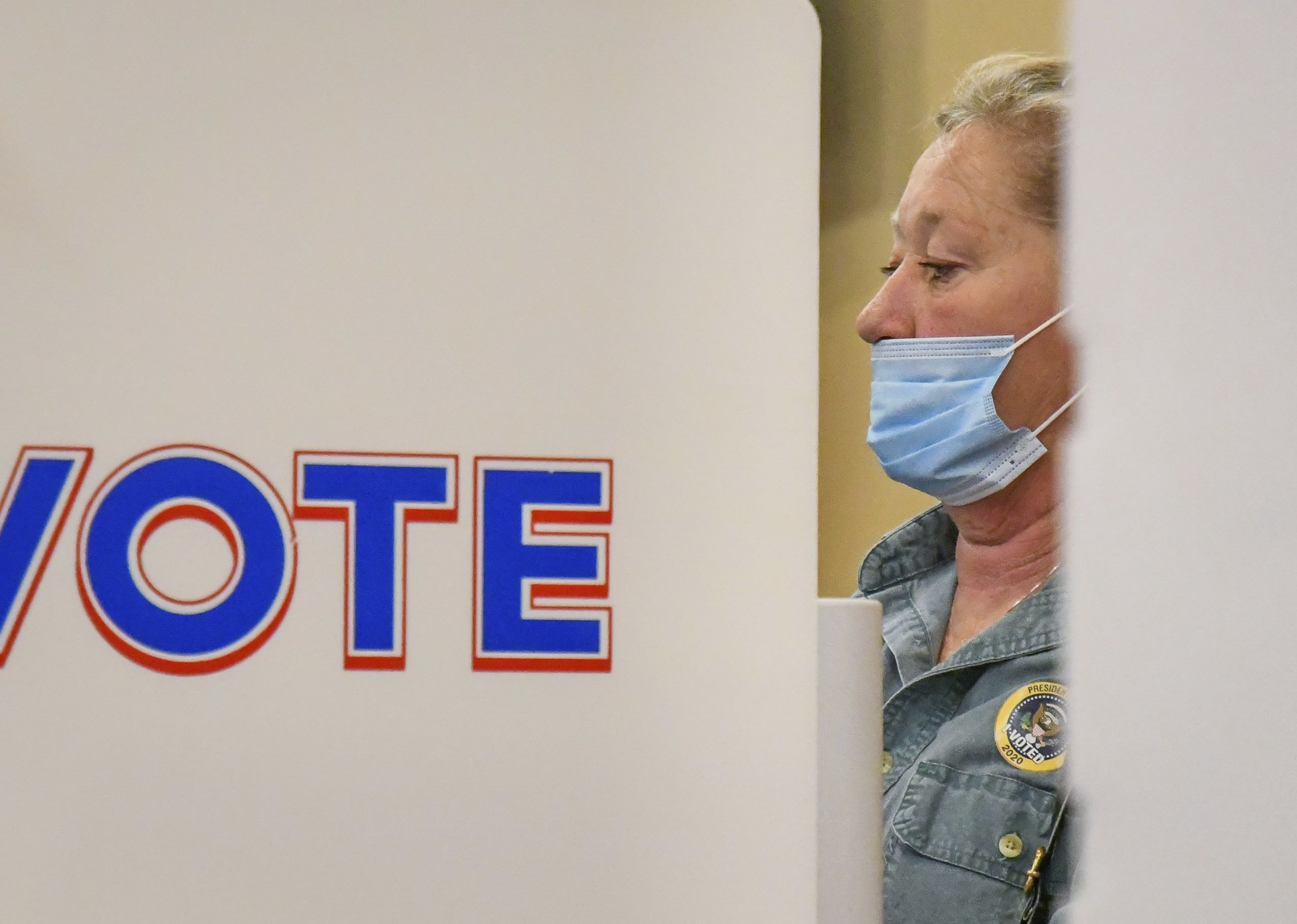
Jeanne Smith fills out her ballot at the voting center located at the Glenwood Springs Community Center on Tuesday, Nov. 3, 2020, in Glenwood Springs, Colo. (Chelsea Self/Glenwood Springs Post Independent via AP)
