






Biden, Trump locked in tight races in battleground states
WASHINGTON — As the fiercely contested 2020 campaign came to an close, President Donald Trump and Democratic challenger Joe Biden were still locked in tight races in battleground states late Tuesday night as the nation braced for an outcome that might not be known for days.
Races were too early to call in the most fiercely contested and critical states on the map, including Michigan, Wisconsin, North Carolina, and Pennsylvania. As of 11 p.m. MST, with hundreds of thousands of votes remaining to be counted, Biden was leading the electoral vote count 205-139 in the race to accumulate 270 votes.
Trump won the key battleground states of Florida and Ohio, and other wins included Iowa, Kansas, North Dakota and other conservative bastions. Biden won California, the nation’s biggest electoral haul, and other predictable victories including Colorado and Virginia, two former battlegrounds that have become Democratic strongholds.
Americans made their choices as the nation faced a confluence of historic crises with each candidate declaring the other fundamentally unfit to navigate the challenges. Daily life has been upended by the coronavirus, which has killed more than 232,000 Americans and cost millions of jobs.
Millions of voters braved their worries about the virus — and some long lines — to turn out in person, joining 102 million fellow Americans who voted days or weeks earlier, a record number that represented 73% of the total vote in the 2016 presidential election.
Early results in several key battleground states were in flux as election officials processed a historically large number of mail-in votes. Democrats typically outperform Republicans in mail voting, while the GOP looks to make up ground in Election Day turnout. That means the early margins between the candidates could be influenced by which type of votes — early or Election Day — were being reported by the states.
Control of the Senate was at stake, too: Democrats needed to net three seats if Biden captured the White House to gain control of all of Washington for the first time in a decade. Senate Majority Leader Mitch McConnell of Kentucky won reelection in an early victory for the Republicans, and GOP Sen. Lindsey Graham of South Carolina, a close Trump ally, fought off a fierce challenge to hang onto his seat.
The parties traded a pair of seats in other early results: Democratic former Colorado Gov. John Hickenlooper defeated incumbent Sen. Cory Gardner, and in Alabama Republican Tommy Tuberville knocked off Sen. Doug Jones. The House was expected to remain under Democratic control.
Democratic hopes of presidential nominee Joe Biden cruising to an easy victory have been dashed as he and President Trump notched razor-thin margins early on election night.
Biden’s campaign projected confidence in the closing days of his bid that the two-term vice president and 36-year Delaware senator had expanded the Democratic electoral map, forging multiple pathways to 270 electoral votes.
Yet hours after polls started closing across the country, another tighter narrative began to emerge.
Trump was headed to a win in Florida and its 29 electoral votes and, though still in the initial stages of counting votes, was performing well in Georgia. Biden’s lead in North Carolina and Ohio evaporated as Election Day ballots were taken into account.
Trained political eyes will be watching the “blue wall,” a block of once reliably Democratic Upper Midwest states that Trump smashed four years ago. Pennsylvania, with its 20 electoral votes, is perpetuating its reputation as the Keystone State. While Trump still trails there, it’s his best hope of preventing Biden from replacing him in the Oval Office.
Trump aides had alluded to the prospect of the president declaring victory if early results in Sunbelt states such as Arizona, Florida, Georgia, North Carolina, and Texas favored him. Those states tend to report their vote totals quickly, but Georgia and North Carolina election officials delayed some of their deadlines due to technological snafus.
The statement was a response to the Supreme Court’s ruling providing Pennsylvania with extra time to count mail-in ballots postmarked by Election Day.
“You have to have numbers. You can’t have these things delayed for many days and maybe weeks. You can’t do that. The whole world is waiting. This country is waiting, but the whole world is waiting,” said Trump during a visit to the Republican National Committee’s headquarters, his only public event of the day.
Biden kept himself busy on Tuesday, making several stops in Pennsylvania, showing two of his granddaughters his childhood home in Scranton for the first time.
Trump watched returns deciding whether or not he’ll serve a second term roll in from the White House, hosting about 400 people in the executive compound.
Meanwhile, the nation waited anxiously for a still-unknown result.
A new anti-scaling fence was erected around the White House, and in downtowns from New York to Denver to Minneapolis, workers boarded up businesses lest the vote lead to unrest.
The president began his day on an upbeat note, predicting that he’d do even better than in 2016. But during a midday visit to his campaign headquarters, he spoke in a gravelly, subdued tone.
“Winning is easy,” Trump told reporters. “Losing is never easy, not for me it’s not.”
“I’m superstitious about predicting what an outcome’s gonna be until it happens … but I’m hopeful,” said Biden. “It’s just so uncertain … you can’t think of an election in the recent past where so many states were up for grabs.”
The momentum from early voting carried into Election Day, as an energized electorate produced long lines at polling sites throughout the country. Turnout was higher than in 2016 in numerous counties, including all of Florida, nearly every county in North Carolina and more than 100 counties in both Georgia and Texas. That tally seemed sure to increase as more counties reported their turnout figures.
Voters braved worries of the coronavirus, threats of polling place intimidation and expectations of long lines caused by changes to voting systems, but appeared undeterred as turnout appeared it would easily surpass the 139 million ballots cast four years ago.
No major problems arose on Tuesday, outside the typical glitches of a presidential election: Some polling places opened late, robocalls provided false information to voters in Iowa and Michigan, and machines or software malfunctioned in some counties in the battleground states of Ohio, Pennsylvania, Georgia and Texas.
The cybersecurity agency at the Department of Homeland Security said there were no outward signs by midday of any malicious activity.
The Associated Press and Washington Examiner contributed to this report.
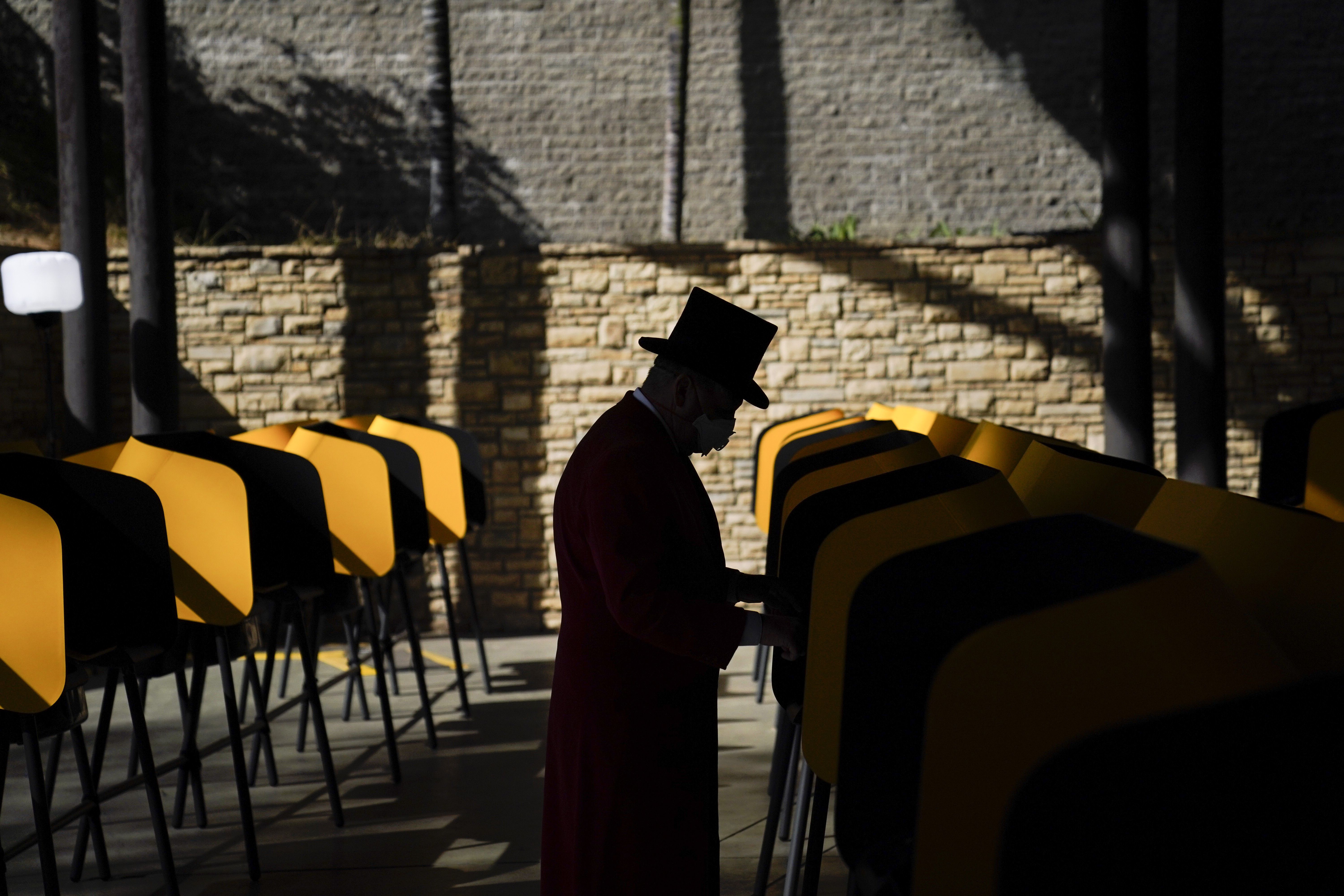
Former Beverly Hills ambassador Gregg Donovan casts his ballot at a vote center set up at Hollywood Bowl in Los Angeles, Tuesday, Nov. 3, 2020. (AP Photo/Jae C. Hong)