






How much does white supremacy pollute America’s white churches? | David Ramsey
Robert P. Jones grew up in the pews at First Baptist Church in Macon, Ga. He was in the building five days a week, at least. He met most of his friends there.
He was engulfed and nurtured by America’s brand of white, conservative Christianity.
So, when he challenges the white church in America, he’s not a detached critic. He speaks as a passionate insider.
“The Christian church that once supported slavery has let it go,” he says by phone. “It strongly supported segregation and has let it go. But the thing going through all of it was this belief of superiority of white over all races and that has not been fully let go.”
Jones is the author of “White Too Long,” an examination of how white supremacy has polluted churches in America for centuries. It currently ranks No. 1 on Amazon’s list of Christian history books. “White Too Long” is harsh, but harsh in the way your father was harsh when you spoke disrespectfully to your grandmother.
It’s harshness born of love.
The American church, Jones says, has failed to eradicate white supremacy from its midst. One of the prime reasons for this failure has a surprising explanation, at least to me. Jones says the church’s deep belief in personal responsibility limits Christians’ ability to see injustice on a grand scale.
“They believe invoking social structure shifts blame from where it belongs: with sinful individuals,” he writes. This “individualist theology insists that Christianity has little to say about social injustice.”
This emphasis on the individual, he writes, means police brutality toward nonwhites can be explained by a few rogue police officers. Unfair national lending practices can be explained by a few intolerant lenders. The emphasis on the individual, Jones says, blinds Christians to the racial insensitivity and inequality he believes is embedded in American culture.
The book’s prime point is uncomfortable. I reached out to several local ministers for interviews on Jones and his views of American Christianity. Not one of the ministers wanted to talk on the record. That’s easy to explain. The ministers want to remain at peace with their mostly white flocks.
The book has landed during a fiery, angry American summer, and I realize many of you are weary of criticism. Listen to Jones anyway.
He’s the founder of Public Religion Research Institute, which means his observations on the racial shortcomings of American Christians are backed by data. He asked 2,500 random Americans to answer 15 questions that revealed racial sensitivity.
For instance, 86% of white evangelical protestants believe the Confederate battle flag is more a symbol of Southern pride than racism compared with only 41% of religiously unaffiliated Americans.
Another statement — “Today discrimination against whites has become as big a problem as discrimination against blacks and other minorities” — offered similar results. Answers to his other 13 questions followed the same pattern. Christians, Jones says, showed less racial sensitivity than religiously unaffiliated Americans.
His conclusion:
“To put it in a nutshell, the data tells us that white supremacy still lives on inside of American Christianity,” he says.
He emphasizes that a white Christian can avoid being a racist but still be part of white supremacy. In the book, Jones quotes African American pastor Lenny Duncan:
“White supremacy doesn’t need active racists to function,” Duncan says. “It is a demonic system with a life of its own. It is radical evil.”
Jones is not seeking to inspire guilt in the hearts of American Christians. He seeks a goal far more precious:
Repentance.
Humans are fallible, prone from wandering along the path of destruction. That’s a key slice of the Gospel message. Hard labor is required to purify the heart.
“And part of that work is to figure out where did our forebears get it wrong,” Jones says. “That’s the question for this generation. That’s the question of every generation. What is worth keeping? What is worth salvaging? Where did our forebears get it wrong?
“What you receive on one hand is a set of traditions that you didn’t create. What you receive on the other hand is what you’re going to be handing down. You’re part of a great chain. The job of every generation is to, as faithfully as possible, not blindly pass it along. … You’re working out your salvation. That’s what it really is about.”
Have you, as a Christian, eradicated racism from your heart?
Great, Jones says in “White Too Long.”
Now go out and eradicate racism from society, too.
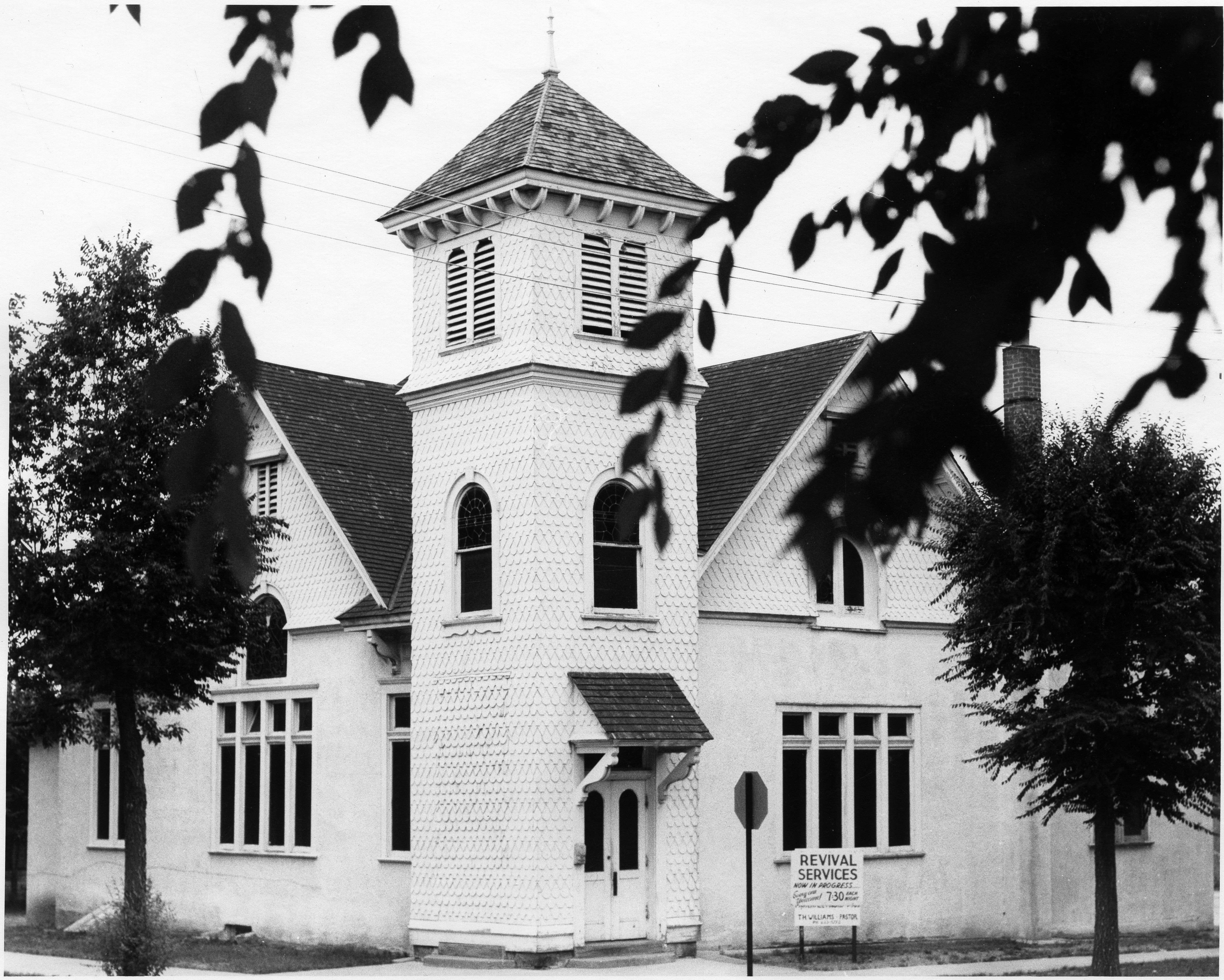
A small church building with a square belltower with fish-scale shingles is seen in this 1965 photo. The sign in front reads: “Revival Services Now in Progress Everyone Welcome! 7:30 Each Night T.H. Williams, Pastor” with phone number. The photo is identified on the back as “Baptist Church (now Immanuel Missionary Church) 1 S. 24th St. Dedicated Nov. 21, 1891. The building cost $4,500. Name changed to Bethany Baptist Church at union of Colorado City with Colorado Springs. Moved to new building in 1950.”
