






Denver’s search for a Safe Outdoor Space continues, and it’s looking to Gov. Polis for help
After six weeks, the city is still searching for a place to plant the first of up to three temporary camping sites for people experiencing homelessness during the pandemic. However, the parking lot of the Denver Coliseum — a top contender less than a month ago — is now off the table.
The zoning application for the lot was withdrawn July 30, said Cole Chandler of the Colorado Village Collaborative, the nonprofit that will run the campsites.
The decision was made after the proposal drew backlash from the surrounding Globeville and Elyria-Swansea neighborhoods, which have been home since April to two temporary 24-hour emergency homeless shelters inside the Denver Coliseum and at the nearby National Western Complex. Denver Councilwoman Debbie Ortega, who represents the city at large, and Councilwoman Candi CdeBaca, who represents District 9 in which the Coliseum sits, have demanded a more equitable stopgap solution on behalf of the community.
“Once again, Globeville/Elyria/Swansea is expected to bear the brunt of addressing the problem of where to ‘direct’ our unhoused neighbors,” Ortega wrote July 15 in a lengthy email to Councilwoman At Large Robin Kniech, who worked with the mayor’s office to identify that location. “Despite the lip-service made to equity and transparency, this is yet another example of city power brokers making decisions behind closed doors that negatively impact low-income, communities of color without their input or involvement.”
The proposal “seemed to be creating quite a bit of trauma in the GES neighborhoods,” Chandler said in a phone interview with Colorado Politics, “and it just wasn’t healthy or whole and was having adverse impacts that we didn’t really want to be a part of. All those things combined led us to stepping back and assessing and looking for other sites.”
A dozen of the city’s community service providers, including the Colorado Village Collaborative, the Interfaith Alliance of Colorado, Radian, the Colorado Coalition for the Homeless and other nonprofits that make up the Denver Homeless Leadership Council have since urged Colorado Gov. Jared Polis to help.
The groups voiced their request in a letter to Polis on July 30, the day after the Colorado State Patrol disbanded a large homeless encampment across from the Capitol, and days after Polis had invited the cleanup, which sent people experiencing homelessness back into surrounding streets and neighborhoods.
Meanwhile, communities around Denver are feeling increasingly unsafe with an influx of strangers, many of whom have mental health issues, near their homes and families.
“In light of the State of Colorado’s involvement in the displacement of our unhoused neighbors on July 29, 2020, we the undersigned call upon our state government to provide state-owned land in order to advance our efforts to establish Temporary Safe Outdoor Spaces for unsheltered individuals throughout the COVID-19 Pandemic,” the letter read.
“After months of discussion with officials of Mayor Hancock’s administration, this effort has received the full support of Denver’s highest leaders,” the group wrote. “Now, we need your support, through the provision of state-owned land, in order to swiftly implement this temporary harm reduction measure across our city.”
The governor’s office has not yet offered to temporarily offer state-owned land for Denver’s unsheltered, but says it’s considering it.
“The State will continue to work with state and city homeless services and housing providers and anyone else, to identify safe solutions for people who are without homes,” Polis’ spokesman Conor Cahill told Colorado Politics in an email Tuesday morning. “Our partners help us identify people who need immediate sheltering and we work together to identify the best location for them. We are looking at all of our state properties to determine if we have a property that would match the needs.”
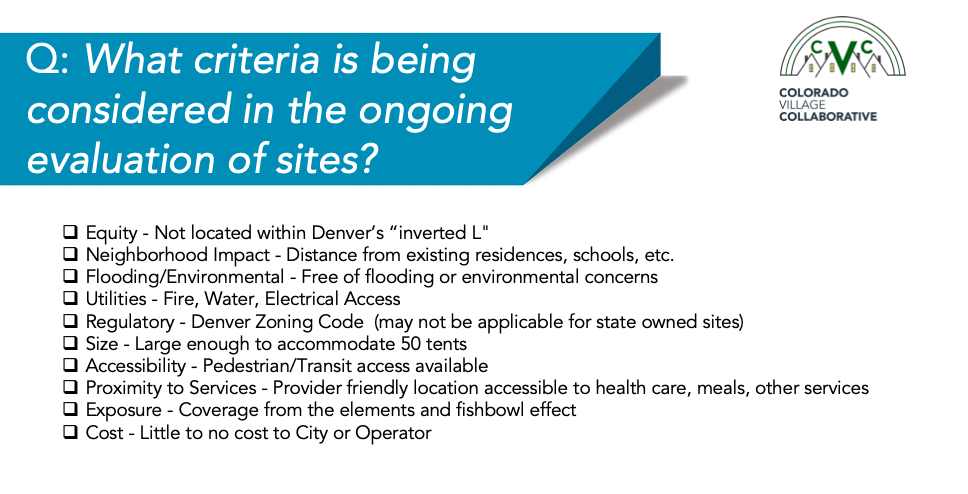
The site selection criteria “continue to evolve to help the team better evaluate potential sites submitted by Council and others, including racial equity analysis,” Kniech told Colorado Politics in an email.
Chandler provided a list the criteria and said although it may not be possible to check each box for a given site, all criteria are being taken into consideration.

The search for spots has been on since Mayor Michael Hancock announced July 1 “with some reluctance” his support of the Safe Outdoor Space proposal that was first brought forth about three months earlier by the Colorado Village Collaborative, which also runs the city’s “tiny home” village.
Hancock said he based his decision on these being “extraordinary times that require extraordinary measures,” a pivot that comes eight years after the city passed its urban camping ban and barely a year since Denver residents voted overwhelmingly to uphold it. (A Denver county judge has since ruled the camping ban unconstitutional, and the city has appealed that decision.)
A week later, Hancock asked for help finding locations from a group of council members who, in late April, had written to him lobbying for a temporary sanctioned outdoor space.
Only four councilors — CdeBaca, Chris Hinds, Amanda Sandoval and Jamie Torres — formally submitted proposals to the mayor’s office, according to Skye Stuart, Hancock’s legislative director.

The city’s goal is to stand up three sites that each can hold 60 people and up to 50 tents. Each Safe Outdoor Space would be staffed 24/7 by the Colorado Village Collaborative and accessible around the clock. The goal is to mitigate the spread of the coronavirus and connect the unhoused with health care, hotels, housing and other resources.
Each camp will be equipped with bathrooms, showers, hand sinks, food, water, shade tents, electricity, internet and laundry services. There will also be daily wellness screenings and COVID-19 testing access.
No violence, weapons, drug use “in common areas,” theft, fires, “disruptive” behavior or personal guests will be allowed for residents of the sanctioned spaces.
Around Denver and across the metro area, homelessness continues to rise.
At least 4,171 people were without housing in Denver, according to this year’s Point in Time survey, which was conducted in January prior to the coronavirus pandemic. Among the more than 6,100 people living unhoused in the entire metro area, a quarter of those surveyed said they were staying outdoors.
Of the populations identified, 759 people were actively fleeing domestic violence, 627 were veterans, 278 were unaccompanied youth and there were at least 420 families.
“These data demonstrate homelessness was a crisis before COVID,” said Matt Meyer, executive director at the Metro Denver Homeless Initiative, which coordinates the survey each year and reports the data to the U.S. Department of Housing and Urban Development.
“With eviction moratoriums and other protective measures ending, we fully expect to see dramatic increases as a result of the economic impact of the pandemic,” he said in July. “Reinstating these moratoriums on a local or state level would significantly decrease the impact for those households on the edge that now face homelessness.”
