






After 11,000-plus deaths, U.S. nursing homes plead for more testing
NEW YORK • After two months and more than 11,000 deaths that have made the nation’s nursing homes some of the most terrifying places to be during the coronavirus crisis, most of them still don’t have access to enough tests to help control outbreaks among their frail, elderly residents.
Neither the federal government nor the leader in nursing home deaths, New York, has mandated testing for residents and staff. An industry group says only about a third of the 15,000 nursing homes in the U.S. have ready access to tests that can help isolate the sick and stop the spread. And homes that do manage to get a hold of tests often rely on luck and contacts.
“It just shows that the longer that states lapse in universal testing of all residents and staff, we’re going to see these kinds of stories for a very long time,” said Brian Lee of the advocacy group Families for Better Care. “Once it’s in, there’s no stopping it and by the time you’re aware with testing, too many people have it. And bodies keep piling up.”
That became clear in some of the nation’s biggest nursing home outbreaks. After a home in Brooklyn reported 55 coronavirus deaths last week, its CEO acknowledged it was based on symptoms and educated guesses the dead had COVID-19 because they were unable to actually test any of the residents or staff.
At a nursing home in suburban Richmond, Va., that has seen 49 deaths, the medical director said testing of all residents was delayed nearly two weeks because of a shortage of testing supplies and requirements. By the time they did, the spread was out of control, with 92 residents positive.
Mark Parkinson, CEO of the American Health Care Association, which represents long-term care facilities, says “only a very small percentage” of residents and staff have been tested because the federal and state governments have not made nursing homes the top priority.
“We feel like we’ve been ignored,” Parkinson said. “Certainly now that the emphasis has gone away from hospitals to where the real battle is taking place in nursing homes, we should be at a priority level one.”
Two-thirds of U.S. nursing homes still don’t have “easy access to test kits” and are struggling to obtain sufficient resources, said Chris Laxton, executive director of The Society for Post-Acute and Long-Term Care Medicine.
“Those nursing home leaders who have developed good relationships with their local hospitals and health departments seem to have better luck,” said Laxton, whose organization represents more than 50,000 long-term care professionals. “Those that are not at the table must fend for themselves.”
Public health officials have long argued that measures like temperature checks aren’t sufficient. They can’t stop workers with the virus who aren’t showing signs from walking in the front door, and they don’t catch such asymptomatic carriers among residents either. What is needed is rigorous and frequent testing — “sentinel surveillance,” White House virus chief Deborah Birx calls it — to find these hidden carriers, isolate them, and stop the spread.
The U.S. is testing roughly 150,000 people daily, for a total of 4.5 million results reported, according to data compiled by the COVID Tracking Project. Public health experts say that needs to be much higher. “We need likely millions of tests a day,” said Dr. Ashish Jha, director of the Harvard Global Health Institute.
The federal Health and Human Services Department said “there are plenty of tests and capability for all” priority categories and that all should be tested. The agency also noted one of President Trump’s briefings this week in which he underscored the states’ role in coordinating testing.
Only one governor, West Virginia’s Jim Justice, appears to be mandating testing for all nursing homes without conditions. Detroit Mayor Mike Duggan ordered tests at all 26 nursing in the city, using new kits that can spew out results in 15 minutes. Massachusetts abruptly halted a program to send test kits directly to nursing homes this week after 4,000 of them turned out to be faulty. New Hampshire teamed with an urgent-care company to test care workers. Several states including Colorado, Florida, Maryland, Tennessee and Wisconsin have dispatched National Guard testing strike teams.
While the federal government promised this week to start tracking and publicly releasing nursing home infections and deaths, which could help identify hot spots, that work was only beginning. In the meantime, The AP’s tally from state health departments and media reports put the count at 11,128 deaths from outbreaks in nursing homes and long-term care facilities nationwide. About a third of those are in New York.
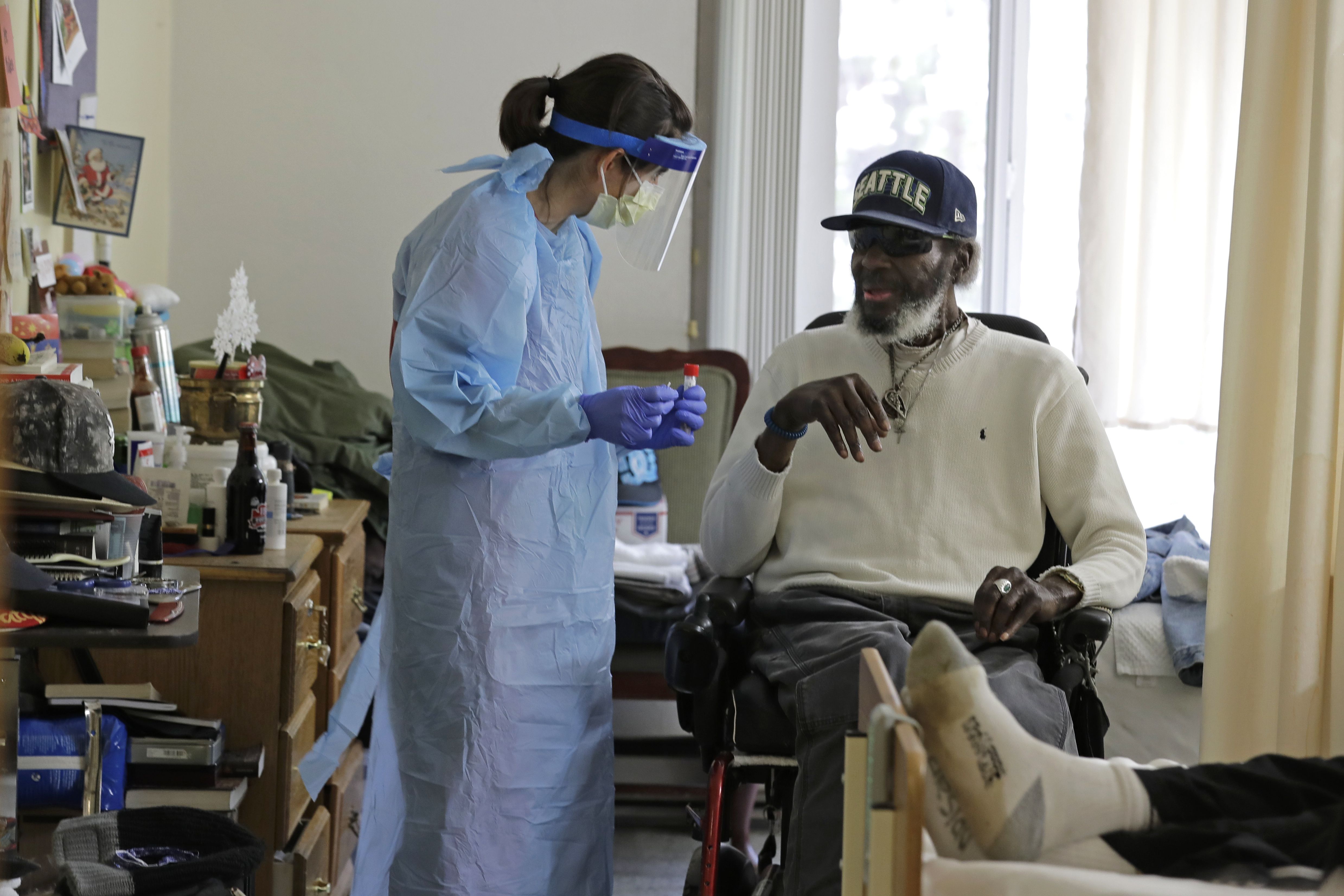
On April 17, Dr. Gabrielle Beger prepares to take a nose-swab sample from Lawrence McGee, as she works with a team of University of Washington medical providers conducting testing for the new coronavirus at Queen Anne Healthcare, a skilled nursing and rehabilitation facility in Seattle.
A vial used to collect a nose swab sample is put into a collection bag as members of a team of University of Washington medical providers conduct coronavirus testing at Queen Anne Healthcare in Seattle.
