






Judge rejects White House claims of immunity for close aides
WASHINGTON • A federal judge has ruled that close presidential advisers aren’t immune from being forced to testify in congressional inquiries in an opinion that could eventually clear the way for numerous administration officials to be summoned as part of the impeachment investigation of President Trump.
U.S. District Judge Ketanji Brown Jackson struck a blow against a decades-old legal doctrine known as complete immunity, which has long been asserted by lawyers representing presidential administrations of both parties but has remained largely untested in the courts.
The Monday ruling comes as part of a lawsuit brought by the House of Representatives to enforce a subpoena against Don McGahn, Trump’s former White House counsel. Though the House is seeking McGahn’s testimony in matters unrelated to the president’s interactions with Ukraine that are part of the current impeachment inquiry, the ruling could have broader implications.
McGahn “must appear before the Committee to provide testimony, and invoke executive privilege where appropriate,” Jackson wrote.
Several administration officials asked to testify by the House in the impeachment probe, including former White House national security officials John Bolton and Charles Kupperman, were ordered not to appear by the White House. They have indicated a willingness to testify but were awaiting court guidance on the immunity question raised in the McGahn suit.
The legal argument dates to a 1971 Justice Department memo and asserts that Congress cannot compel a president to appear because it would “promote a perception that the president is subordinate to Congress, contrary to the Constitution’s separation of governmental powers into equal and coordinate branches.” The Justice Department goes on to argue that close presidential advisers are extensions of the president.
That claim has only been tested once before in court, in 2008, when a lower court judge rejected the immunity argument and ordered George W. Bush’s White House chief of staff and White House counsel to testify in a congressional inquiry. The lawsuit was eventually settled without an appeal — leaving considerable legal ambiguity about claims of complete immunity.
What happens next is far from clear. The Justice Department could seek an appeal of the ruling to a higher court, but such an approach carries risk: A federal appeals court or the U.S. Supreme Court could affirm Jackson’s ruling and make it a binding precedent for all future disputes between the White House and Congress.
McGahn could also appear before Congress but refuse to answer questions on the separate grounds of executive privilege, a longstanding doctrine that the president is entitled to keep some information from being released to promote candor among his advisers and protect national security.
Assuming Congress wanted to contest that claim, it would have to do so in a separate lawsuit, which could further delay attempts to hear McGahn’s testimony. In the separate impeachment inquiry, lawmakers in recent weeks have indicated they are unwilling to slow down their proceedings with long court battles.
Also unknown is how other administration officials will view the ruling. Besides Bolton and Kupperman, acting White House chief of staff Mick Mulvaney has been ordered by the White House not to testify on the grounds of complete immunity.
Kupperman has brought his own lawsuit asking a judge to resolve whether he has to testify, but that lawsuit isn’t due to be argued until December. It is unclear if Kupperman or Bolton would view Jackson’s ruling as a go-ahead. The House has withdrawn its subpoena for Kupperman’s testimony, but lawmakers remain very eager to hear from Bolton.
Kupperman and Bolton are both represented by the same attorney, Charles Cooper. Cooper suggested in a letter to the House earlier this month that the legal issues presented in the McGahn litigation are slightly different than the ones facing Kupperman. But the McGahn case, if appealed to a higher court, could also resolve the larger legal question and provide an avenue for officials like Bolton to appear.
The lawsuit against McGahn stems from fallout over the investigation of special counsel Robert Mueller. McGahn provided testimony in the Mueller investigation; the Judiciary Committee says the former White House counsel is a crucial witness in its review of the Mueller probe and its findings.
McGahn was instructed by the White House not to testify, prompting the House to file suit earlier this year to enforce a subpoena.
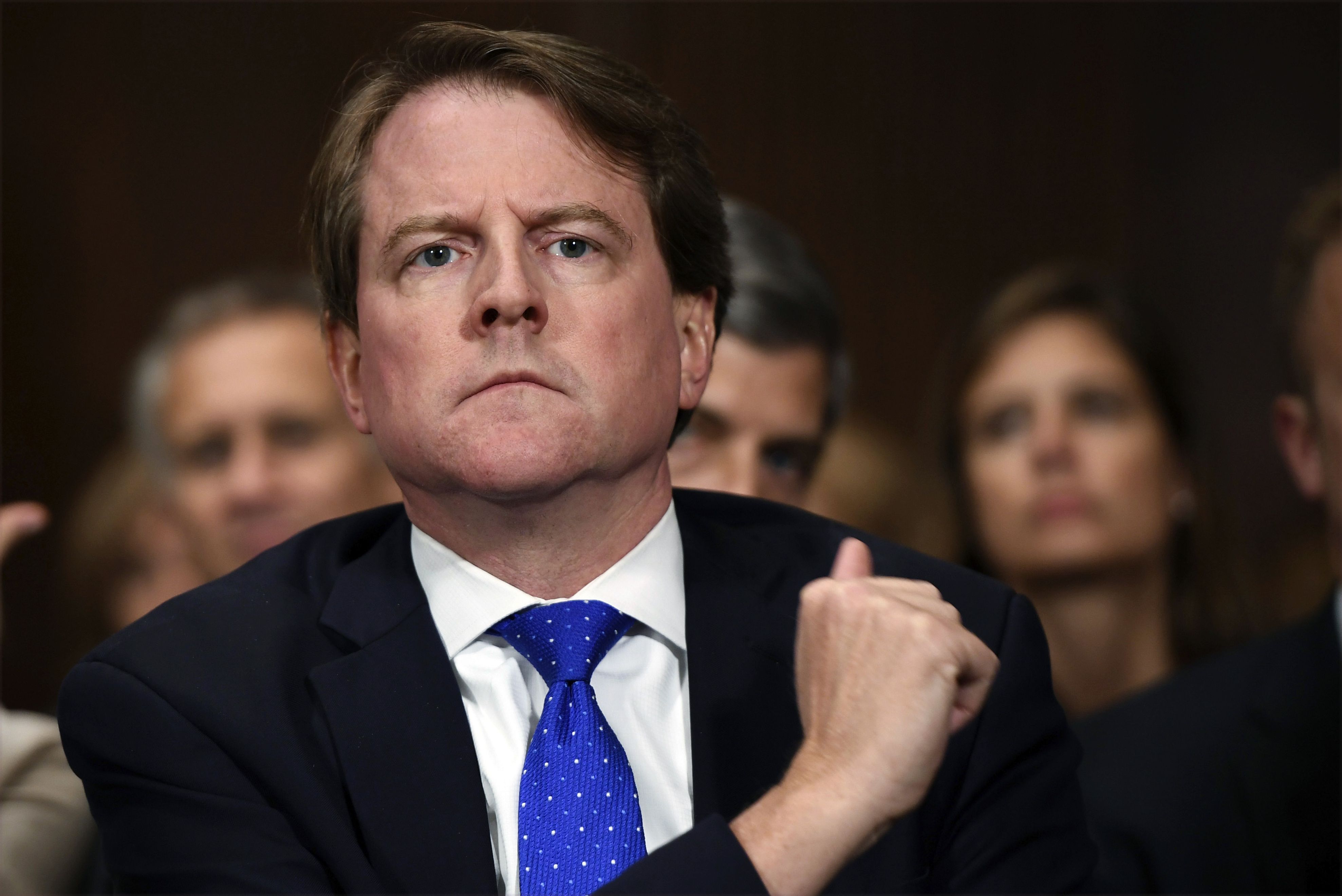
Then-White House counsel Don McGahn listens as Supreme Court nominee Brett Kavanaugh testifies before the Senate Judiciary Committee on Capitol Hill in Washington in September 2018. A federal judge has ordered McGahn to appear before Congress in a setback to President Trump’s effort to keep his top aides from testifying. The outcome could lead to renewed efforts by House Democrats to compel testimony from other high-ranking officials, including former national security adviser John Bolton.