






Witnesses testify on concerns about Trump-Zelensky call
WASHINGTON • Three current and former national security officials testified that they were concerned by a July 25 call in which President Donald Trump urged his Ukrainian counterpart to undertake investigations that could benefit him politically, in the third day of public impeachment hearings.
A fourth witness, the former U.S. special envoy for Ukraine negotiations, shed new light Tuesday on the extent of the influence wielded by Rudy Giuliani, the president’s personal attorney, over Trump’s views toward Ukraine.
Taken together, the marathon day of hearings portrayed a White House in which officials were grappling in real time with the significance and potential political fallout of Trump’s July call with Ukrainian President Volodymyr Zelensky, which would ultimately set off the House impeachment inquiry. In that call, which came shortly after the president ordered a hold on nearly $400 million in aid to Ukraine, Trump pushed Zelensky to investigate Democratic presidential candidate Joe Biden and alleged 2016 Ukrainian election interference.
In responding to Rep. Adam Schiff in the impeachment hearing Tuesday, Lt. Col. Alexander Vindman detailed his concerns about Trump’s July 25 call with Zelensky and how the call “was inappropriate; it was improper.”
Democrats sought to highlight the witnesses’ firsthand knowledge of the July call and conversations with Ukrainian officials over the summer as a sign that Trump was inappropriately wielding the power of his office for his own political gain. Republicans aimed to cast doubt on the credibility of one of Tuesday’s witnesses while saying throughout that there was no clear evidence to support Democrats’ allegation of bribery or extortion by the president.
Vindman, the National Security Council Ukraine expert who was on the president’s July call, told impeachment investigators that Trump’s request for an investigation into a political rival was “inappropriate and improper.”
“I made that connection as soon as the president brought up the Biden investigation,” he said. The call, he added, represented his “worst fear” that U.S. policy with Ukraine was being hijacked in an effort to personally benefit Trump.
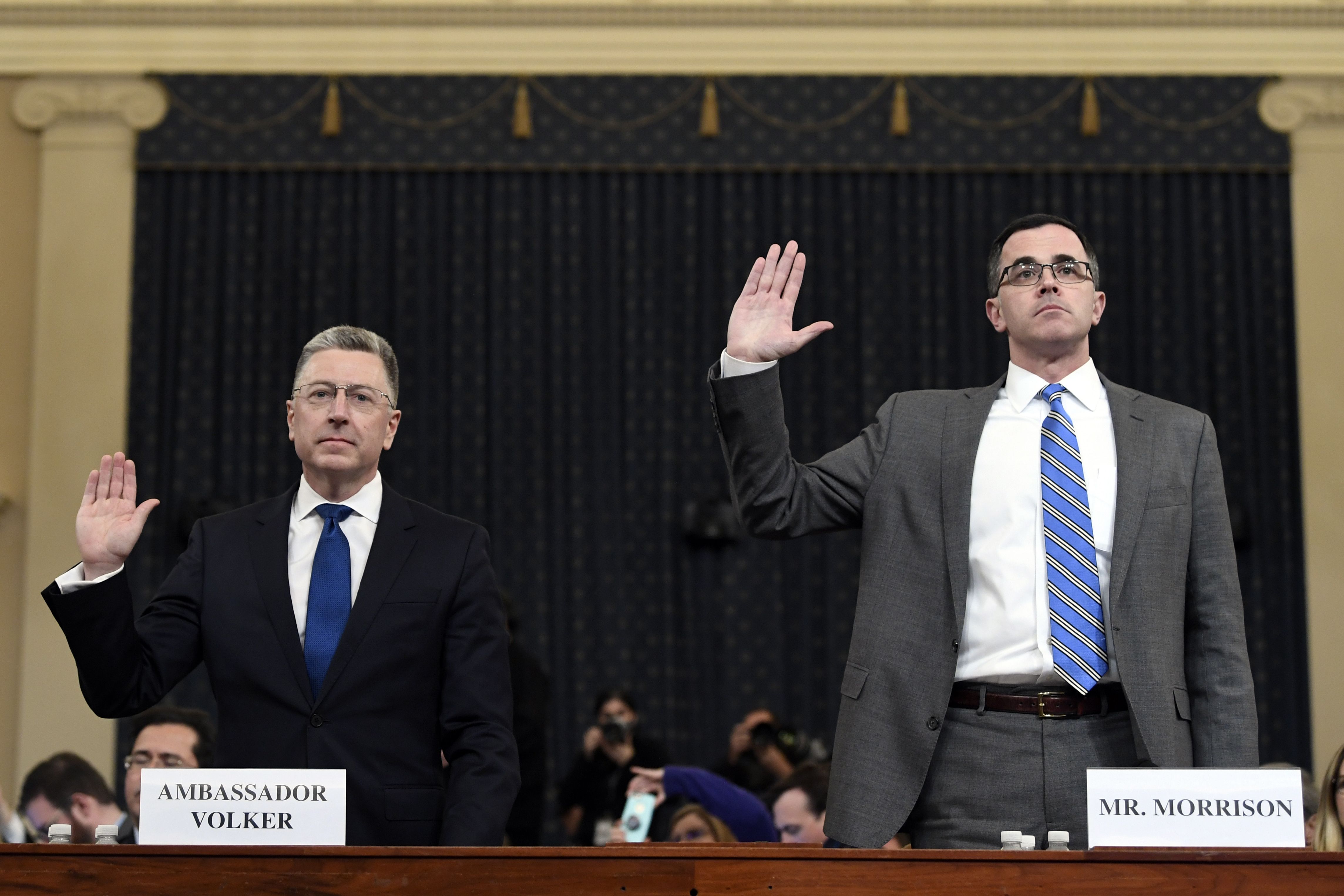
Kurt Volker, the former envoy who appeared at Republicans’ request, testified that any push to have Ukraine announce an investigation into Biden and his son Hunter would be “unacceptable” and didn’t serve the national interest. Broadly, Volker said U.S. foreign policy toward Ukraine had been “strong” and consistent under the Trump administration.
Trump has denied wrongdoing and has repeatedly criticized the impeachment inquiry, calling the probe in a Cabinet meeting Tuesday “an embarrassment to our nation.”
Republicans in the hearing also referenced what they said was Democrats’ changing description of Trump’s alleged wrongdoing. “Democrats have recently settled on bribery. They replaced their quid pro quo allegation because it wasn’t polling well,” said Rep. Devin Nunes of California, the top Republican on the House Intelligence Committee.
In addition to Vindman, two other witnesses — Jennifer Williams, a national security adviser to Vice President Mike Pence, and Timothy Morrison, a former NSC official — each testified Tuesday that they had listened to the president’s July 25 call and were concerned by it, though for different reasons.
Williams said the call was unusual because it “involved discussion of what appeared to be a domestic political matter.” Morrison, who testified at Republicans’ request, said: “I feared at the time of the call on July 25 how its disclosure would play in Washington’s political climate. My fears have been realized.”
Vindman testified he interpreted Trump’s request that Zelensky undertake investigations as a demand, noting the “power disparity” between the two leaders.
“When a senior asks you to do something, even when it’s polite and pleasant, it’s not to be taken as a request, it’s to be taken as an order,” he said. Ukraine saw the security aid, which was appropriated by Congress and ultimately released in September, as key to helping fend off Russia.
The two witnesses Republicans called offered significant criticism of the president and Giuliani. Nunes sought to distance Republicans from Morrison and Volker, describing them as “your witnesses” as he addressed Democrats toward the conclusion of the hearing.
Democrats called them to address the panel after Republicans requested their testimony.
While Morrison said he didn’t believe Trump’s push for investigations on the Zelensky call was illegal, he said he was concerned by — and later reported to a White House lawyer, at the direction of then-national security adviser John Bolton — a Sept. 1 conversation between Gordon Sondland, the U.S. ambassador to the European Union, and an aide to Zelensky in which the ambassador said the Ukraine aid wouldn’t be released until the country announced investigations the president sought.
Sondland is set to testify publicly Wednesday.
Ambassador Kurt Volker, left, former special envoy to Ukraine, and Tim Morrison, a former official at the National Security Council, are sworn in to testify Tuesday before the House Intelligence Committee on Capitol Hill in Washington. It was part of a public impeachment hearing of President Donald Trump’s efforts to tie U.S. aid for Ukraine to investigations of his political opponents.