






House to vote on a road map for its impeachment inquiry
WASHINGTON • The House plans to vote on a resolution laying out Democrats’ next steps in the impeachment inquiry into President Trump and move to a public phase of the investigation, the first significant vote since the probe began.
This isn’t a vote to authorize starting an impeachment inquiry, but it would affirm the one started last month into whether Trump pressured Ukraine to investigate a political rival.
Democrats maintain that they aren’t under any obligation to hold a vote to authorize an impeachment inquiry — a position affirmed by a U.S. district court judge last week. But they said they plan to vote on a resolution to set up the next part of the probe that will be public and give Trump and his attorneys a chance to participate in the process.
House Republicans have demanded a more public process since the inquiry began. Trump has called the investigation a “kangaroo court,” and the White House has said it doesn’t need to cooperate with what it views as an illegitimate inquiry.
House Speaker Nancy Pelosi, D-Calif., said Monday the House would vote to affirm the continuing investigation and establish the procedure for open hearings.
The resolution, which hasn’t yet been released, will also authorize the disclosure of transcripts of the depositions, which have occurred behind closed doors, and will set forth due-process rights for Trump and his attorneys.
“We are taking this step to eliminate any doubt as to whether the Trump Administration may withhold documents, prevent witness testimony, disregard duly authorized subpoenas, or continue obstructing the House of Representatives,” Pelosi wrote to colleagues.
Two Democratic aides said they expected the vote to be Thursday.
The White House “won’t be able to comment fully until we see the actual text, but Speaker Pelosi is finally admitting what the rest of America already knew — that Democrats were conducting an unauthorized impeachment proceeding, refusing to give the President due process, and their secret, shady, closed door depositions are completely and irreversibly illegitimate,” White House press secretary Stephanie Grisham said.
House Republicans denounced the resolution as legitimizing an impeachment investigation that they refer to as a sham.
“Today’s backtracking is an admission that this process has been botched from the start,” said Rep. Kevin McCarthy of California, the chamber’s GOP leader.
“Codifying a sham process halfway through doesn’t make it any less of a sham process,” said Rep. Jim Jordan of Ohio, the top Republican on the Oversight Committee.
The House’s move to lay out the public phase of the probe came as federal courts are increasingly being drawn into the inquiry amid disputes between Congress and the White House over witnesses and documents. The investigation is focused on efforts by Trump and his allies to persuade Ukraine to investigate Democratic presidential candidate Joe Biden and his son, as well as matters related to the 2016 election.
A Democratic aide said the vote will be more focused on establishing a process for the public hearings, at the request of Rep. Adam Schiff, D-Calif., the Intelligence Committee chairman who is leading the investigation into the Ukraine allegations.
This resolution will establish procedures for open hearings that will be conducted by the House Intelligence Committee and permit questioning by staff and lawmakers, according to a congressional aide; that is similar to the process currently happening behind closed doors. The resolution will also set procedures for transferring materials between committees that have been investigating the president.
The move to have a full House vote came as a surprise to Democratic lawmakers in competitive districts, who have been hesitant to take a vote while saying they support the investigation. One lawmaker in such a district said he was “blindsided” and said the vote was “completely unhelpful.”
It couldn’t be determined why the vote was needed, given U.S. District Judge Beryl A. Howell ruled on Friday that a vote wasn’t necessary to validate the House process. The judge ruled in favor of giving Congress grand-jury evidence collected by former special counsel Robert Mueller. The Justice Department has asked a federal appeals court to block the ruling.
The White House hasn’t cooperated with the investigation, and Schiff said refusal to allow witnesses to testify would be used as evidence that the administration was trying to obstruct the proceedings. Trump’s former deputy national security adviser Charles Kupperman defied a congressional subpoena on Monday, instead asking a federal court to resolve the question of whether he is required to testify in the face of conflicting orders from Congress and the White House.
Both cases are likely to set up court battles over how much access congressional investigators will have to senior White House staffers as they weigh whether the president committed an impeachable offense. Any decision by the courts on either matter could have long-term reverberations for executive-congressional relations.
But Democrats in the House suggested that they were unwilling to wait for the process to drag out in the federal courts — and would press forward without Kupperman’s testimony and without waiting for the judiciary to come to an answer on some of the questions being raised in both lawsuits.
Schiff said Monday that the House wouldn’t wait for the courts to enforce a subpoena against Kupperman or other witnesses. “We are not willing to allow the White House to engage us in a lengthy game of rope-a-dope in the courts,” Schiff said.
Kupperman was on the July 25 call between Trump and President Volodymyr Zelensky of Ukraine that is at the center of the impeachment inquiry. He would be the first witness who actually heard the call to testify. He was a top staffer and associate of former White House national security adviser John Bolton, who is also in negotiations to testify.
The House has issued a subpoena for Kupperman’s appearance, but the White House’s top lawyer has argued that close advisers to the president are immune from being required to testify in front of Congress and ordered him not to appear. The White House stance reflects a longstanding Justice Department position but has never been blessed by the courts.
Kupperman’s lawyer filed a lawsuit Friday saying Kupperman was being subject to “irreconcilable commands by the Legislative and Executive Branches of the Government.”
The House hasn’t responded to Kupperman’s lawsuit in U.S. District Court in Washington, D.C. One possible outcome is that the House could seek dismissal of the claim on procedural grounds. That would be unlikely to win his cooperation with the inquiry but would avoid a lengthy legal fight that would consume the House’s time and attention.
The matter concerning the Mueller material is expected to be heard by a federal appeals court in Washington in the coming days. At issue is the evidence collected by Mueller using a grand jury, which the Justice Department has argued for keeping secret. A judge last week ruled against the agency, writing: “The White House’s stated policy of non-cooperation with the impeachment inquiry weighs heavily in favor of disclosure.”
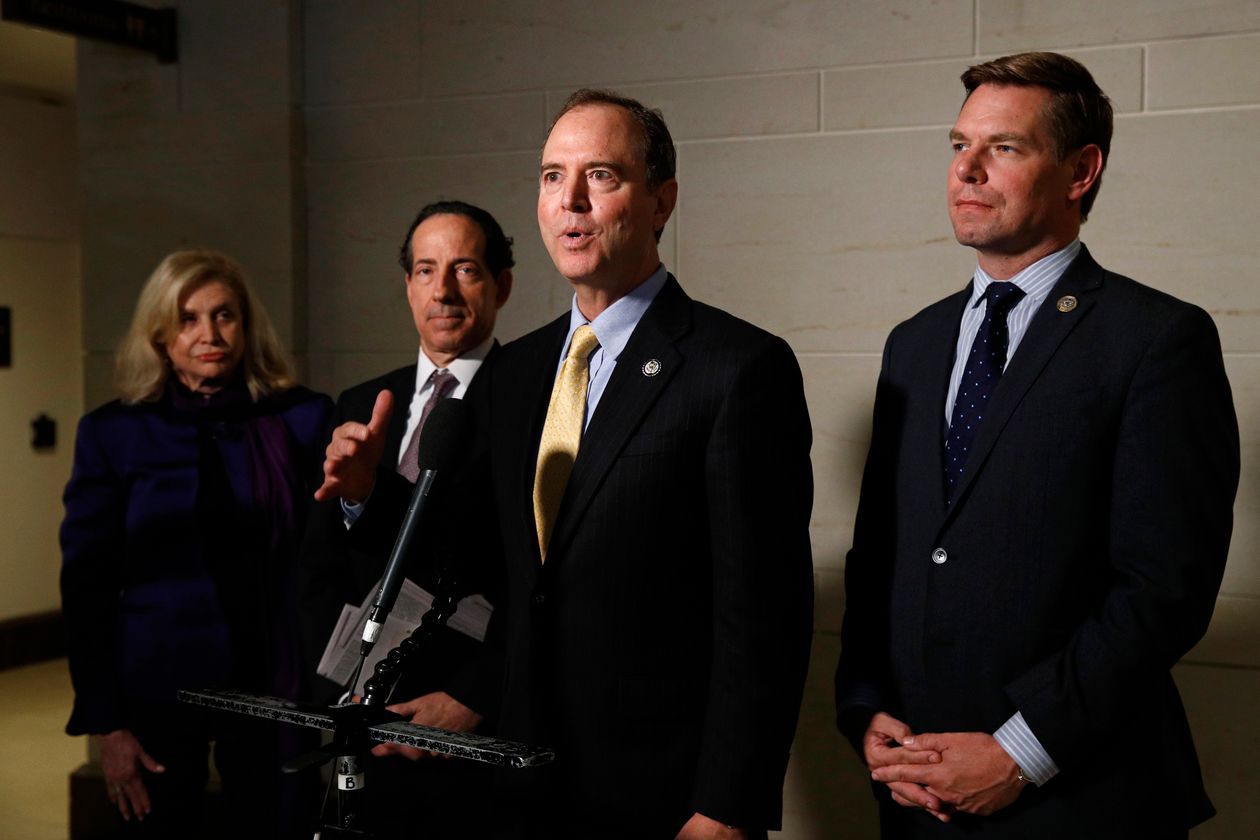
Rep. Adam Schiff, D-Calif., House Intelligence Committee chairman, said the impeachment probe would still move forward despite Charles Kupperman’s noncooperation.