






Johnson insists Brexit will happen Oct. 31 despite new law ruling it out
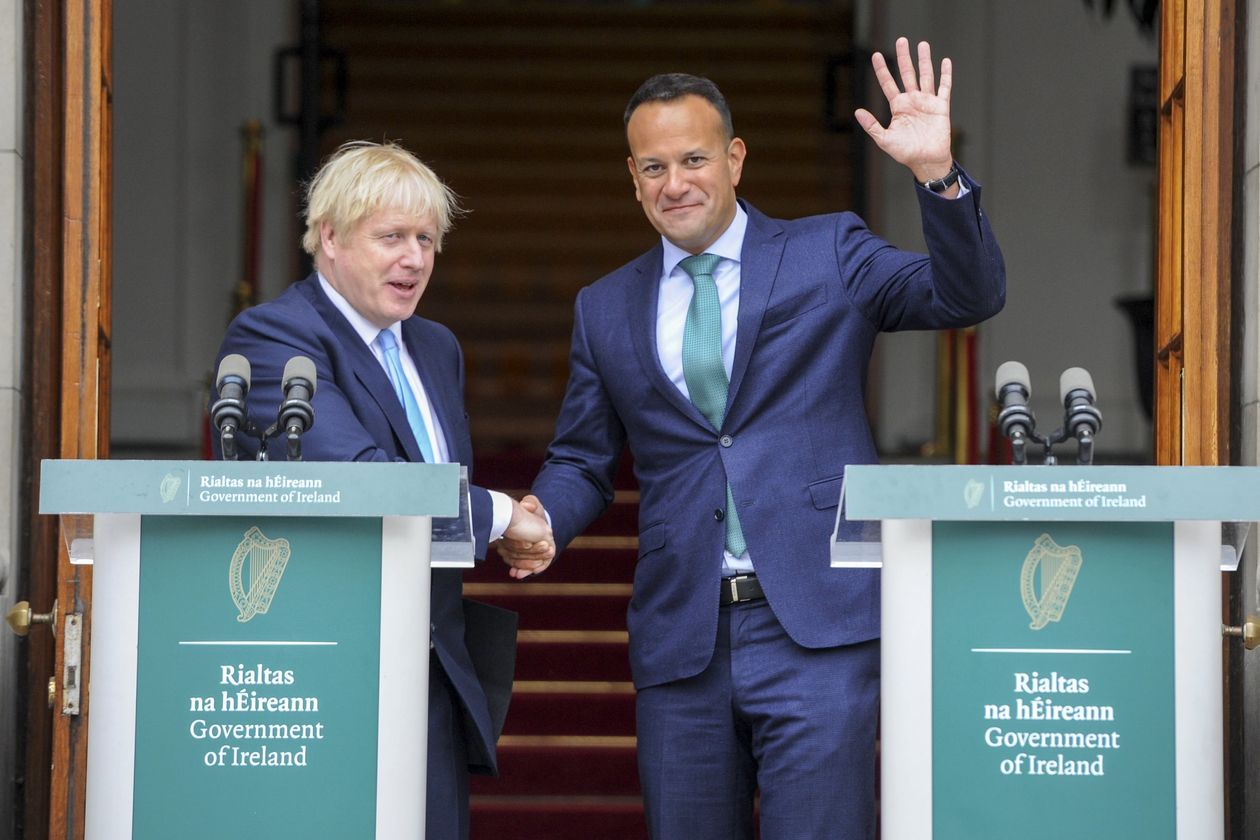
British Prime Minister Boris Johnson stuck to his pledge that the U.K. would leave the European Union on Oct. 31 — even as a law came into force preventing the country from leaving on that date without an agreement and Parliament again rejected his bid to call an election before then.
In his first meeting with his Irish counterpart, Leo Varadkar, since taking office in July, Johnson Monday insisted he wanted to leave the EU with an agreement to smooth the U.K.’s exit from the bloc. Although he outlined some ideas, he didn’t give any detail about how he would do it.
“I want to find a deal,” Johnson said during a news conference. “I have looked carefully at no-deal. Yes, we could do it, the U.K. could certainly get through it, but be in no doubt that outcome would be a failure of statecraft for which we would all be responsible. I would overwhelmingly prefer to find an agreement.”
The biggest obstacle to a deal remains the so-called Irish backstop, a plan to avoid a physical border emerging after Brexit between Ireland, an EU member, and the U.K. region of Northern Ireland.
Johnson has described the proposal, negotiated between his predecessor and the EU, as unacceptable because, he says, it would leave Britain closely tied to the EU indefinitely even after its split.
Johnson traveled to Dublin hours ahead of a vote in Britain’s Parliament that rejected his call for fresh elections for a second time in a week.
“The public have had enough of the delectable disputations of this house,” Johnson said during a debate before the vote, in which 293 lawmakers favored a quick poll, short of the two-thirds majority the government needed to secure one.
Opposition lawmakers are refusing to back a general election until they have ruled out the prospect of a no-deal exit on Oct. 31, the current date on which the U.K. is meant to leave the EU.
Queen Elizabeth on Monday signed the bill aimed at preventing such an exit into law. After Monday’s vote, the government was set to suspend Parliament until mid-October, the government’s spokesman said.
The law that came into effect Monday requires the government to ask the EU to further delay the U.K.’s exit until Jan. 31 if an agreement isn’t secured by Oct. 19 with the bloc. Its passage last week was a serious defeat for Johnson’s government.
Further, two cabinet ministers have since quit his government, including his brother, Jo Johnson, and Work and Pensions Secretary Amber Rudd, both of whom supported Britain remaining in the EU during the 2016 referendum campaign.
The demand for such an extension puts Johnson in a bind. He has pledged to not delay the U.K.’s split with the EU, but now under the law the government must request the agreement of the other 27 member states for an extension. Brexit has been twice postponed from the original U.K. date of March 29.
European officials say the bloc would agree to an extension to allow an election to take place. However, the government’s spokesman said Johnson would refuse to seek an extension to Brexit from the EU; he wouldn’t answer the question whether the prime minister would resign rather than ask for a delay.
Meanwhile, the government has said it would obey any laws Parliament passes. If Johnson does quit, it would open the way for a caretaker government to form a majority in the House of Commons and request a delay.
In Dublin, Johnson said alternative arrangements could achieve the same goal as the backstop and outlined what he described as the “landing zone” for a new solution to replace it. He said this would involve electronic customs checks for goods and common rules on animal health and related agricultural regulations for the two parts of the island.
“If you can do both of those things you can get a long way through the problem,” Johnson said, without elaborating on the proposals.
Varadkar appeared skeptical, and reiterated his commitment to the backstop unless the U.K. government comes up with a better alternative. “No backstop is no deal for us,” he said.
U.K. Prime Minister Boris Johnson, left, with his Irish counterpart, Leo Varadkar, in Dublin on Monday.