






Gold’s luster spreads to other precious metals
Gold has recovered some of its former shine lately. Silver and platinum have been dull by comparison, but if history is any guide they are likely to regain their luster too.
The price of silver, as measured by futures contracts traded on the New York Mercantile Exchange, has surged by 8.3% over the past two weeks. This may be a sign that gold’s impressive rally over the past year — its price has gone up 16%, compared with roughly 6% for the S&P 500 — is finally spreading to other precious metals.
Part of the yellow metal’s jump is explained by extraordinary demand for haven assets. Investors have been fretting about the risk of a global economic slowdown as well as an escalation in the U.S.-China trade spat.
But much of it also has to do with the Federal Reserve’s policy. And that should eventually boost all precious metals.
While gold is used in jewelry and does have some industrial applications — such as acting as a conductor of electricity in chips and other electronic devices — its value mostly comes from speculative investment demand. Unlike bonds, it generates no income, which means that it is less attractive to hold whenever interest rates go up. On the plus side, a bond’s promise to pay a fixed quantity of money loses value if inflation rises, whereas gold doesn’t.
This means that the price of gold depends in great part on interest rates after subtracting expected inflation. There’s no perfect gauge of this, but inflation-protected U.S. government debt is a good approximation.
Gold tends to move in the opposite direction to these bonds’ yields, which have plummeted since the beginning of the year. This is because the Fed has led investors to believe that it will soon lower rates — most now expect the first rate cut in a decade to happen later this month.
What is more surprising is that the other two top-traded precious metals, silver and platinum, have lagged so far behind. Earlier this month, the ratio of gold to silver closed at a 24-year high. Platinum has done even worse: Relative to gold, it has spent four years hitting new lows.
To be sure, industrial demand matters more for these two metals than it does for gold. This is especially true of platinum, which is mostly used in catalytic converters for car engines. With car sales falling in China, the world’s largest market, platinum probably won’t pop to record highs anytime soon.
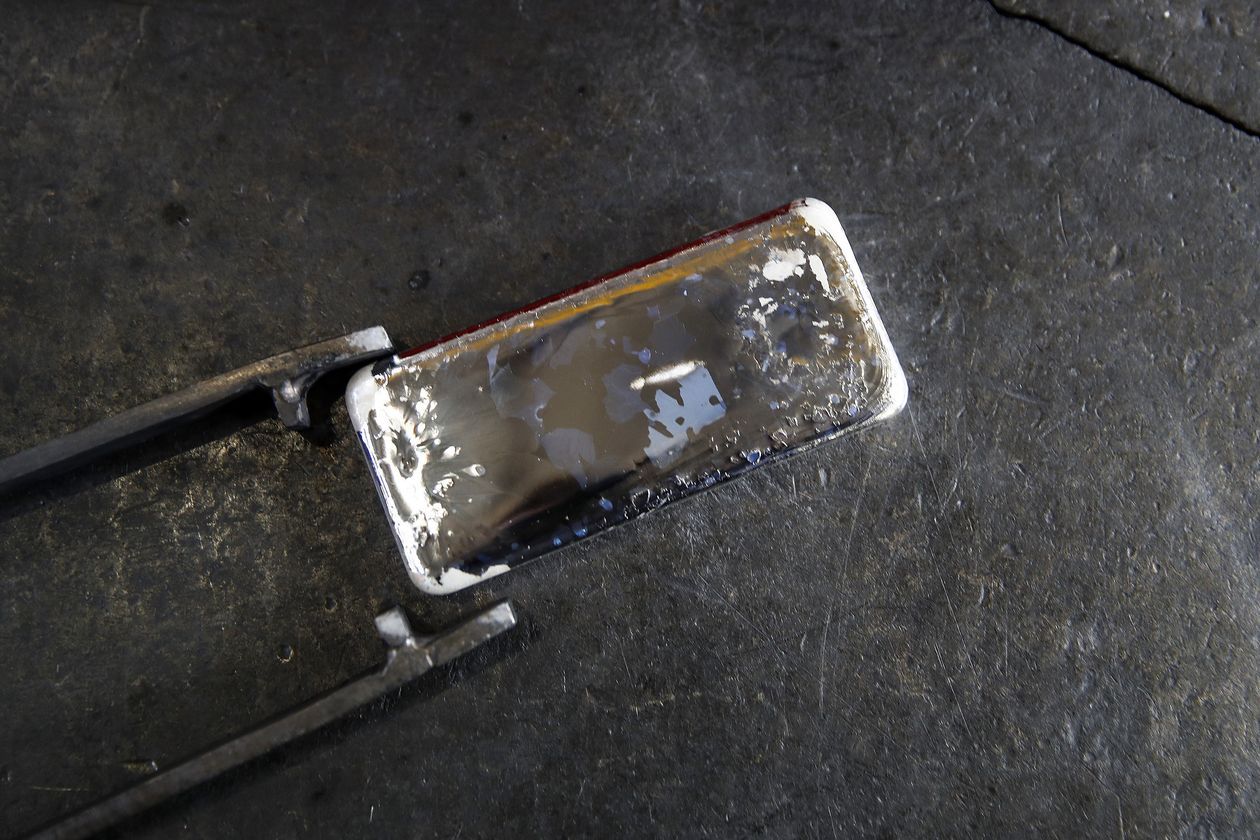
A worker uses tongs to handle a freshly cast silver bullion bar at the Valcambi precious metal refinery in Lugano, Switzerland.