






Trump threatens to end NAFTA if Congress attempts to ‘interfere’
President Donald Trump on Saturday threatened to withdraw the United States from the North American Free Trade Agreement, asserting his right to broker a new trade pact that does not include Canada despite opposition from lawmakers and questions over his legal authority to do so.
Trump on Friday formally informed Congress of his intent to enter into a trade deal with Mexico, with the notice adding the administration hopes Canada would be added to the new pact later. U.S. and Canadian negotiators worked throughout the week on adding Canada to Friday’s notice, but the negotiations failed to produce an agreement ahead of Trump’s own Friday deadline.
Negotiations with Canada are set to continue Wednesday in the hopes of adding Canada to the deal, and lawmakers have told Trump they will only sign onto a new NAFTA deal that includes all three North American nations.
But Trump issued a warning to Canadian Prime Minister Justin Trudeau and Congress on Saturday in a post on Twitter, writing he would go on without Canada and could unwind North American free trade if lawmakers would not support his approach.
“There is no political necessity to keep Canada in the new NAFTA deal. If we don’t make a fair deal for the U.S. after decades of abuse, Canada will be out. Congress should not interfere w/ these negotiations or I will simply terminate NAFTA entirely & we will be far better off…,” Trump wrote.
“We make new deal or go back to pre-NAFTA!” Trump wrote as part of a subsequent post.
It’s unclear whether Trump could withdraw from NAFTA without support from Congress, though he has repeatedly threatened to do so. Many lawmakers have said they would move to stop Trump if he attempts to withdraw from the deal, and the move would likely face legislative and legal challenges.
The withdrawal process would require Trump to give Mexico and Canada six months’ notice of his intent to leave the pact.
Ending NAFTA without a replacement would cause large-scale economic disruption across North America and beyond.
Companies accustomed to moving products across borders with few or no taxes would see costs jump — price hikes that would pass to consumers — and domestic producers would find their access to foreign markets diminished.
Canada is the No. 1 destination for American products shipped abroad, and more than 8 million U.S. jobs are supported by trade with Canada, according to the U.S. Chamber of Commerce.
The move would shelter some domestic industries from foreign competition, part of Trump’s aim to revitalize some domestic industries that have opted to move production overseas.
U.S. lawmakers have generally backed NAFTA, saying the overall economic benefits of cheaper products and greater efficiency have outweighed the negative consequences of job losses. But Trump has focused on areas where industrial decline has led to deep economic hardship.
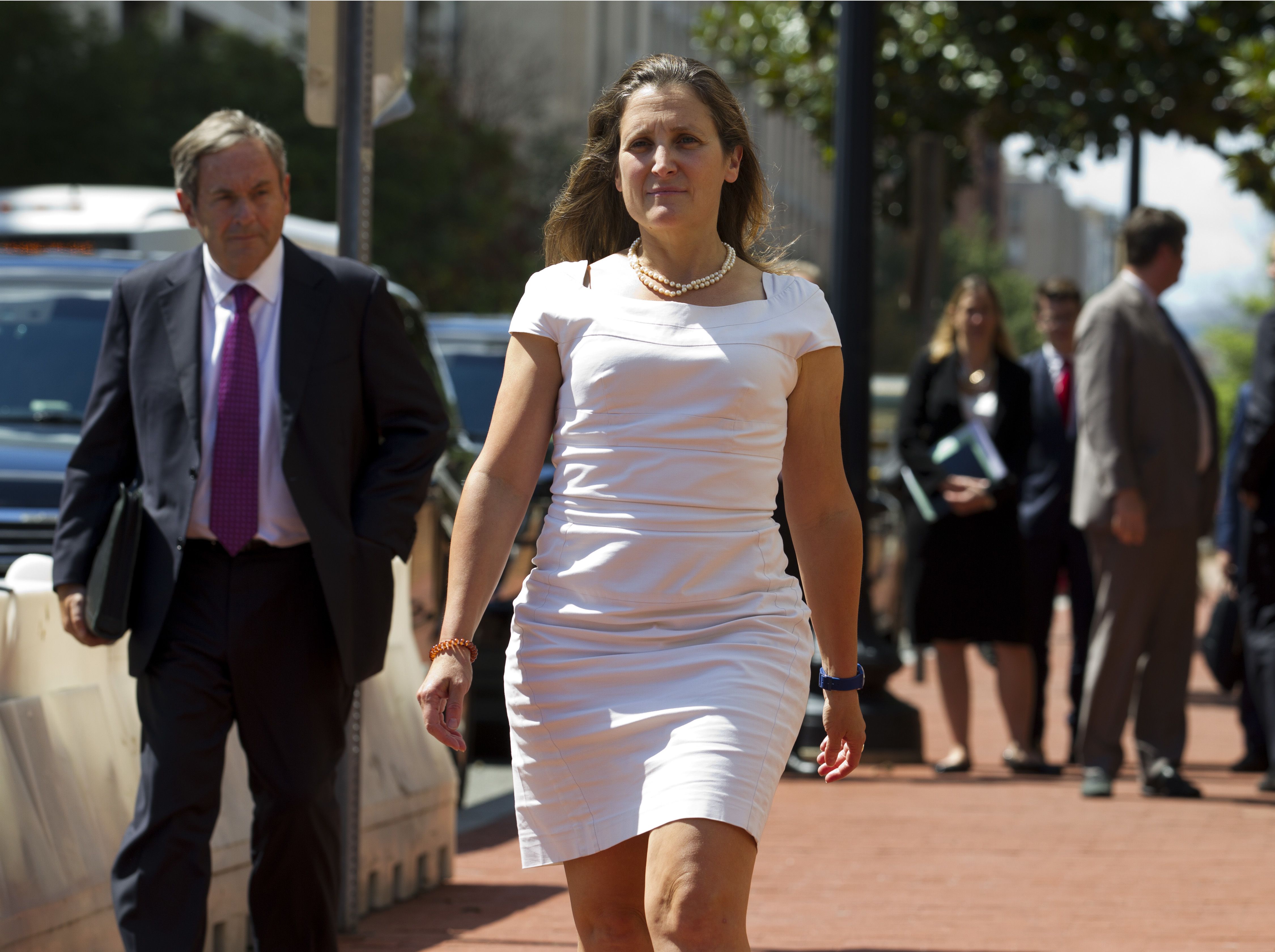
Trump’s threat to withdraw from NAFTA comes as U.S. Trade Representative Robert Lighthizer and Canadian Foreign Affairs Minister Chrystia Freeland are to resume negotiations Wednesday.
The president, who has relished standing apart from Washington’s political establishment, found himself more isolated than ever Saturday, airing his latest grievances and retreating to his private golf course in Virginia as his peers gathered to pay homage to the late Sen. John McCain.
Trump had not been invited to the memorial service for McCain at Washington National Cathedral, where his two recent predecessors, Barack Obama and George W. Bush, delivered eulogies.
Besides the threats to NAFTA, Trump spent Saturday morning promoting a false conspiracy theory alleging government misconduct in its surveillance of one of his former campaign aides.
In a pair of tweets to his 54 million followers, Trump promoted an article from CNSNews.com, a conservative website, that suggested a recent report from Judicial Watch, a conservative government watchdog group, contained a bombshell revelation: A U.S. surveillance court failed to hold hearings when granting and renewing warrants to monitor the movements and communications of ex-Trump campaign adviser Carter Page in 2016 and 2017.
Trump quoted Judicial Watch President Tom Fitton alleging “corruption” within the FBI and Department of Justice and the leadership of those agencies “being out to lunch” in seeking accountability.
In fact, the story was baseless, given that the Foreign Intelligence Surveillance Court, which handles warrants for surveillance of suspected spies and terrorists, normally does not hold hearings.
The 11 judges, all appointed by the Supreme Court’s chief justice, take rotating turns as the “duty judge” for several weeks at a time, and review written applications from the Justice Department and rarely hold hearings to consider them.
The court’s proceedings are classified and ex-parte, so no lawyers or witnesses for the suspects are aware of the application for a warrant.
Trump spent just over four hours at the Trump National Golf Club in Sterling, Va. Though White House aides did not provide details about his activities, news photographers published photos of him golfing.
As the president departed the resort in midafternoon, his motorcade passed by nearly a dozen protesters holding signs and flying small balloons depicting a baby version of Trump in diapers.
“You, Trump, are no John McCain,” one sign read.
Canada’s Foreign Affairs Minister Chrystia Freeland arrives at the Office of the United States Trade Representative, Friday in Washington. She and Representative Robert Lighthizer are scheduled to resume negotiations on Wednesday.
President Donald Trump waves after arriving on Air Force One at Andrews Air Force Base in Maryland on Friday.