






As wildfires rage, California frets over future of greater perils
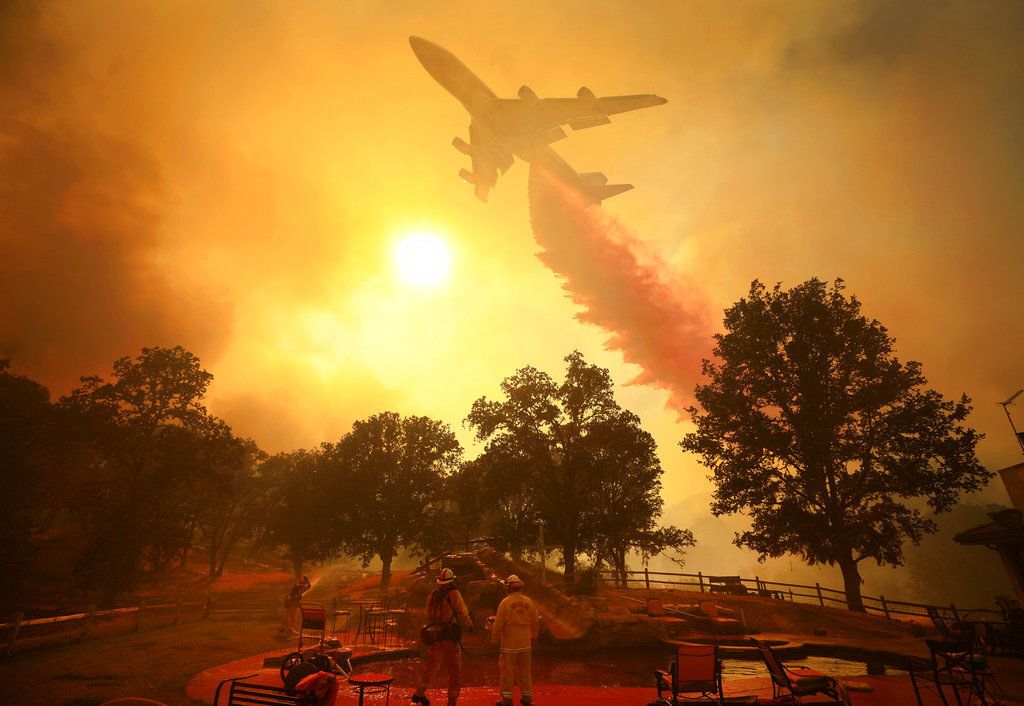
REDDING, Calif. • The wildfire that has burned with speed and efficiency through neighborhoods, jumped the wide Sacramento River and killed a half-dozen residents and firefighters has turned yet another place into a harbinger of what the future holds for this state.
The neighborhoods along the Trinity Highway were tucked among Douglas firs, oaks and eucalyptus, among the nearly 2 million homes statewide that — after years of permissive development in California — sit amid lovely and hazardous tinder.
Now some of them are ashes, only brick chimneys rising from charred foundations. The Carr fire has burned more than 1,000 houses to the ground.
A summer heat wave, fanned by evening winds, helped light up the parched land. Despite the scope of the blaze, not nearly enough firefighters are on the scene, their ranks stretched thin by the 15 other wildfires burning throughout the state.
“We grabbed a change of clothes, our medications, some pictures of my mother,” said Stephen Dobbs, as he smoked a cigarette in the 104-degree heat of the Shasta College evacuation center, with his companion dog, Shay, at his feet.
Around his neck dangled a small silver vial, containing some of his mother’s ashes.
“Luckily, I have this on,” he said, “I always have this on now in case we need to leave quickly.”
On Saturday, more than 13,000 firefighters continued corralling blazes across the state, including the Carr fire, which is 40 percent contained. A huge blaze southwest, known as the Mendocino Complex, has surpassed it as the biggest burning. That inferno has charred more than 200,000 acres, larger than the land area of New York City.
Smoke from the Carr fire hovers over Northern California, including the state capital, Sacramento, providing a dramatic backdrop for one of the most consequential policy debates in years — about who should pay for the growing number of increasingly destructive fires — now and in a hotter, drier future.
The election-year debate reflects a change in focus, from the long-term to the immediate, for a state that has been at the leading edge of environmental regulation. As wildfires become a year-round threat, California is moving to change long-standing laws to address the emergency of climate change, with the interests of those fighting, suffering from and paying for the fires in the balance.
The question before state lawmakers is whether public utilities should remain “strictly liable” for damage from fires that start because of their equipment, even if the utilities are not negligent. The largest utility, Pacific Gas and Electric, faces costs that could reach $12 billion for its role in last year’s deadly Northern California fires. Company officials say they cannot continue to afford the escalating payouts.
Insurance companies are fighting change, given that costs will be theirs alone if utilities escape future liability for fires caused by their equipment. The Carr fire, which was sparked by a malfunctioning vehicle, is a case in point. The insurance companies will pay for that damage.
Only Alabama applies the same strict standard, and California utility officials say the frequency and scale of fire damage in a changing climate make the law obsolete. Six of the 20 most destructive fires in California history have occurred in the past year, including ones caused by utility company equipment.
Speaking this past week in Sacramento, Democratic Gov. Jerry Brown said “there is concern that we could lose our utilities” to bankruptcy unless the law changes. Utilities are owned by shareholders, and liability for fire damage has, in the past, been passed on to customers.
If utilities suffer financially because of the strict-liability law, “our whole program of trying to deal with renewable energy and mitigate climate change would be adversely affected,” Brown said.
Brown, who leaves office at the end of the year, has made climate change the centerpiece of his legacy. His point now is that if California’s big utilities cannot afford to pay the exorbitant liability costs each year, the state will have no partner in vehicle electrification, solar and wind power proposals and other measures that need utility money and support.
Brown has named a special legislative committee, which includes lawmakers from districts hardest hit by recent wildfires, to develop a measure before the session ends Aug. 31.
He offered his proposal, which would be a step toward lifting the “strict liability” standard. Utility companies have spent nearly $2 million this year lobbying for such a change along with others they are pursuing.
“What’s different today is that the scale of the liability in California from these fires has gotten so large that it is essentially bigger than the companies involved,” said Michael Wara, a senior research scholar at the Woods Institute for the Environment at Stanford University. “The fear is that if the utilities get pneumonia for the next 10 years, it really calls into question the state’s ability to achieve its climate goals.”
The utility with the most at stake immediately is PG&E, whose power lines, according to California investigators, started 16 fires last fall in what was the most catastrophic season on record.
PG&E has written off $2.5 billion of earnings to cover potential costs, a figure that the company’s senior vice president for strategy and policy, Steven E. Malnight, called “a low-end to our possible liability.”
Some estimates place the potential damage from last fall’s North Bay fires as high as $12 billion, although investigations into some of the most damaging fires have not been concluded.
“We’ve moved beyond fire seasons in this state,” Malnight said. “And we have to recognize that yesterday’s laws will not keep up with tomorrow’s risks.”
The strict-liability standard is in place because, in California, utilities have the right to seize private land to accommodate their power lines, transformers and other equipment. This is the power of eminent domain usually reserved for government agencies.
On the other side of the argument are the insurance companies, which would face a huge increase in costs if liability for fire damage is shifted from utilities.
The debate is beginning as lawmakers return from a summer hiatus. Already, though, a consensus is emerging that, regardless of any liability change, much more needs to be done to clear decades of highly flammable dead trees and windfall, examine planning policies that have allowed suburbs to spread into forests and better fund firefighting efforts.
The state has spent $125 million fighting fires this budget year, which began July 1. That is more than a quarter of its allotted budget to do so, and the height of what has traditionally been fire season — September and October — is still to come.
A tanker makes a drop in front of flames from a wildfire Thursday in Lakeport, Calif.