






Movie review: ‘Blindspotting’: Race, class and a tale of two Oaklands
The best films teach you how to watch them within the first few minutes. “Blindspotting” is no exception.
The film gets off to an exhilarating start, with split-screen images of Oakland, Calif., unspooling to the tune of a soaring aria. It’s a vibrant, contagiously joyful mosaic of street life, parties, Warriors and Raiders fandom and workaday grit. But soon a disparity sneaks in: A shot of an African-American kid popping wheelies comes up alongside a white guy riding a bespoke penny-farthing bicycle. The corner store rubs right up against a Whole Foods.
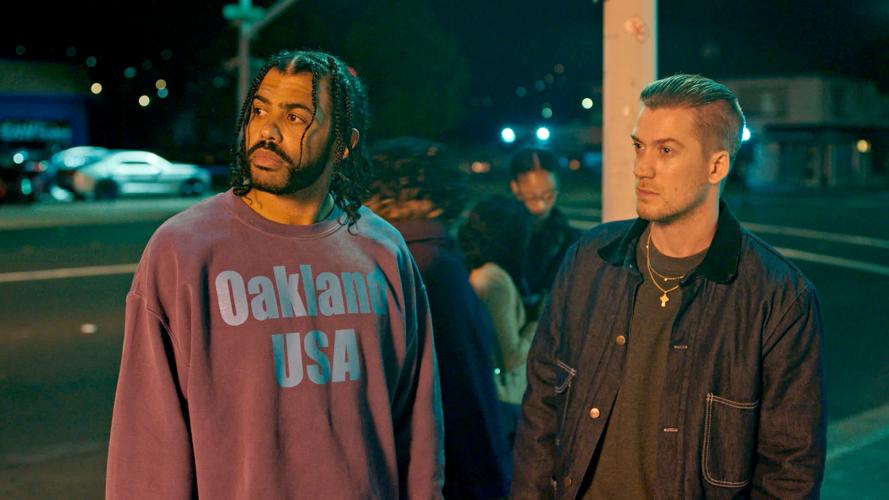
Moments later, we see Collin, the hero of “Blindspotting” played by the Tony-winning “Hamilton” actor Daveed Diggs, being released to probation, impassive while he listens to the judge’s instructions. The film gets underway in earnest when Collin is three days from having his probation lifted, as he sits in a car with his hotheaded best friend, Miles (Rafael Casal), and the driver. What starts as a Linklater-esque slice of guy-life turns into a comic routine worthy of the Marx Brothers, albeit with a decidedly foreboding subtext.
Here is what we’ve learned: “Blindspotting” will be a tale of Oakland, but it will be a tale of two cities; we will immediately be on the side of Collin, who although he’s a felon evinces a soft-spoken, gentle manner that is irresistible. And Miles — a tattooed white guy sporting a gold-toned grill, a mouth full of casual racial epithets and abiding resentment toward the gentrifiers colonizing his town — will be the most outlandish source of the film’s frequently uproarious humor. But he will also, most likely, be the source of Collin’s undoing.
Whether and how that ensues over the next few days forms the structural spine of “Blindspotting,” directed by Carlos López Estrada from a script written by Diggs and Casal, both gifted and charismatic performers who grew up in the Bay Area and are lifelong friends. As the movie counts down the days until Collin will be released from his halfway house, he tries to keep on the straight and narrow, despite Miles’ worst anarchic impulses. When Collin witnesses the murder of an unarmed black man at the hands of a white police officer, he’s pulled into a vortex of grief, guilt and unresolved trauma. While self-preservation dictates keeping his head down, Collin’s nagging self-respect suggests otherwise.
The film’s title is inspired by Collin’s ex-girlfriend, Val (Janina Gavankar), who is studying psychology and uses the term as a way to remember Rubin’s Vase, a visual exercise in which the viewer either sees a vase or two faces in profile. Seeing both at once, she explains, is “hella hard.”
For the most part, “Blindspotting” is a remarkably vivid, seamlessly flowing examination of modern life that is willing to take on not only capitalism, structural racism and contested social space, but also the perverse, even murderous implications of masculinity at its most tough and toxic.
As it becomes painfully clear to Collin that Miles’ impulsivity will land him back in jail — or worse — the dynamics of their friendship come under scrutiny, but it goes both ways. Miles might get away with more because he’s white, but in his view Collin is afforded immediate authenticity and credibility because he’s black. (This matters a lot, to which a frightening scene of mistaken identity at an upscale cocktail party attests.)
Just as Oakland is a gloriously ambiguous melting pot, nothing is precisely black or white in “Blindspotting,” a spirited, thoughtful, thoroughly entertaining valentine to a city and its still-unfolding history, and a bracing reminder that two things can be true at the same time. Understanding that fact will always be hella hard.
