






High Chateau fire in Teller County is 15 percent contained
Christian Murdock
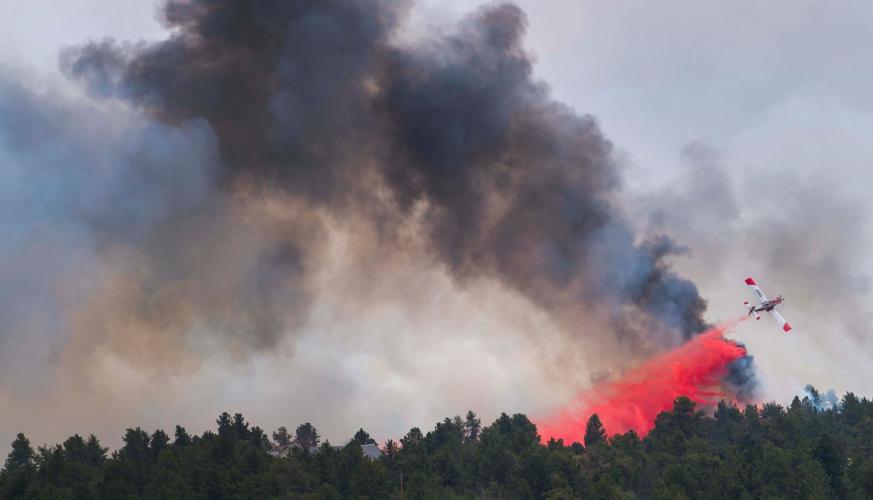
With an orange cast to the sky, a heavy smell of smoke and brisk hot winds, firefighters struggled Monday to gain an upper hand on the High Chateau fire in west Teller County, leaving more than 1,700 evacuees no closer to returning home.
Multiple houses have burned in the fire south of Florissant, though the exact number destroyed remained unclear midday Monday, Teller County Sheriff Jason Mikesell said. He said crews still are working to identify which houses burned, a task complicated by the lack of house numbers at those fire-swept residences.
“The problem with these types of fires is, we don’t know which are homes and which are barns, because there are no addresses,” Mikesell said.
The fire was 15 percent contained by Monday night, despite 25-mph gusts from the southwest threatening to fan flames that had blackened at least 1,328 acres.
It was one of several fires burning across the state, mostly in areas where fire conditions worsened Monday afternoon. By midday, military tankers from Peterson Air Force Base had joined the fight, making their first retardant drops on a far larger blaze burning over La Veta Pass, called the Spring Creek fire.
All residents affected by the High Chateau fire are feeling the pain, said Kim Fein, whose Highland Meadows neighborhood was one of the first two of many neighborhoods evacuated Friday afternoon.
“A lot of us were scared for our lives,” she said, describing a large plume of smoke that rose high, quickly spread and forced residents to flee. “It’s devastating, and you don’t care if it’s your home or your neighbor’s. They are all our homes, and it’s all the same loss.”
None of the more than 1,700 evacuated residents was allowed to return home Monday. Sanborn Ranch, a Western-style adventure camp for youths ages 9-17, voluntarily evacuated 362 children and about 125 horses.
An additional 1,800 residents are on pre-evacuation status.
Several factors contributed to the slow go, said Todd Pechota, incident commander of the federal Type 1 Rocky Mountain Incident Management Team.
“The weather is what it really gets down to,” Pechota said. “You’re in a very serious drought, which has a serious impact on the fuel and is creating extreme conditions.”
When fire isn’t moving across the tops of the trees, it crawls through the organic matter of the soil, he said. Combined with “steep, rocky, nasty in places” terrain, the fire break line in place is not able to hold steady, he said.
Those conditions have made it difficult to even reach the fire’s origin in the High Chateau neighborhood, Mikesell said, so investigators have not yet determined a cause.
At least 205 personnel, including six hand crews, were on the site Monday, along with more than 20 fire engines, five helicopters, bulldozers and single-engine air tankers, Pechota said.
Monday’s mid-80-degree temperatures, wind speeds of up to 25 mph and low relative humidity didn’t help, he said.
No firefighters have been injured – a fact that drew applause during a community fire briefing Monday afternoon.
Not knowing whether his home is still standing has been the worst part for Kenny Rankin, who’s lived in High Chateau since 1992.
He recalled barely escaping his house as the fire erupted Friday, and he left without taking enough medication for an extended stay away.
Authorities allowed him back for 10 minutes Saturday to swap out vehicles and get more prescription pills. But he has agonized over whether he will see his house again.
“You’re dependent on these guys. You’re looking at these maps; you can’t see your house. You can’t see if your house is still standing,” said Rankin, who was staying with a friend in Victor.
He was among several residents describing a frantic rush for safety in the fire’s first moments.
As residents fled the flames, several of their Teller County neighbors took to Facebook to help — offering trucks to haul livestock, hay to feed horses and updates on lost animals spotted running along emptying roadways.
Margaret Renner and her husband decided to go out for breakfast Friday. By the time they tried to return home, their neighborhood was blocked off.
First responders grabbed two of her five cats, and that was it.
“If it weren’t for my cats that are still there, I’d be fine,” Renner said. “You can always replace things, but I’m really concerned about my fur babies. And it doesn’t look like we’ll be able to go home anytime soon.”
She and her husband recently moved from Colorado Springs to High Chateau for the beauty, peace and small-town life. She never imagined she would be meeting her new neighbors at a wildfire briefing.
“We’re so impressed and proud to be part of this community,” she said. “It’s been a very tough situation, but everyone’s been helpful.”
The endless wait frustrated Meggan Hurley, her husband and their daughter, who live on the line between Teller and Park counties.
The family packed two cars full with possessions but found it difficult to figure out where they can go with animals and livestock. They were turned away from the Woodland Park shelter because they had cats and dogs, Hurley said, only to be told later that they could enter.
“We’ve been frustrated by the lack of information and the lack of coordination between the two counties,” she said.
Hurley said her family was going to camp Monday night and hope for the best.
“We’ve been sleeping in the Jeep. We’ve had no showers in three days,” she said. “I don’t know how much longer we can do this.”
About 30 evacuees spent Sunday night at the Cripple Creek-Victor Junior-Senior High School in Cripple Creek, and nine were at the Woodland Park High School, two evacuation centers set up by the American Red Cross.
“We’ve had wonderful outpouring from the community,” said Red Cross day manager Kenneth Harnett. Residents and businesses have donated water, fruit, snacks and other food to the centers, he said. The sites are providing restrooms, showers, meals and shelter.
Several evacuees bedded down for the night in the Woodland Park High School parking lot in their campers.
In all, 193 small animals and 349 large animals have been moved to temporary shelters, Mikesell said.
Several evacuees said they were concerned about a lack of public water for their livestock and other large animals such as horses.
Mikesell said his office would work on getting water to Florissant for animals.
“We’ve been so dry, wells are drying up,” he said.
As the winds picked up Monday, Mikesell asked residents for patience.
“Right now, everything is about your safety. “Bear with us. We’re going to continue to fight this fire and go after it aggressively.”
Contact the writer: 719-476-1656.
Contact the writer: 719-476-1656.
Contact the writer: 719-476-1656.
