






Air Force Academy cadets develop leadership skills with drone program
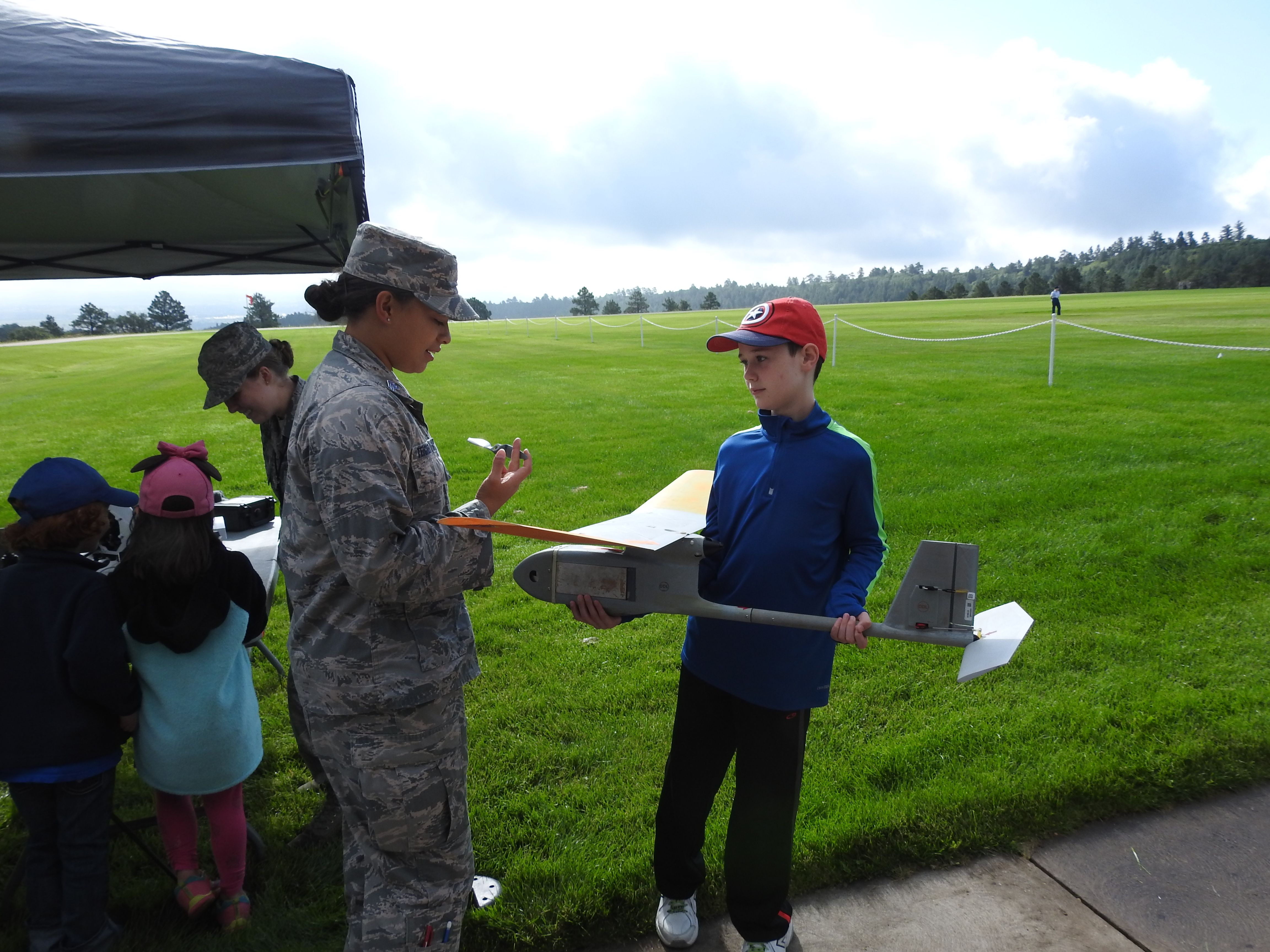
In a squat concrete building overlooking the Air Force Academy’s Fairchild Hall, cadets learn and practice the fundamentals of drone warfare.
Faculty and cadets with the remotely piloted aircraft program run an air operations center and two drone simulators and practice flying the RQ-11 Raven – a reconnaissance drone not much bigger than a model airplane that’s used by troops overseas.
Established in 2009, the program is designed to not only educate cadets on the operation of drones but to develop leadership skills as upperclassmen instruct younger cadets, said Lt. Col. Casey Tidgewell, the program director.
Like the academy’s soaring and jump programs – where cadets learn to fly gliders and parachute – the drone program prepares cadets for the active duty Air Force, where communication is key.
“As a remotely piloted aircraft pilot and even with our high-end fighter aircraft, flying the airplane really is not all that difficult,” Tidgewell said.
“It really is taking all that data that is coming in, synthesizing it, deciding what is important and acting on it.”
Tidgewell and a handful of other faculty prepare cadets for that reality by running cadets through scenarios in their air operations center, a miniature copy of the combat headquarters used to control air battles overseas.
“They go through five or six scenarios that increase in complexity. By the end, by the culminating event, they are really gelling as a team and really knocking it out of the park,” Tidgewell said. “They are communicating effectively and acting on inputs and what they see in a timely manner to achieve all of the mission objectives.”
Cadets can join the program as freshmen, but it is not until after their second year that they test their leadership chops.
After cadets finish their sophomore with the drone program, they travel to Hurlburt Field in Florida, where they become certified Raven operators.
Then they spend the next two years instructing younger cadets, commanding scenarios in the air operations center and guiding underclassmen as they pilot the Ravens, Tidgewell said.
Junior cadet Shanon Teicher has been with the program since the spring semester of her freshman year.
“Leading is my favorite thing that I have been able to do in the program,” she said.
“Reaching that point where I am an instructor, where I am qualified operationally.”
Teicher also feels responsible for the program’s growth during her time at the academy.
“We were really small – the numbers weren’t really there. Over the years since I have been part of it, we have really got involved with the cadet wing.”
The program now has about 70 cadets learning how to pilot drones and command drone operations.
“This program has played a big part in why I have stayed, feeling a part of something,” Teicher said. “Having ownership of this program is like I have left something here bigger than myself.”
ir Force Academy cadet Shanon Teicher demonstrating the capabilities of the RQ-11 Raven to spectators. Teicher has been with the program – which includes an air operations center and two drone simulators – since the spring semester of her freshman year. (Courtesy United States Air Force Academy)