






Hawaii volcano erupts anew, spews huge plume of ash into sky
HONOLULU — Hawaii’s Kilauea volcano erupted anew early Thursday with little sound and only modest fury, spewing a steely gray plume of ash about 30,000 feet (9,100 meters) into the sky that began raining down on a nearby town.
The explosion at the summit came shortly after 4 a.m. following two weeks of volcanic activity that sent lava flows into neighborhoods and destroyed at least 26 homes. Scientists said the eruption was the most powerful in recent days, though it probably lasted only a few minutes.
Geologists have warned that the volcano could become even more violent, with increasing ash production and the potential that future blasts could hurl boulders the size of cows from the summit.
Toby Hazel, who lives in Pahoa, near the mountain, said she heard “a lot of booming sounds” Thursday. Those came after days of earthquakes.
“It’s just time to go — it really, really is,” she said, preparing to leave town. “I feel so sorry for the people who don’t go, because they don’t have the money, or don’t want to go to a shelter and leave their houses.”
Some people in the community closest to the volcano slept through the blast, said Kanani Aton, a spokeswoman for Hawaii County Civil Defense, who spoke to relatives and friends in the town called Volcano.
At least one person who was awake heard nothing. Epic Lava tour operator John Tarson is an early riser and only learned about the eruption after receiving an alert on his phone. The plume, a towering column of ash reaching into a hazy sky, looked different than others he’s witnessed, because of its sheer height.
“What I noticed is the plume was just rising straight into the air, and it was not tipping in any direction,” he said. “We’ve been expecting this, and a lot of people are going to see it and get excited and scared.”
Tour guide Scott Wiggers didn’t hear the eruption either and wasn’t aware anything happened. Later in the morning, he picked up four travelers for a tour and headed toward the volcano with the hopes of seeing “some action.” But it was raining too hard for them to see much.
The only sign of the eruption he encountered was ash covering the back bumper of his truck.
Residents as far away as Hilo, about 30 miles from Kilauea, were starting to notice the volcano’s effects. Pua’ena Ahn, who lives in Hilo, complained about having labored breathing, itchy, watery eyes and some skin irritation from airborne ash.
A National Weather Service ash advisory was in effect until noon, and county officials distributed ash masks to area residents. Several schools closed because of the risk of elevated levels of sulfur dioxide, a volcanic gas.
The immediate risk health risk comes from ash particles in the air, said Dr. Josh Green, a state senator who represents part of the Big Island.
Anyone with respiratory difficulties, such as asthma or emphysema, should limit exposure to the ash, Green said.
“People need to stay inside until the winds shift and the ash has settled,” he said.
Extended exposure to sulfur dioxide can increase risk of bronchitis and upper respiratory infections in the long run, according to findings of a study Green worked on with other experts published in 2010 in the Journal of Toxicology and Environmental Health.
The summit crater sits within Hawaii Volcanoes National Park, which has been closed since May 11 as a safety precaution over risks of a violent eruption.
Scientists warned May 9 that a drop in the lava lake at the summit might create conditions for a large explosion. Geologists predicted such a blast would mostly release trapped steam from flash-heated groundwater.
Kilauea, one of the world’s most active volcanoes, has been erupting continuously since 1983. It’s among the five volcanoes that form the Big Island, and it’s the only one actively erupting. An eruption in 1924 killed one person and sent rocks, ash and dust into the air for 17 days.
Scientists cannot say why the eruption is happening now, given that Kilauea has been active for 35 years.
“There’s so many variables. It’s complicated, like a bad Facebook relationship status,” said volcanologist Janine Krippner of Concord University in West Virginia. “Something will eventually change, like it has over and over and over again.”
Robert Hughes owns the Aloha Junction Bed and Breakfast, about a mile and a half from the crater. He said he didn’t hear anything and has yet to spot ash. So far, he said, Thursday has been a “nice rainy day.”
His business has been hit hard by fears of the volcano, a major attraction for visitors. He’s lost hundreds of reservations and had just three guests Thursday instead of the 12 to 14 he has typically served. One was a news reporter, and the other two were visiting from Italy.
“In the old days, people used to love to come see the volcano. They’d even take their little postcards, burn one corner in the lava flow, mail them off, stuff like that,” he said. “Now they’re acting like it’s all super-dangerous and everything, but it just kind of oozes out.”
___
Associated Press writers Jennifer Kelleher and Audrey McAvoy in Honolulu, Becky Bohrer in Juneau, Alaska, and Seth Borenstein in Washington, D.C., contributed to this report.
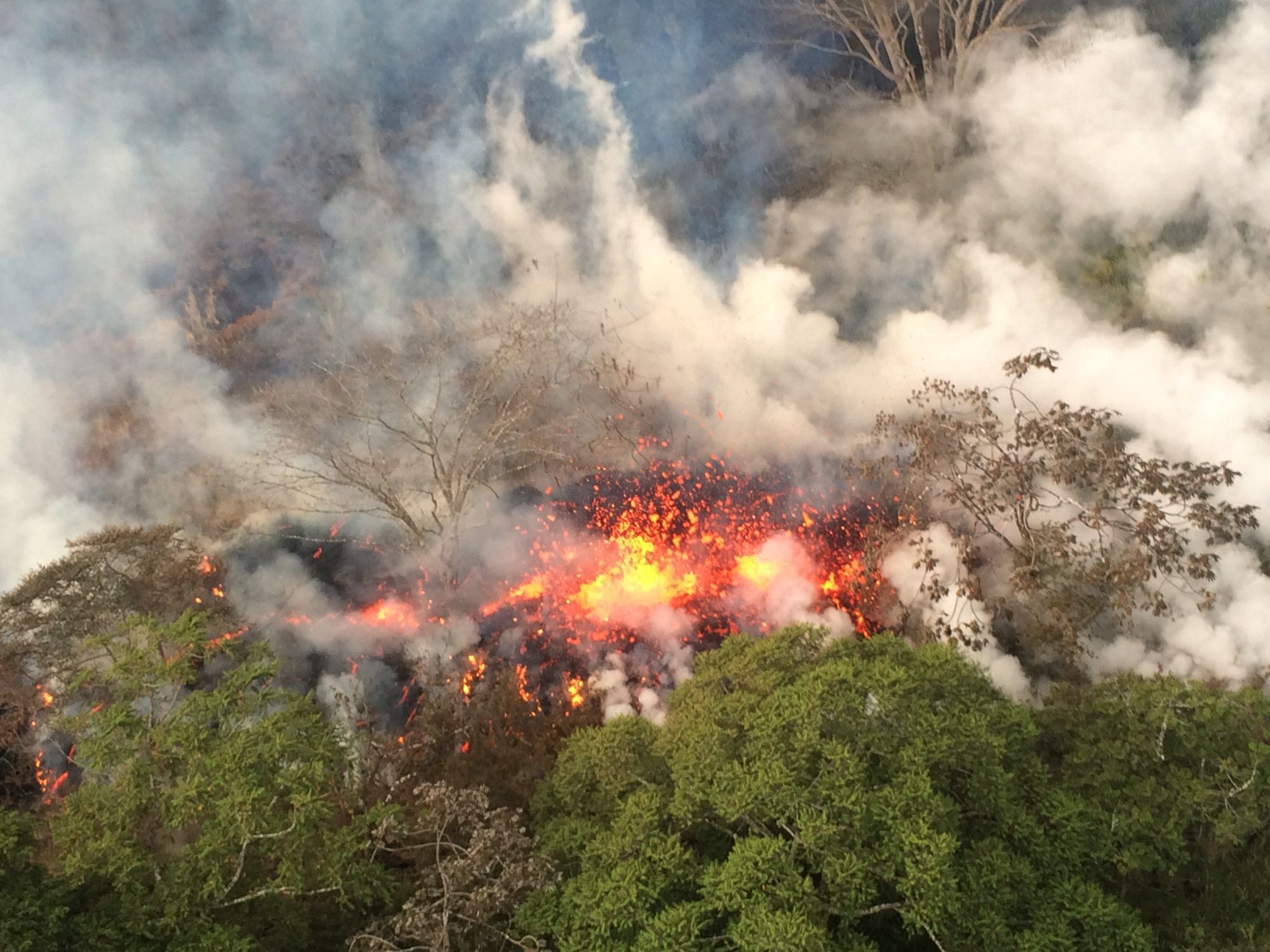
This Wednesday, May 16, 2018, image provided by the U.S. Geological Survey shows lava spattering from an area between active Fissures 16 and 20 photographed at 8:20 a.m. HST, on the lower east rift of the Kilauea volcano, near Pahoa, Hawaii. Plumes range from 1 to 2 kilometers (3,000 to 6,000 feet) above the ground. Officials say some vents formed by Kilauea volcano are releasing such high levels of sulfur dioxide that the gas poses an immediate danger to anyone nearby. (U.S. Geological Survey via AP)
FILE – This May 9, 2018 file photo provided by the U.S. Geological Survey a Hawaii Volcano Observatory geologist records a temperature of 103 degrees C (218 degrees F) at a crack along Nohea Street in Leilani Estates near the town of Pahoa, Hawaii. As Hawaii’s Kilauea volcano sputters lava into a second week, scientists are examining samples to seek clues on what might be happening beneath the earth’s surface. The age of the lava and the rate at which it’s shooting out of the ground also provides hints on the length and intensity of the current eruption. Sometimes the spurts of lava are shooting fountains 200 feet into the air. (U.S. Geological Survey via AP, File)
This Wednesday, May 16, 2018, image provided by the U.S. Geological Survey, shows lava spattering from an area between Fissures 16 and 20 photographed at 8:20 a.m., HST on the lower east rift of the Kilauea volcano, near Pahoa, Hawaii. By the time geologists reached the site on foot, the spattering had died down and they were only hearing gas rushing sounds. Plumes range from 1 to 2 kilometers (3,000 to 6,000 feet) above the ground. Officials say some vents formed by Kilauea volcano are releasing such high levels of sulfur dioxide that the gas poses an immediate danger to anyone nearby. (U.S. Geological Survey via AP)
FILE – In this May 5, 2018 file photo, offerings of ti leaves, rocks and cans to the fire goddess Pele, lie in front of lava as it burns across a road in the Leilani Estates subdivision as an unidentified person takes pictures of the flow near Pahoa, Hawaii. When residents of rural Hawaii neighborhoods where lava from Kilauea volcano has burned down or threatened to consume their homes, a name often comes up: Pele. Pele, known as the goddess of volcanoes and fire, is an important figure in Hawaiian culture. (AP Photo/Caleb Jones, File)
FILE – In this June 22, 2004 file photo, an offering to Pele, goddess of Hawaiian volcanoes, adorns the cliffs above the newest lava flow from Kilauea volcano as it enters the Pacific Ocean at dawn in Volcano, Hawaii. When residents of rural Hawaii neighborhoods where lava from Kilauea volcano has burned down or threatened to consume their homes, a name often comes up: Pele. Pele, known as the goddess of volcanoes and fire, is an important figure in Hawaiian culture. (AP Photo/David Jordan, File)
FILE – In this April 23, 2003 file photo, members of the Hula Na Mamo O Pu’uanahulu hula school perform a hula for Pele, the Hawaiin goddess of the volcano, on the rim of Kilauea Volcano in Hawai’i Volcanoes National Park in Hawaii. When residents of rural Hawaii neighborhoods where lava from Kilauea volcano has burned down or threatened to consume their homes, a name often comes up: Pele. Pele, known as the goddess of volcanoes and fire, is an important figure in Hawaiian culture. (AP Photo/David Jordan, File)
Ken McGilvray, of Keaau, Hawaii, golfs in Volcano, Hawaii as ash from the summit crater of Kilauea volcano rises in the background, Wednesday, May 16, 2018. McGilvray lives about 12 miles away from the area where homes from lava fissures are being destroyed, and he has friends from the Leilani Estates neighborhood staying with him after they evacuated. (AP Photo/Caleb Jones)
This Tuesday, May 15, 2018 photo provided by the U.S. Geological Survey shows incandescence observed at Fissure 14 around 10:30 a.m. HST at Kilauea Volcano, in Hawaii. Pulsing, gas-rushing sounds could be heard coming from the crack. Yellow sulfur deposits appear on the crack margins. (U.S. Geological Survey/HVO via AP)
In this Tuesday, May 15, 2018 photo provided by the U.S. Geological Survey, highly viscous lava oozes from the edge of a flow spreading slowly from fissure 17 at Kilauea Volcano, in Hawaii. Earthquakes were damaging roads and buildings on Hawaii’s Big Island on Wednesday as ash emissions streamed from Kilauea volcano. Scientists say earthquakes may shake loose rocks underground and open up new tunnels for lava to flow. (U.S. Geological Survey/HVO via AP)
A plume of volcanic steam rises from the alignment of fissures in Hawaii’s Kilauea East Rift zone, Wednesday, May 16, 2018. Earthquakes were damaging roads and buildings on Hawaii’s Big Island on Wednesday as ash emissions streamed from Kilauea volcano. (Cindy Ellen Russell/Honolulu Star-Advertiser via AP)