






History comes home for Fort Carson battalion
History comes home for Fort Carson battalion
{child_byline}By tony Peck Special to The Gazette{/child_byline}
Soldiers of Fort Carson’s 4th Battalion of the 9th Infantry Regiment honored their predecessors and welcomed home a century-old artifact of their involvement in China’s Boxer Rebellion during a ceremony last week.
The unit, which is preparing for combat in Afghanistan, formed up in front of the 4th Infantry Division Museum on Wednesday afternoon as leadership presented the Liscum Bowl, a 92-pound bowl of silver made in 1902.
“Listen well, this is our history and we are on the doorstep of another combat deployment,” said Lt. Col. David Uthlaut, the battalion commander.
Uthlaut and his soldiers will deploy with the rest of 1st Brigade Combat Team to Afghanistan in the coming weeks.
The 9th Infantry Regiment — dubbed “Manchus” for their time in China — are no strangers to combat deployments. The unit’s battle streamers include the War of 1812, World War I and II, the Korean War, Vietnam and the wars in Iraq and Afghanistan.
But it was the regiment’s involvement in the China Relief Expedition that earned them the Liscum Bowl.
The Chinese government built the bowl in 1902 to honor the unit’s help in putting down China’s Boxer Rebellion — an xenophobic uprising that took place in China, 1899-1901.
During the expedition, more than 2,500 U.S. soldiers and marines fought alongside troops from the Eight-Nation Alliance to protect Chinese Christians and save citizens from alliance nations besieged in Beijing’s legation quarter.
The bowl is named after Col. Emerson H. Liscum — a former commander of the 9th Infantry Regiment — who was killed in action in Tienstin, China, on July 13, 1900, said Joe Berg, the director of the 4th Infantry Division Museum.
After being mortally wounded, Liscum urged his men forward with a command that would become the unit’s motto, “Keep up the fire.”
But the remaining battalion of the 9th Infantry Regiment has been without its treasured silver bowl since it was reactivated in 2006. Historically, the regiment was assigned to the 2nd Infantry Division based at Camp Red Cloud in South Korea — where the bowl has remained on display.
Until Wednesday.
Draped in a black cloth, the Liscum Bowl was veiled as commanders, unit veterans and a Liscum descendant emphasized the importance of history and legacy to the soldiers in formation.
At the end of the ceremony, the black cloth was removed and most of the soldiers saw the bowl for the first time.
“It was in South Korea for a long time. It is finally home with the 9th Infantry,” said Rebecca Liscum, a distant cousin of the colonel. “I never thought the day would come, it is just such an American treasure.”
Liscum recounted the story of her ancestor’s life of service before wishing the “Manchus” a safe deployment.
“Carry on his legacy, keep up the fire,” she said.
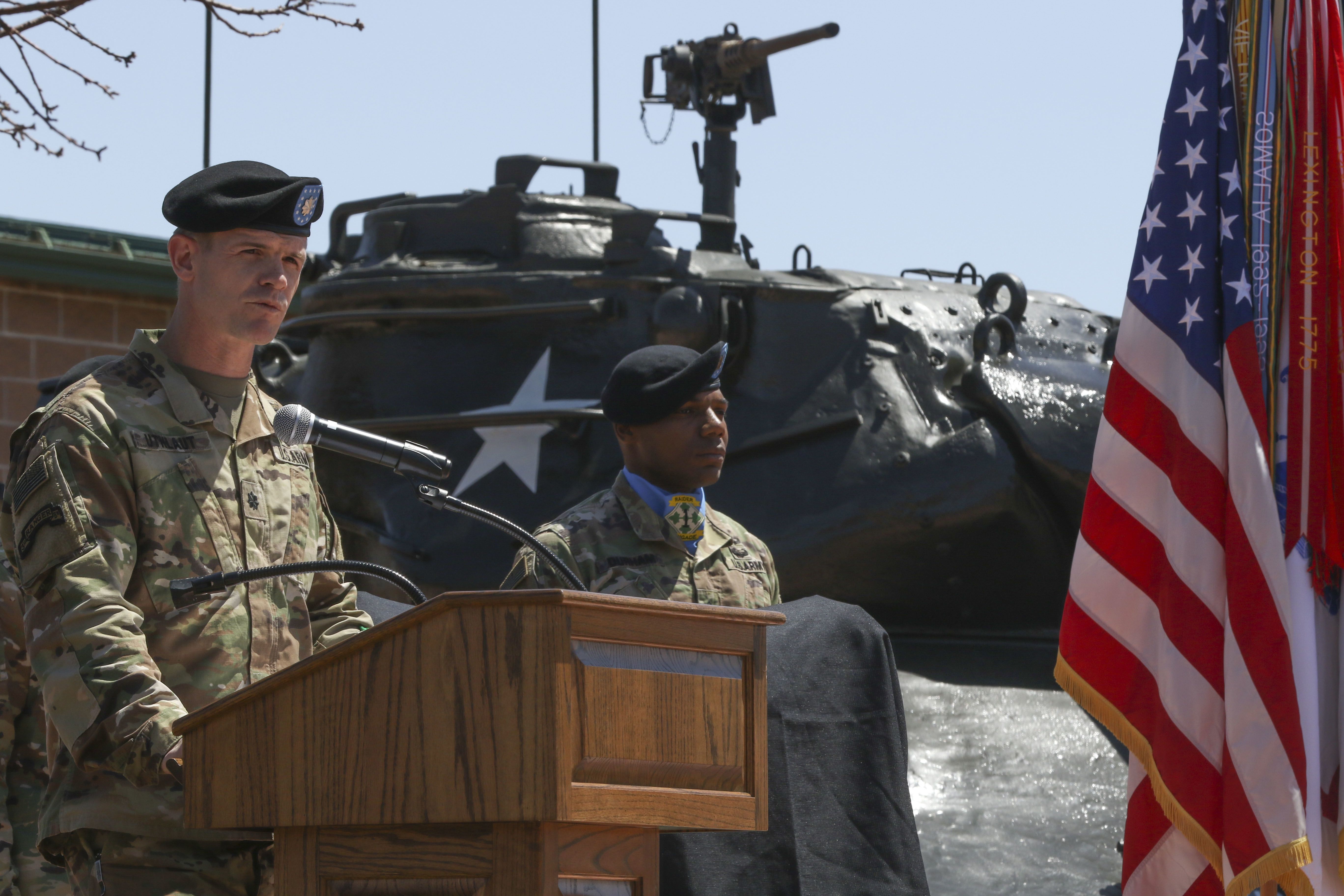
Lt. Col. David Uthlaut, battalion commander of the 4th Battalion, 9th Infantry Regiment “Manchus,” 1st Stryker Brigade Combat Team, 4th Infantry Division, speaks to an audience of Manchu veterans, Soldiers, friends and family during the unveiling of the 9th Infantry Regiment legacy trophy, the Liscum Bowl, April 25, 2018, Fort Carson, Colorado. The Liscum Bowl is a silver punch bowl, made from more than 90 pounds of silver bullion that was seized by the 9th Infantry Regiment during the Boxer Rebellion in 1900 and was presented to the regiment as a token of appreciation for its action during the conflict. The bowl had been on display in the 2nd Infantry Division museum at Camp Casey, South Korea, but it was recently returned to the 4th Battalion, 9th Infantry Regiment, the only active duty element of the 9th Infantry Regiment still in existence, and will be displayed at the Fort Carson Museum. (U.S. Army photo by Staff Sgt. Leah R. Kilpatrick)
Lt. Col. David Uthlaut, battalion commander of the 4th Battalion, 9th Infantry Regiment “Manchus,” 1st Stryker Brigade Combat Team, 4th Infantry Division, speaks to an audience of Manchu veterans, Soldiers, friends and family during the unveiling of the 9th Infantry Regiment legacy trophy, the Liscum Bowl, April 25, 2018, Fort Carson, Colorado. The Liscum Bowl is a silver punch bowl, made from more than 90 pounds of silver bullion that was seized by the 9th Infantry Regiment during the Boxer Rebellion in 1900 and was presented to the regiment as a token of appreciation for its action during the conflict. The bowl had been on display in the 2nd Infantry Division museum at Camp Casey, South Korea, but it was recently returned to the 4th Battalion, 9th Infantry Regiment, the only active duty element of the 9th Infantry Regiment still in existence, and will be displayed at the Fort Carson Museum. (U.S. Army photo by Staff Sgt. Leah R. Kilpatrick)