






North and South Korea agree to work toward ‘common goal’ of denuclearization
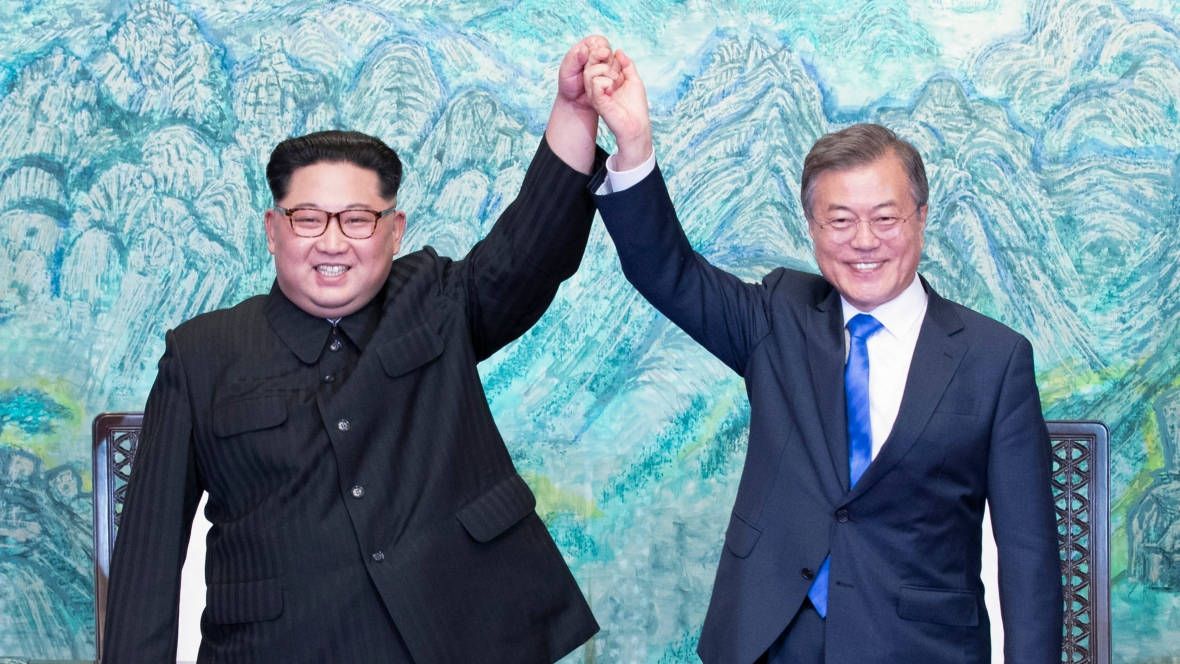
GOYANG, South Korea — North Korea’s Kim Jong Un has laid the foundations for a meeting with President Trump as soon as next month, signaling a willingness to discuss denuclearization and trying to dispel the idea that he’s an unreliable “little rocket man.”
In an astonishing turn of events, a beaming Kim on Friday stepped across the border into South Korea for a day of talks that began and ended with him holding hands with Southern President Moon Jae-in.
They talked, they joked, they walked, they ate, and, when they signed a joint statement pledging to work toward their “common goal” of denuclearizing their peninsula, they hugged.
“Today we saw Kim Jong Un’s charm offensive in action,” said Duyeon Kim, a visiting fellow at the Korean Peninsula Future Forum in Seoul. “He’s exerting his influence and trying to grab the spotlight with a big smile. But behind that smile, he was wearing his game face,” she said.
Indeed, with Friday’s historic summit and the bold, if vague, pledge to discuss giving up his nuclear program, Kim is trying to rewrite the public narrative about him and ease some of the outside pressure on him.
“Good things are happening, but only time will tell!” Trump, who has championed a “maximum pressure” campaign against Kim, tweeted early Friday morning in Washington.
The warmth of the meeting and the positive images beamed onto TV screens across the globe have set the stage for Kim to meet with Trump at the end of May or early June. The former reality TV host has said he will go to the talks only if they promise to be “fruitful,” a bar that likely was met with Friday’s meetings.
Kim and Moon Friday signed a three-page “Panmunjom Declaration,” named after the truce village in the Demilitarized Zone between the two Koreas where it was forged, stating that “South and North Korea confirmed the common goal of realizing, through complete denuclearization, a nuclear-free Korean Peninsula.”
“South and North Korea agreed to actively seek the support and cooperation of the international community for the denuclearization of the Korean Peninsula,” it said.
But the agreement was short on details, and the phrase “a nuclear-free Korean Peninsula” will ring alarm bells in Washington because it implies that nuclear weapons will not be allowed in South Korea, either.
The United States, South Korea’s security ally, regularly sends nuclear-capable aircraft and ships to the South during military exercises, so this clause will raise suspicions that Pyongyang is calling for a significant change in the U.S.-South Korea alliance.
Moon had previously said that Kim would not insist on the withdrawal of U.S. troops from the South, and there was no mention of this in Friday’s agreement.
Kim did not mention the word “denuclearization” when he appeared before the press after signing the agreement, although he stayed on message throughout.
“We will work to make sure that the agreement bears good results, by closely communicating to ensure that the failure to implement North-South agreements in the past will not be repeated,” Kim said, standing at a podium in front of cameras.
Previous inter-Korean agreements have also pledged denuclearization, and there is a significant amount of skepticism in Washington and Tokyo in particular about whether this time will be any different.
The fact that Kim signed his name to a statement that even included the word “denuclearization” marked significant progress after a year of threats and missile launches that brought the specter of war back to the Korean Peninsula.
And Friday’s agreement marks a significant change from Kim’s previous statements when he said he will continue to expand his nuclear arsenal, said Patrick McEachern, a fellow at the Wilson Center in Washington.
Instead, the two leaders established a framework for plausible resolution of the most pressing issues on the peninsula, he said.
“This is a great start and should be cause for cautious optimism,” said McEachern, who worked on North Korea in the State Department. “The public conversation should now shift from speculation on whether North Korea would consider denuclearization to how South Korea and the United States can advance this denuclearization pledge in concrete steps.”
Even the most optimistic analysts were surprised at the scope of the agreement, noting in particular that Kim has now signed a document that includes the word “denuclearization.”
“You can’t ask for more than that,” said John Delury, a professor of international relations at Yonsei University in Seoul and a keen proponent of diplomatic engagement.
“Yes, there are still questions about how to guarantee North Korea’s security on the path the denuclearization. But I’m surprised they would go this far at this early stage, that Kim Jong Un didn’t save this for his meeting with Trump,” Delury added.
In Friday’s declaration, Kim and Moon also agreed to work to turn the armistice agreement that ended the Korean War in 1953 into a peace treaty that would officially bring the war to a close.
“South and North Korea will actively cooperate to establish a permanent and solid peace regime on the Korean Peninsula,” the joint statement said in English, as officially translated by the South’s presidential Blue House.
The Korean language version used the words “peace treaty” — an important distinction. “Treaty” generally refers to a piece of paper while “regime” means a system for peace, such as stopping military activities.
“Bringing an end to the current unnatural state of armistice and establishing a robust peace regime on the Korean Peninsula is a historical mission must not be delayed any further,” the statement said.
Read the full story at The Washington Post.
Kim Jong-un and Moon Jae-In take ceremonial steps into each other’s countries at border town.
Kim Jong-un and Moon Jae-In take ceremonial steps into each other’s countries at border town.