






Fort Carson trains for ‘worst case scenario’ during emergency response training
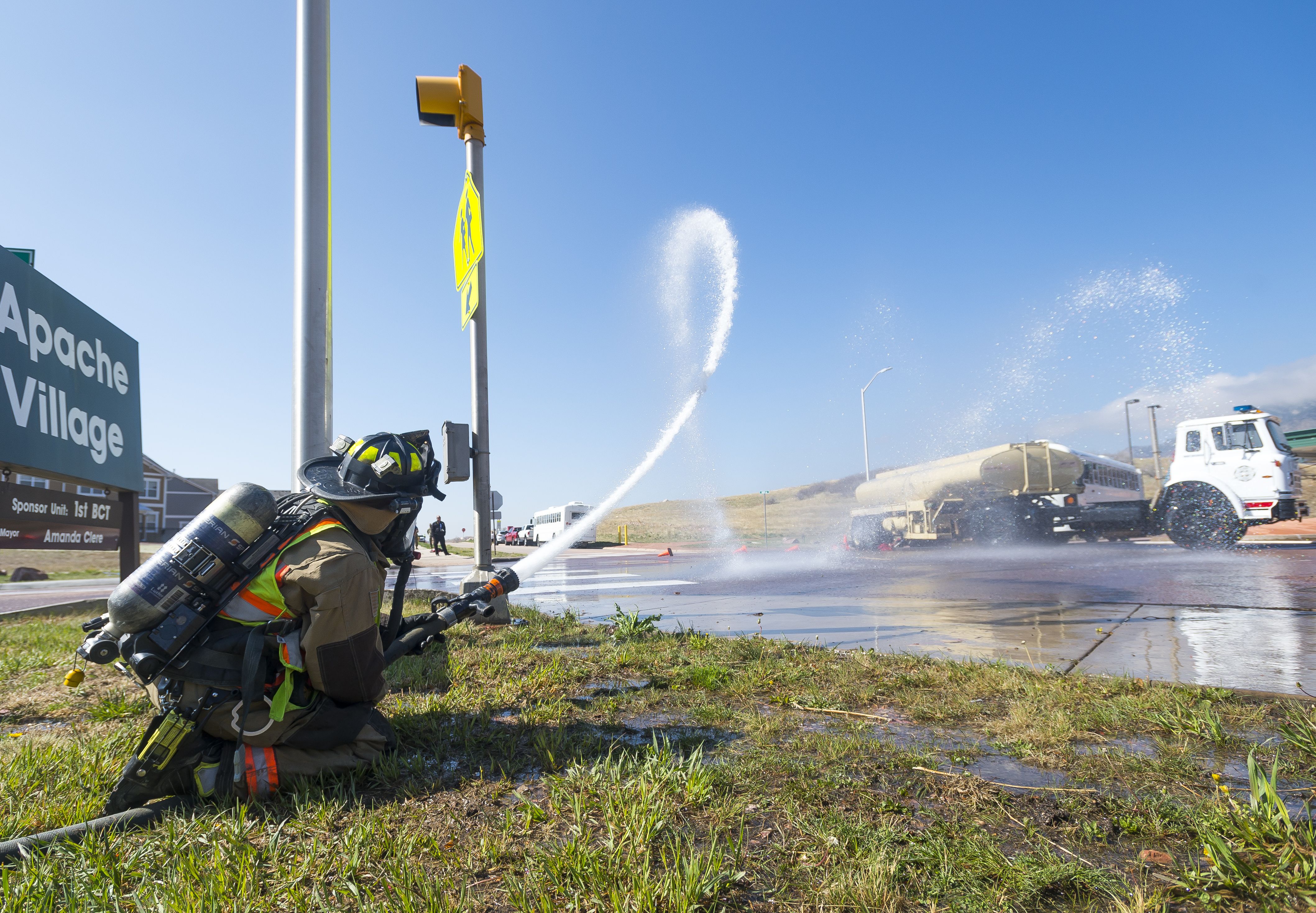
Fort Carson conducted full-scale emergency response training Wednesday, testing every tool – from public affairs and garrison command to first responders.
The training began when Fort Carson Fire Department responded to a “traffic accident with unknown injuries.”
When fire crews arrived, they faced a “worst case scenario,” firefighter Capt. Mike Wupper said.
The training scenario was complex – a bus had crashed into a large Army fuel tanker in the middle of an intersection between Gate 2 and residential areas on post.
“The tanker was carrying gasoline, one of the worst scenarios that we have,” Wupper said.
The test involved extinguishing fires, handling fuel runoff and rescuing 20 victims from the vehicles – although there were no real casualties or flames.
“What we do initially is get in between the emergency and the people we are here to protect,” Wupper said. “Life safety – get in there and put the fire out as soon as we can.”
Escalating from a traffic accident to a worst-case scenario tested every level of the post’s emergency response system.
As fire crews handled the scene, commanders set up an emergency operations center, Evans Army Community Hospital prepared to care for “simulated injuries” and the post’s public affairs office practiced sending emergency briefs to the community.
The training was the culmination of smaller monthly exercises completed by garrison staff during the past year, said Col. Ronald Fitch, Fort Carson’s garrison commander.
“Just like any other community, we do emergency management exercises,” Fitch said. “It provides perspective on where we sit capability wise.”
Wednesday’s training is an annual requirement from the Army’s Installation Management Command. In the past, the exercise scenarios have included simulated cyberattacks, tornadoes, winter storms, active shooters, aviation accidents and terrorist attacks, the Army said.
The post deliberately makes situations as complex as possible, so they can evaluate the response and discover areas to improve, Fitch said.
While the Army’s first responders train for on-base emergencies, they also provide support to the Pikes Peak region.
“We’ve responded to more fires off post than on post,” Fitch said.
Most recently, the Fort Carson units supported Colorado Springs and El Paso County fire crews battle the 117 fire – a blaze that burned about 43,000 acres and multiple homes.
Wednesday’s training helps firefighters stay prepared for such challenges.
“The more we train together, the better we are at serving our community,” Wupper said.
During a drill training exercise, a Fort Carson firefighter sprays downt the tanker truck as the Fort Carson fire department ran an accident simulation involving the tanker truck and a bus on base at Fort Carson Wednesday April 25, 2018 in Colorado Springs.
During a drill training exercise, a Fort Carson firefighter tends to one of the “injured” victims as the Fort Carson fire department ran an accident simulation involving a tanker truck and a bus on base at Fort Carson Wednesday April 25, 2018 in Colorado Springs.