






The oceans’ circulation hasn’t been this sluggish in 1,000 years. That’s bad news
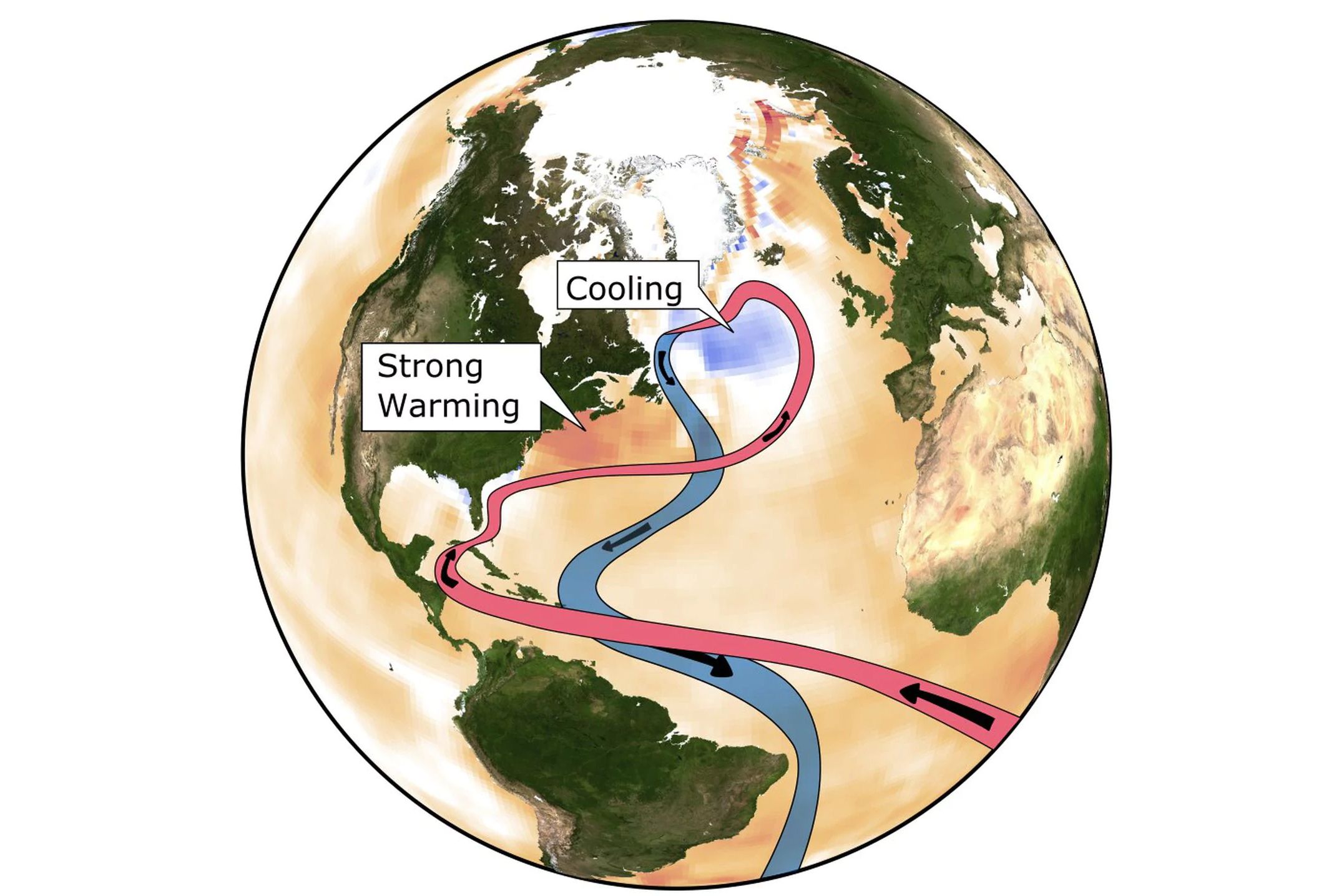
The Atlantic Ocean circulation that carries warmth into the Northern Hemisphere’s high latitudes is slowing down because of climate change, a team of scientists asserted Wednesday, suggesting one of the most feared consequences is already coming to pass.
The Atlantic meridional overturning circulation has declined in strength by 15 percent since the mid-20th century to a “new record low,” the scientists conclude in a peer-reviewed study published in the journal Nature. That’s a decrease of 3 million cubic meters of water per second, the equivalent of nearly 15 Amazon rivers.
The AMOC brings warm water from the equator up toward the Atlantic’s northern reaches and cold water back down through the deep ocean. The current is partly why Western Europe enjoys temperate weather, and meteorologists are linking changes in North Atlantic Ocean temperatures to recent summer heat waves.
The circulation is also critical for fisheries off the U.S. Atlantic coast, a key part of New England’s economy that have seen changes in recent years, with the cod fishery collapsing as lobster populations have boomed off the Maine coast.
Some of the AMOC’s disruption may be driven by the melting ice sheet of Greenland, another consequence of climate change that is altering the region’s water composition and interrupts the natural processes.
This is “something that climate models have predicted for a long time, but we weren’t sure it was really happening. I think it is happening,” said one of the study’s authors, Stefan Rahmstorf of the Potsdam Institute for Climate Impact Research in Germany. “And I think it’s bad news.”
But the full role of climate change in the slowing ocean current is not fully understood, and another study released Wednesday drew somewhat different conclusions.
This study, which was also published in the journal Nature, found that the AMOC has slowed over the past 150 years and similarly found that it is now weaker than at any time in more than a millennium.
“The last 100 years has been its lowest point for the last few thousand years,” said Jon Robson, a researcher at the University of Reading and one of the study’s authors. (The study’s lead author was David Thornalley of the University College London.)
The two studies have their differences: The second suggests the slowdown probably began for natural reasons around the time of the Industrial Revolution in 1850, rather than being spurred by human-caused climate change, which fully kicked in later.
But like the first study, the second finds that the circulation has remained weak, or even weakened further, through the present era of warming.
“These two new papers do point strongly to the fact that the overturning has probably weakened over the last 150 years,” Robson said. “There’s uncertainty about when, but the analogy between what happened 150 years ago and today is quite strong.”
The AMOC amok?
The AMOC circulation is just one part of a far larger global system of ocean currents, driven by differences in the temperature and salinity of ocean water. Warm surface waters flow northward in the Atlantic, eventually cooling and — because cold, salty water is very dense — sink and travel back southward at great depths. The circulation has thus been likened to a conveyor belt.
But the melting of Arctic sea ice and Greenland’s ice sheet can freshen northern waters and interfere with sinking. Recent research has in fact confirmed that meltwater from Greenland is lingering on the ocean surface, where it could be interrupting the circulation.
Direct measurements of the circulation are only a little over a decade old. And while those have shown a downturn, that’s too short a time period to detect a definitive trend.
So the new studies sought to infer the state of the circulation from more indirect evidence.
In the first, the authors highlight a curious pattern of ocean temperatures that match what you would expect from a weakening AMOC — namely, a strong warming off the coast of the eastern United States, paired with a cooling south of Greenland, which sometimes been called the cold “blob”:
The research finds that the odd alignment, which has produced regions of record cold and record warmth right next to one another, has been developing since the 1950s and closely matches what a very high resolution climate model predicted would occur.
The study was led by the Potsdam Institute’s Levke Caesar with along with co-authors at institutions in Germany, Greece, and Spain, as well as from the U.S. National Oceanic and Atmospheric Administration.
The second study, meanwhile, draws on sediment samples from the deep ocean off Cape Hatteras, N.C., to infer the strength of the current going back well over a thousand years. Because a stronger current can carry thicker sand grains, the study was able to detect a weakening beginning around 160 or 170 years ago when the “Little Ice Age” in the Northern Hemisphere ended. That trend has then continued through the present.
“In terms of this initial drop in the AMOC, it’s very likely that’s a kind of natural process,” Robson said. “It’s very likely, based on other evidence, that human activities may have continued to suppress the AMOC, or maybe led to further weakening.”
Read the full story at The Washington Post.
(Levke Caesar/Potsdam Institute for Climate Impact Research)
The cold “blob” was particularly pronounced in the first half of the year 2015. (NOAA)
(Levke Caesar/Potsdam Institute for Climate Impact Research)
The cold “blob” was particularly pronounced in the first half of the year 2015. (NOAA)