






The myth of the lonely gamer playing in solitude is dead
Jeff Kaplan met his wife in his 20s, as many do. He was an aspiring writer living in Los Angeles while moonlighting as a Halfling rogue in the multiplayer fantasy video game Everquest. She was a Dark Elf warrior at the time, and, to prove himself worthy of joining her guild, Kaplan had to duel her with a set of serrated bone knives. It’s the usual, age-old story of love.
At first, they only knew each other by their screen names, and whatever could be gleaned through the clunky text chat programs of the 1990s. “For years, I thought she was a male,” Kaplan recalled.
They became close all the same, then met, then married. At the dawn of multiplayer video gaming, Kaplan and his wife understood what a Washington Post-University of Massachusetts Lowell poll just made abundantly clear three decades later: The myth of the lonely gamer is a lie.
Nearly three quarters of Americans age 14 to 21 had played or watched an online multiplayer game in the last 12 months, when the poll was conducted last fall. The survey is among the first to gauge the growing popularity of e-gaming, and finds 25 percent of all adults played or watched games in the past year, peaking at 43 percent among those under age 40.
About half of gamers age 14 to 21 considered friendship an essential part of playing, the poll found. And nearly half had made at least one friend through a game, be it in a Call of Duty arena or one of the countless online role-playing games that succeeded Everquest.
These friends may talk by text, like the Kaplans in the 1990s, or lately by voice — which has become a standard component in most online games — and video, through game streaming websites such as Twitch. Or they may meet in person, dragging an Xbox to a friend’s living room or crowding into a bar with hundreds of other gamers, like NFL fans on a football Sunday, to catch a match from the exploding esports scene.
The medium hardly matters. Many of these friendships deepen for years, until the bone knife duels and deathmatches that enabled them are nearly forgotten, and only bonds between people remains.
The Kaplans are still together. Jeff set aside his writing ambitions to help make multiplayer games. He worked on World of Warcraft and then as lead designer on Blizzard’s ultra-popular, team-based shooter, Overwatch. Both are largely designed around in-game friendships.
Multiplayer games are more popular than ever now, and what Kaplan and his wife knew in the ’90s is becoming something close to an industry motto:
“The most important story in a video game is between the people playing the game together,” Kaplan said.
Bonding in battle
Riggie Medina and Christian Alaniz are nearly the same age, 18 and 19. They’re both Catholic and both plan careers in law enforcement. They both bowl, work out and listen to ska and rap in their spare time.
All their lives, they have lived a few miles apart in neighboring central California towns of a few thousand people. But Medina and Alaniz never met until a couple years ago, when they ended up on the same team in a Call of Duty match and got to chatting afterward in the game’s target shooting arena.
“When we were all tired out from playing against other people, we’d usually go shoot offline bots,” Alaniz said.
It was there, in a virtual arena that connected their separate lives, they found out all they had in common.
They struck up a friendship and now game together nearly every weekend — one usually driving to the other’s house to shoot up imaginary worlds in each other’s personal company.
A 54 percent majority of teen and young-adult gamers say enjoying time with friends is a major reason they play or watch games, far more than say they play to improve their skills or to have a chance at winning championships. A similar 52 percent of young gamers say they play or watch online games with friends they met offline, while 45 percent say they have become friends with people they connected with while playing games online.
None of this seems strange to Rebecca Adams, a professor at the University of North Carolina at Greensboro who studies and has written several books on the science of friendships.
Sociologists identified the fundamentals of friend-making decades before the Internet existed, Adams said. Two people meet more or less accidentally, often because they both regularly visit the same places — a baseball field or coffee shop or office. They discover a few things in common, and a relationship develops naturally, in a setting they’d frequent regardless of the other party’s presence.
As the friendship deepens, it eventually transcends the place where it started, moving from the coffee shop to, say, dinner parties. Or from a fantasy dungeon to a voice chat program.
In some cases with video gaming, a deep friendship can form without ever moving off the screen. Pearl Lee, a 21-year-old college student on Long Island, N.Y., says she could never afford to travel overseas. Likewise, her friend who stocks shelves in the United Kingdom could never afford to visit New York. And yet the pair have known each other for years — ever since they met on a dungeon raid in the role-playing game Mabinogi. Only Lee still plays that particular game, but she and her friend talk nearly every day through the voice app Discord.
“I don’t think this is such a new thing,” Adams said. In some ways, video games might even be more natural places to incubate friendships than a coffee shop. “When you’ve been through something together it bonds you,” she said, giving the examples of World War II soldiers in a fox hole, or Grateful Dead fans who saw the same concert. “It’s going through those experiences that make you more likely to start talking. I can imagine this couple that went on the raid together probably wanted to debrief after, and that’s probably why they started to talk.”
A different kind of matchmaking software
At Blizzard, Kaplan jokes that “game designers are amateur psychologists … we spend a lot of time thinking about psychology and sociology with no degree in it.”
Nevertheless, his design philosophy sounds remarkably similar to the theories of friendship studied by Adams and her academic colleagues.
Overwatch features dozens of characters players can utilize while on teams with five other players, often randomly selected by the game.
One character, Pharah, flies around the arena with a jet pack and launches rockets from the air — but dies quickly if targeted by the enemy team. Another character, Mercy, can’t fly on her own but can tether herself to any player and heal their wounds. They are more or less made for each other, prompting their players to communicate and cooperate in the game.
It’s common to see a Mercy player tethered to a Pharah player for an entire match — flying around together, helping each other, often chatting through the voice lines as they play.
When the match ends, the teammates are briefly dumped into a sort of social lobby, where they’re encouraged to add each other to their “friends” list. If they do, they can easily connect and play together in any other Blizzard game.
This is all intentional. Blizzard realized that players’ friendships were transcending the particular games they formed in during the late 2000s, Kaplan said, and the company began to design around the concept.
Overwatch has no single-player story, because in a sense the players and the connections between them are the story, and the game mechanics are designed to encourage those relationships. Call of Duty’s latest iteration, Call of Duty: WWII, features a lobby where players can talk and show off their avatar’s latest accolades, uniforms and weaponry. The game even includes a social score, with special gear unlocked by higher scores.
The social dynamic is also a focal point of the game Destiny, which links up players to complete various quests and battles.
M.E. Chung, a game designer at Bungie, which publishes Destiny, told The Verge last May that the game’s purpose was to create challenges for players to overcome through cooperation.
“I describe that challenge as the fuel to memories between lifelong friends. I think a lot about games I’ve been playing, when you ask yourself, ‘Why am I doing this?’” Chung said. “We hope with Destiny they’re saying, ‘I’m spending time with my friends.’ Most people don’t regret the time they spend with their friends.”
Kaplan would agree.
“The first time I met my wife, she was a night elf warrior who kicked my ass,” Kaplan said. “That’s a more interesting story to me than how the dragon attacked the temple.”
Friendships in fandom
For years it’s been common for sports fans to descend on stadiums or local bars to watch their teams compete. Increasingly, that’s becoming more common in the world of video gaming through the rapid rise of esports. The poll finds 38 percent of teens and young adults say they are fans of esports — just two points lower than those in the poll who follow professional football.
And just like with football, the elite tournaments of esports, like the newly formed Overwatch League, inspire communities of fans and friends around them.
Blizzard says 10 million people watched the Overwatch League’s opening week. The matches weren’t on network TV, so most watched through streaming sites such as Twitch.
Read the full story at The Washington Post.
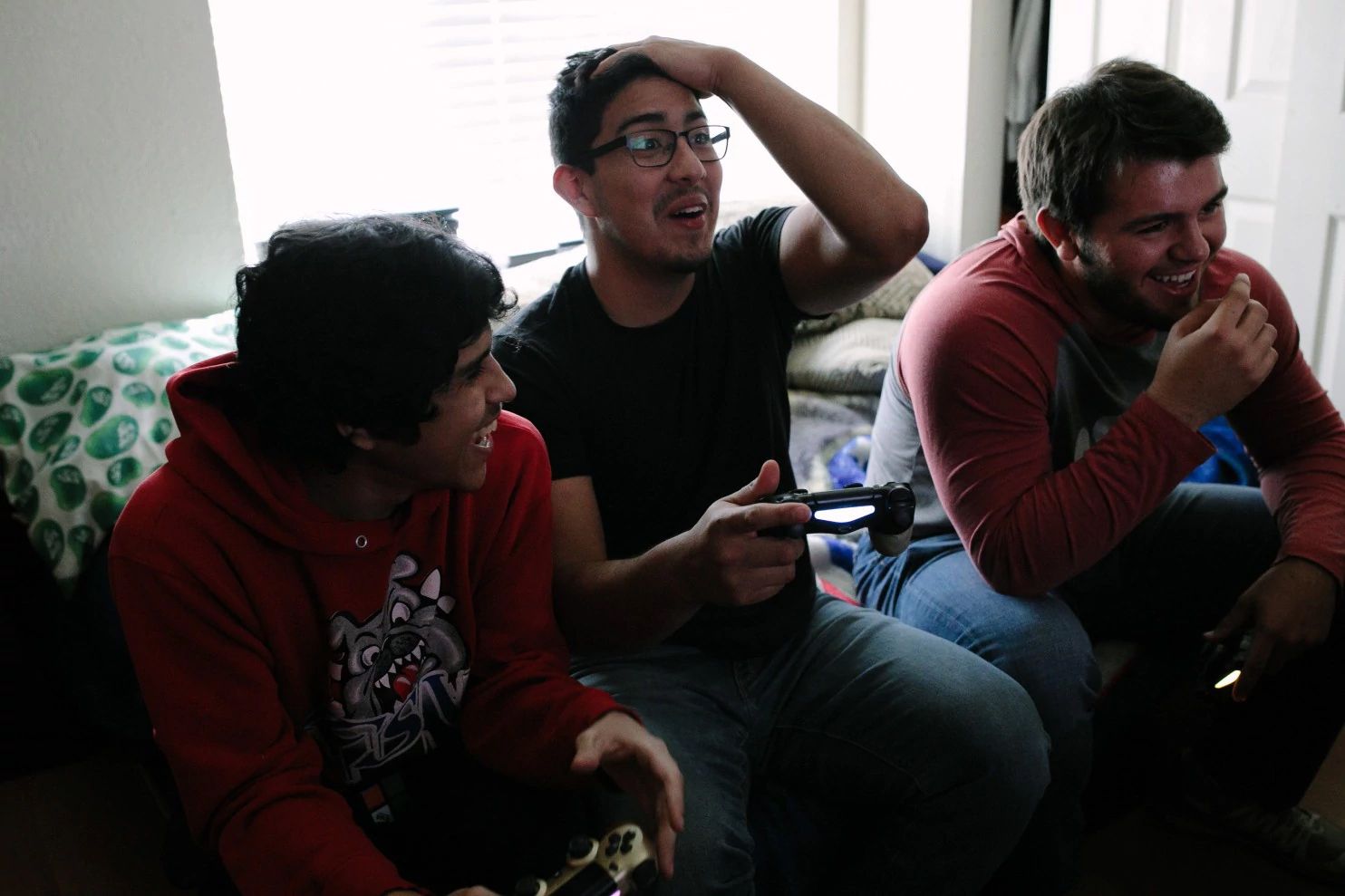
Octavio Sosa, Riggie Medina, and Nick Echeveste play Gang Beasts on PlayStation 4 at their friend’s house in Firebaugh, Calif. The group of friends have been meeting up on Saturdays for last five months to play video games together. (Mason Trinca/For The Washington Post)
Christian Alaniz and Nick Echeveste give each other fist pumps as Riggie Medina walks to their cars after finishing lunch. (Mason Trinca/For The Washington Post)
Three Dallas fans amid a live audience cheer on the Fuel during the first day of the Overwatch League in January. (Noah Smith/Noah Smith/for The Washington Post)
Christian Alaniz and Nick Echeveste give each other fist pumps as Riggie Medina walks to their cars after finishing lunch. (Mason Trinca/For The Washington Post)
Three Dallas fans amid a live audience cheer on the Fuel during the first day of the Overwatch League in January. (Noah Smith/Noah Smith/for The Washington Post)
Octavio Sosa, Riggie Medina, and Nick Echeveste play Gang Beasts on PlayStation 4 at their friend’s house in Firebaugh, Calif. The group of friends have been meeting up on Saturdays for last five months to play video games together. (Mason Trinca/For The Washington Post)