






Supermoon, blue moon and lunar eclipse all coming to a sky near you this week
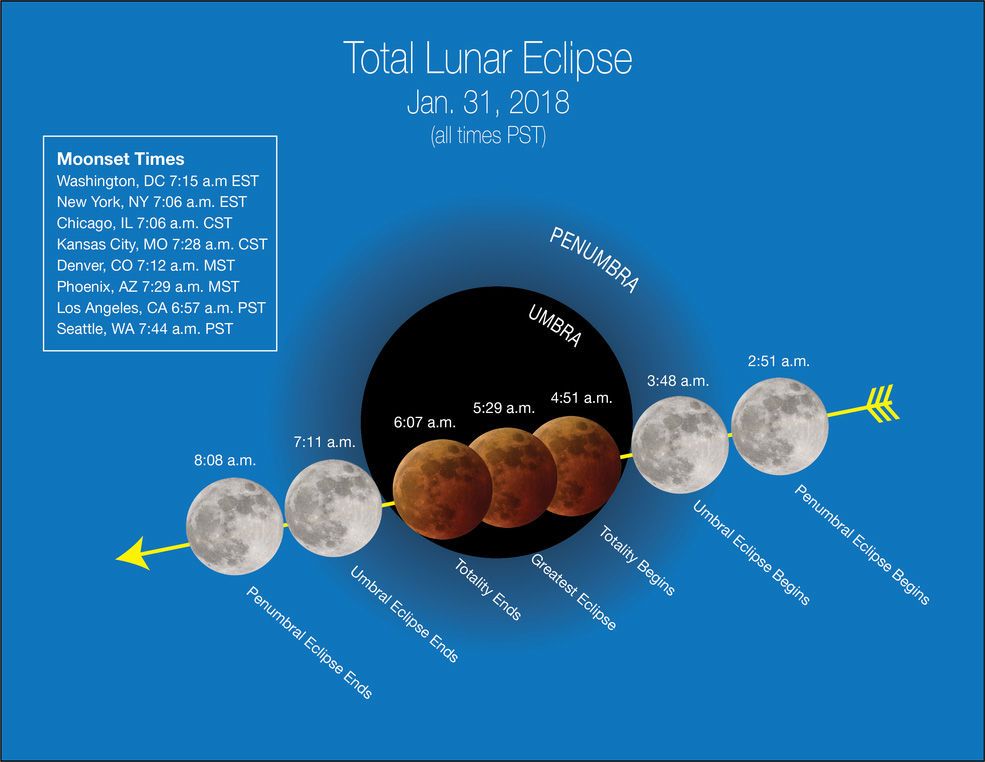
Skywatchers will get a rare triple treat early this Wednesday, Jan. 31: a supermoon, a blue moon and a total lunar eclipse.
How rare is the event? Even without the supermoon, it’s the first blue moon total lunar eclipse in the U.S. since March 1866, less than a year after the Civil War ended, according to EarthSky.org.
A blue moon — which occurs about every 2½ years — is another term for the second full moon in a single calendar month. January’s first full moon occurred Jan. 1.
“These three lunar events separately are not uncommon, but it is rare for all three to occur at the same time,” AccuWeather meteorologist and astronomy blogger Brian Lada said.
In the Rocky Mountain region, the show begins as the umbra touches the edge of the Moon at 4:48 a.m. MST. The peak of the blood moon eclipse is at about 6:30 a.m. local time, and the Moon will set shortly after 7 a.m.
The moon takes on a reddish tint as it hangs over the Air Force Academy Cadet Chapel in Colorado Springs, Colo. during a total lunar eclipse Sunday night, September 27, 2015. The eclipse occurs when the earth is positioned between the sun and the moon and the hue gives it the name blood moon. Sunday night’s eclipse occurred at a time when the moon was near it’s closest point to the earth. This combination of a supermoon and blood moon hasn’t occurred for 30 years and won’t occur again until 2033. Photo by Mark Reis, The Gazette
(AP file)
Hikers watch the moon rise from atop Pulpit Rock Sunday evening, November 13, 2016. The overnight âsupermoonâ was especially âsuperâ because itâs the closest full moon to Earth since 1948. The moon wonât be this close to the earth again until 2034. The moonâs orbit around Earth is slightly elliptical so sometimes it is closer and sometimes itâs farther away. When the moon is full as it makes its closest pass to Earth it is known as a supermoon. Photo by Mark Reis, The Gazette
The rare supermoon eclipse took place over the Garden of the Gods park in Colorado Springs, Colorado on Sunday, September 27, 2015. Photo by Daniel Owen.
The moon takes on a reddish tint as it hangs over the Air Force Academy Cadet Chapel in Colorado Springs, Colo. during a total lunar eclipse Sunday night, September 27, 2015. The eclipse occurs when the earth is positioned between the sun and the moon and the hue gives it the name blood moon. Sunday night’s eclipse occurred at a time when the moon was near it’s closest point to the earth. This combination of a supermoon and blood moon hasn’t occurred for 30 years and won’t occur again until 2033. Photo by Mark Reis, The Gazette
(AP file)
Hikers watch the moon rise from atop Pulpit Rock Sunday evening, November 13, 2016. The overnight âsupermoonâ was especially âsuperâ because itâs the closest full moon to Earth since 1948. The moon wonât be this close to the earth again until 2034. The moonâs orbit around Earth is slightly elliptical so sometimes it is closer and sometimes itâs farther away. When the moon is full as it makes its closest pass to Earth it is known as a supermoon. Photo by Mark Reis, The Gazette
The rare supermoon eclipse took place over the Garden of the Gods park in Colorado Springs, Colorado on Sunday, September 27, 2015. Photo by Daniel Owen.