






AFA cadets, faculty recognized for ‘outstanding’ research
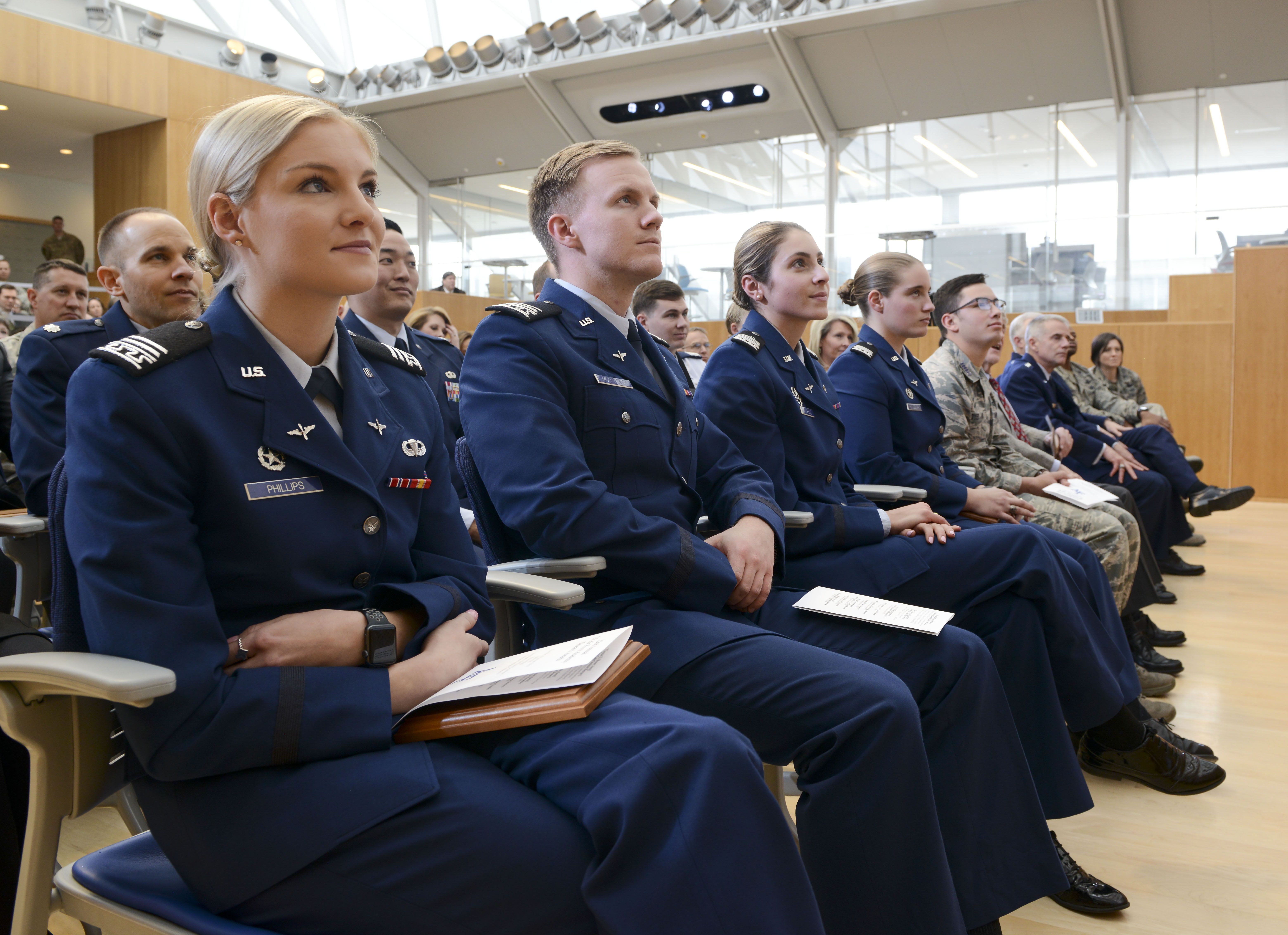
Air Force Academy cadets and faculty received awards last week for “outstanding” research conducted throughout the past year.
The 22nd Annual U.S. Air Force Academy Research Awards was kicked off by academy Superintendent Lt. Gen. Jay Silveria.
“What a great opportunity for us to recognize the innovation and creation that goes on here,” he said to a crowd at the Academy’s Polaris Hall.
Silveria spoke of the “increasingly complex” nature of modern warfare, saying that the research conducted at the academy prepares cadets. “Our second lieutenants are going out into that complex battlefield,” he said.
The awards covered several academic disciplines: basic sciences, engineering, humanities and social sciences. Both faculty and cadets were presented various awards, with the cadet recipients selected by academy professors from a pool of roughly 25 submitted projects.
The work done by cadets was often more than just theory.
Cadet Molly Phillips, a senior from Texas, spent last summer working at the Defense Intelligence Agency in Washington, D.C.
She had to quickly apply for a top-secret clearance, which barely came through in time. “I spent the first couple of days just sitting around the office, waiting,” she laughed.
But once she got to work, she excelled. Over six weeks, she investigated a secret weapons project in an “adversary nation.”
By the end of her time there, she had uncovered a university in that country that was being used as a research institution for weapon development. She also linked more than 650 employees and researchers to that institute.
“It was a lot to take in. It was kind of like a firehose of information.”
The information produced by Phillips is still being used by the nation’s intelligence community. The real-world impact of her research is why academy leadership spends $50 million annually on cadet research programs.
“The maturity and complexity of cadet research has changed since I did my research,” said Col. Gary Packard, who graduated from the Air Force Academy. “We are developing those very important critical thinking skills our officers need to have to fight the 21st-century warfare.” Lt. Gen. John Thompson, commander of the Space and Missiles Systems Center, spoke about specific challenges faced by the Air Force. He told the crowd that the Air Force is playing “catch-up” to its enemies when it comes to space and cyber capabilities.
“The quality of the research I need to play that catch-up needs to be A-plus-plus,” he told the cadets.
Cadet Molly Phillips, left, received the Thomas D. Moore Award for Outstanding Cadet Summer Research at an Air Force Academy event last week. Her award was for her work with the Defense Intelligence Agency where she helped discover a research university being used to develop a new weapon system in a foreign country. Her work linked several hundred employees and students to the institute and she sent 8 reports out to the intelligence community throughout the summer. (Air Force Photo)
Cadet Molly Phillips, left, received the Thomas D. Moore Award for Outstanding Cadet Summer Research at an Air Force Academy event last week. Her award was for her work with the Defense Intelligence Agency where she helped discover a research university being used to develop a new weapon system in a foreign country. Her work linked several hundred employees and students to the institute and she sent 8 reports out to the intelligence community throughout the summer. (Air Force Photo)