






‘BALLISTIC MISSILE THREAT INBOUND TO HAWAII,’ the alert screamed. It was a false alarm.
HONOLULU — A push alert that warned of ballistic missile heading straight for Hawaii and sent residents into a full-blown panic Saturday was a mistake, state emergency officials said.
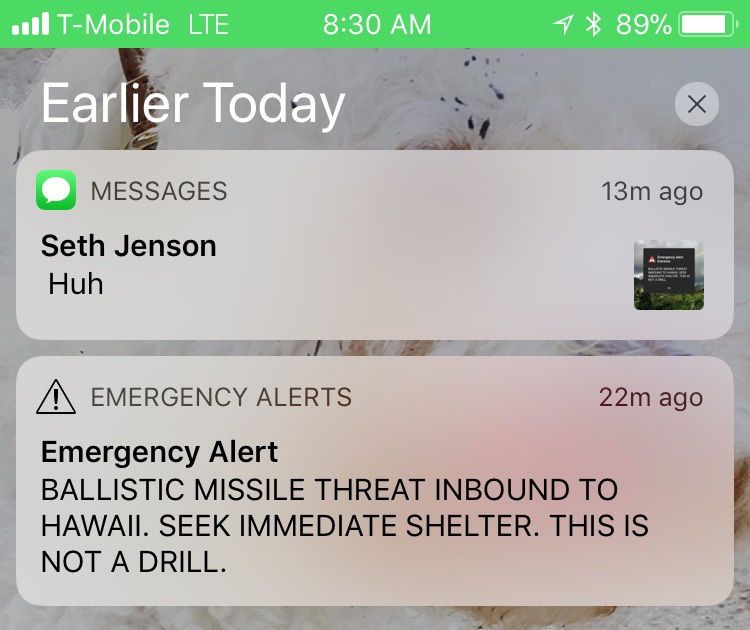
The emergency alert, which was sent to cellphones shortly after 8 a.m, said in all caps, “Ballistic missile threat inbound to Hawaii. Seek immediate shelter. This is not a drill.”
Hawaii Emergency Management Agency spokesman Richard Repoza said it was a false alarm and the agency is trying to determine what happened.
Hawaii falls under U.S. Pacific Command for missile warning, which said there was never a missile threat Saturday.
“Officials said the message was sent in error and that state officials would send out a correction message,” the command said in a news release Saturday. “The Hawaii Emergency Management Agency tweeted at 8:20 local time that no missile threat existed.”
Warning for actual missile attacks around the globe comes from a combination of Colorado Springs military units.
In Colorado Springs, the 21st Space Wing at Peterson Air Force Base tracks missiles using a network of radars around the planet.
Air Force Space Command at Peterson operates two different satellite constellations that search the planet for infrared signatures that show a missile launch.
Also at Peterson, U.S. Northern Command and North American Aerospace Defense Command compile missile warning data and provide launch information to the White House and Pentagon.
Peterson’s Army Space and Missile Defense Command tracks enemy missiles and uses interceptors in Alaska and California to take them out.
The alert caused a tizzy on the island and across social media.
At the PGA Tour event on Oahu, Waialae Country Club was largely empty and players were still a few hours from arriving. The tournament staff urged the media center to evacuate. “This is not a drill,” said Candice Kraughto, who runs the press operations for the Sony Open.
A local radio show from the clubhouse, next to glass windows that overlook the Pacific, kept broadcasting. Staff members at the club streamed into the clubhouse and tried to seek cover in the locker room, which was filled with the players’ golf bags, but instead went into the kitchen.
Several players took to Twitter.
“Just woke up here in Hawaii to this lovely text. Somebody can verify this?” tweeted Emiliano Grillo of Argentina.
Justin Thomas, the PGA Tour player of the year, tweeted, “To all that just received the warning along with me this morning … apparently it was a ‘mistake’?? hell of a mistake!! Haha glad to know we’ll all be safe.”
Jaime Malapit, owner of a Honolulu hair salon, texted his clients that he was cancelling their appointments and was closing his shop for the day. He said he was still in bed when the phone started going off “like crazy.” He thought it was a tsunami warning at first.
“I woke up and saw missile warning and thought no way. I thought ‘No, this is not happening today,'” Malapit said.
He was still “a little freaked out” and feeling paranoid even after hearing it was a false alarm.
Richard Ing, a Honolulu attorney, was doing a construction project at home when his wife told him about the alert.
He dug his phone out and had confirmed he had the same alert. Attempts to find further information on the television or radio didn’t provide further information, but then he saw on Twitter that it was a false alarm.
While he was trying to confirm, his wife and children were preparing to evacuate in case they needed to move to safer ground.
After finding out it was a mistake, Ing tried to find some humor in the situation.
“I thought to myself, it must be someone’s last day at work or someone got extremely upset at a superior and basically did this as a practical joke,’ he said. “But I think it’s a very serious problem if it wasn’t that, or even it was, it shows that we have problems in the system that can cause major disruption and panic and anxiety among people in Hawaii.”
Some were outraged that such an alert could go out in error.
Hawaii U.S. Sen. Brian Schatz tweeted the false alarm was “totally inexcusable” and was caused by human error.
“There needs to be tough and quick accountability and a fixed process,” he wrote.
___
The nGazette’s Tom Roeder contributed to this report.
Associated Press writers Caleb Jones in Honolulu, Doug Ferguson in Maui, Mark Thiessen in Anchorage, Jim Anderson in Denver and Tom Strong in Washington contributed to this report.
This smartphone screen capture shows a false incoming ballistic missile emergency alert sent from the Hawaii Emergency Management Agency system on Saturday, Jan. 13, 2018. (AP Photo/Marco Garcia)
Richard Ing, a Honolulu attorney, is photographed as he joked it was probably someone’s last day on the job Saturday, Jan. 13, 2018, when Hawaii emergency management officials mistakenly sent an alert that a ballistic missile was inbound to Hawaii. His wife told him about the alert while he was doing a construction project at his Honolulu home. (AP Photo/Jennifer Sinco Kelleher)
This smartphone screen capture shows a false incoming ballistic missile emergency alert sent from the Hawaii Emergency Management Agency system on Saturday, Jan. 13, 2018. (AP Photo/Jennifer Kelleher)
This smartphone screen capture shows a false incoming ballistic missile emergency alert sent from the Hawaii Emergency Management Agency system on Saturday, Jan. 13, 2018. (AP Photo/Marco Garcia)
Richard Ing, a Honolulu attorney, is photographed as he joked it was probably someone’s last day on the job Saturday, Jan. 13, 2018, when Hawaii emergency management officials mistakenly sent an alert that a ballistic missile was inbound to Hawaii. His wife told him about the alert while he was doing a construction project at his Honolulu home. (AP Photo/Jennifer Sinco Kelleher)
This smartphone screen capture shows a false incoming ballistic missile emergency alert sent from the Hawaii Emergency Management Agency system on Saturday, Jan. 13, 2018. (AP Photo/Jennifer Kelleher)