






Colorado Springs weather balloon with tiny payload sails toward Atlantic storm
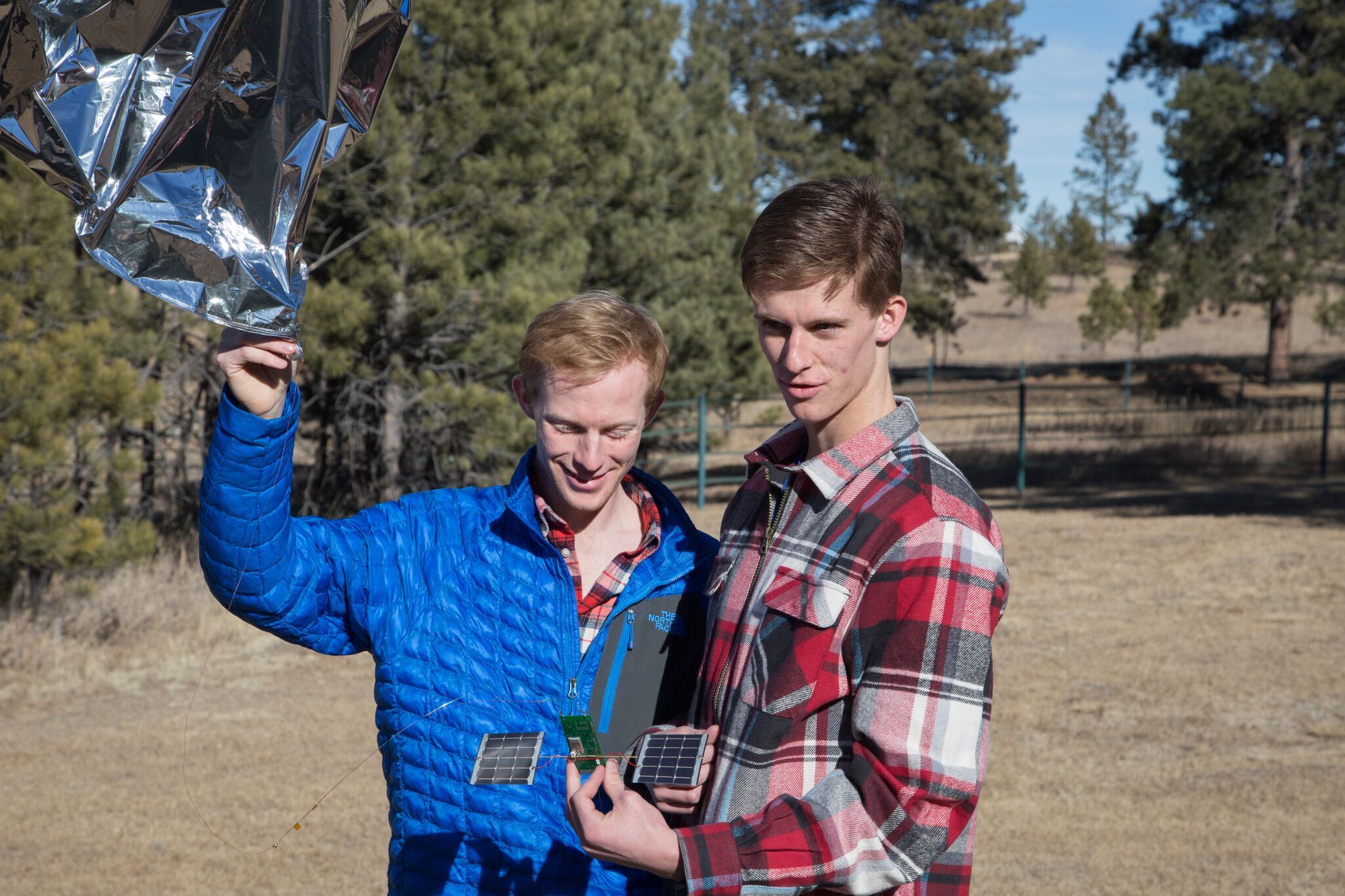
Shepherd Kruse woke up New Year’s Day to mild winds and sunny skies, perfect weather to launch a weather balloon with a mission to circumnavigate the world.
The Colorado Springs native is no stranger to weather balloons, having launched several before. Most have been for science fairs and national competitions, but this balloon wasn’t launched for an award, only to satisfy personal curiosity.
“It is pretty much a party balloon,” he laughed. “A little bigger than your normal one. But it’s made of the same thing.”
He explained that this balloon is made of Mylar and is just large enough to carry its fifteen-gram payload, the same weight as two quarters.
The payload is a Kruse creation. Resembling a miniature satellite, the assembly consists of two minuscule solar panels and a central circuit board. The largest component on the board is the Global Positioning System chip, and the whole device is powered by a miniaturized capacitor.
The balloon is designed – by its size and payload weight – to reach a cruising altitude of 28,000 feet and travel with the jet stream, blown east at an average wind speed of 110 mph.
“I’d say the hardest thing to overcome was the fifteen-gram limit on the payload,” Kruse said.
That payload is currently hanging by fishing line attached to the weather balloon as it zips closer to the winter storm buffeting the East Coast.
“Hopefully it makes it over the Atlantic Ocean,” said Kruse. “I’m amazed the journey it has been on so far.”
The balloon is tracked by radio signal that it can only emit during the day with its solar power. That makes nighttime a little restless for Kruse.
As the balloon was propelled east by the jet stream on New Year’s Day the sun dipped below the western horizon. And as the radio transmitter fell silent, the balloon hit a storm system somewhere over the Central Plains.
Tuesday morning brought anxiety as Kruse waited for the balloon to pop back up on his screen.
“I waited for five hours,” he said. “And then it pops up in Oklahoma. “
Since then, Kruse has tracked the balloon as it sailed over the Gulf of Mexico, cruised along the Florida Peninsula, and made its way towards the ominous gray clouds of a winter storm.
The bumps along the way don’t phase Kruse. He traced wind patterns on a map, pointing to the Alps of northern Italy. “I really hope it gets there,” he said.
Even if the balloon founders in the Atlantic and falls silent for good, Kruse is optimistic, “Doing something new like this opens up my eyes to what is possible.”
When asked how he discovered a passion in weather balloons and engineering, he didn’t hesitate. “My mom has done a fascinating job finding out what we are interested in,” He said.
Kruse and his eight siblings have been home-schooled and raised by their mother, Tamara. Four of her children have won Colorado Springs Best and Brightest awards, including Shepherd.
“I was super interested in engineering, so she got me into science fairs,” he said. “She is amazing.”
Shepherd Kruse, right, and his brother prepare to launch the weather balloon on New Years Day. (Provided by Shepherd Kruse)
The weather balloon payload weighs fifteen grams. The two solar panels power a GPS device, radio transmitter, and various other functions on the circuit board. (Provided by Shepherd Kruse)
The weather balloon payload weighs fifteen grams. The two solar panels power a GPS device, radio transmitter, and various other functions on the circuit board. (Provided by Shepherd Kruse)
Shepherd Kruse, right, and his brother prepare to launch the weather balloon on New Years Day. (Provided by Shepherd Kruse)