






Analysis: Millennials aren’t killing stable employment
If millennials hop jobs, baby boomers are supposed to hang on to them, steadily climbing the ladder at the same company – or so conventional thinking goes.
Reality is more complicated. A new report from the Bureau of Labor Statistics suggests the older generation wasn’t that much more rooted than the younger one.
People born between 1957 and 1964, the later end of the baby boom, held an average of 11.9 jobs from age 18 to age 50, according to the government data. That adds up to one job every three years.
A closer look at when they switched employers most often packs another revelation. The baby boomers made about half the job changes from 18 to 24 – quitting an average of one job per year.
Heidi Shierholz, senior economist and director of policy at the Economic Policy Institute, a left-leaning think tank, said that doesn’t mean every young American is a fleeting hire. At the start of their careers, people are figuring out what they like and what they’re good at, she said. And in a healthy economy, a job change generally leads to higher wages.
“There is this narrative that millennials are jumping around a lot,” she said. “But moving around at the beginning of your career is not a new story. There’s more turnover than most people realize in the day-to-day labor market.”
The BLS hasn’t released comparable numbers on how often millennials – those born between 1982 and 2000, per the Census Bureau definition – quit jobs for new ones. The boomer intel is from a national longitudinal survey, stretching back decades.
Researchers haven’t been able to keep such tabs on millennials, the youngest of whom are 17. The government tracks the number of workers quitting each month (2.1 percent of the labor force in June), but those figures don’t account for characteristics like gender or age.
The Census Bureau’s Current Population Survey, however, opens a window into how employed millennials stack up against Generation Xers, who were born between 1965 and 1984.
Last year, according to the most recent data, 63.4 percent of millennials with jobs reported that they had worked for their employer for at least 13 months. In 2000, for comparison, 60 percent of similarly aged workers, mostly Gen Xers, had lasted that long.
When it came to longer tenures, 22 percent of millennials in 2016 said they’d been with their company for five years – which roughly matched the share of young people answering the same question in 2000.
It’s still true that older workers, on average, have stuck around longer at their current workplaces than younger ones. But there’s nothing that proves the employment patterns of millennials won’t shift into something that resembles stability.
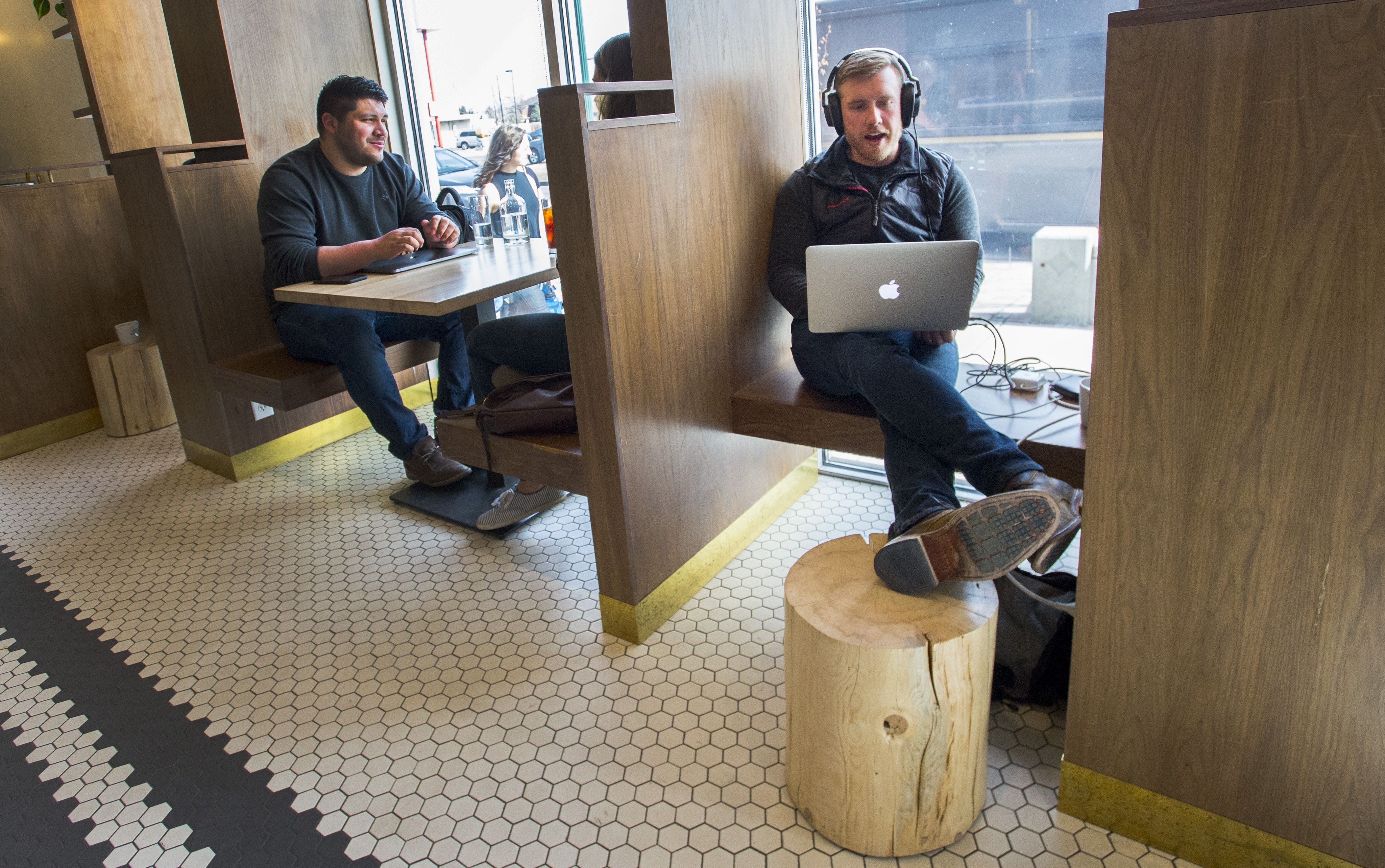
Cameron Kenney, 29, right, works from his computer Thursday, Feb. 9, 2017, at Loyal Coffee in Downtown Colorado Springs. Gov. John Hickenlooper in his State of the State address said that Colorado is one of the top destination for Millennials after graduating from College. Kenney recently moved to Colorado Springs when his wife started working at Young Life. (The Gazette, Christian Murdock)
Cameron Kenney, 29, right, works from his computer Thursday, Feb. 9, 2017, at Loyal Coffee in Downtown Colorado Springs. Gov. John Hickenlooper in his State of the State address said that Colorado is one of the top destination for Millennials after graduating from College. Kenney recently moved to Colorado Springs when his wife started working at Young Life. (The Gazette, Christian Murdock)