






Muslim worshipers confront police as Israel maintains metal detectors at holy site
JERUSALEM -Thousands of Muslim worshipers held prayer services at noon Friday outside the gates of Jerusalem’s Old City after being denied entry to the al-Aqsa Mosque, or refusing to enter in protest, as tensions mounted after the Israeli government decided to keep in place controversial security arrangements at the entrance to the sensitive holy site.
Israeli police units were deployed in the area keeping a watchful eye on the growing crowds, and military units were on standby for any violence after the prayers. Police restricted entry to the site for the first time in three years, allowing men over 50 to enter, as well as all women, and requiring worshipers to pass through newly installed metal detectors.
Israeli police said hundreds of people passed through the metal detectors to pray in the mosque, but there were still thousands who rejected Israeli security measures, praying instead outside the police barricades in protest.
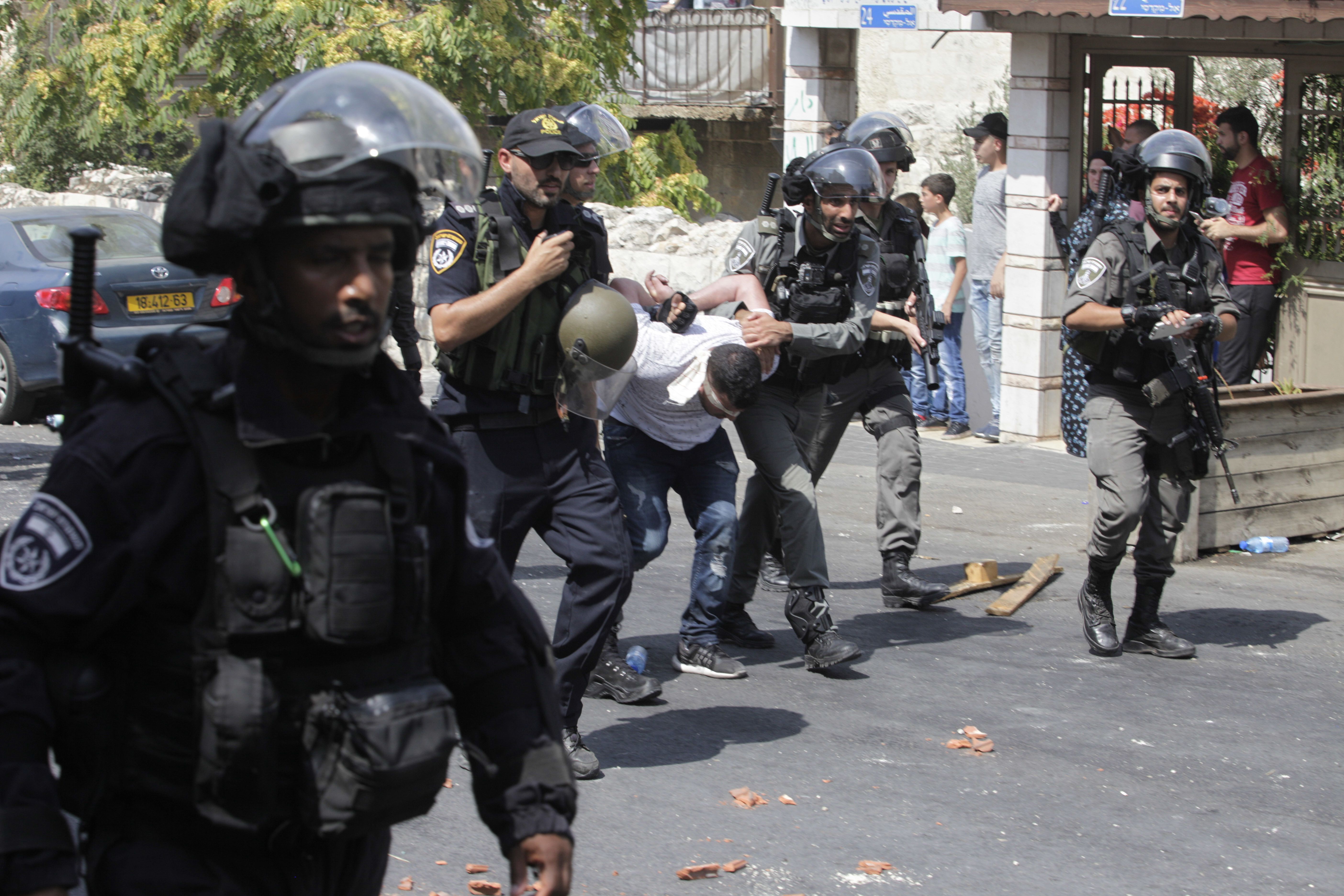
While most of the worshipers left the area after the prayers, there were reports of unrest, with Israeli police using water cannons and tear gas to disperse crowds.
The heightened security measures were put in place Sunday after an attack last Friday in which two Israeli police officers were fatally shot by three Palestinian Israeli gunmen. The gunmen, who police say came from inside the holy complex, were killed in a shootout with police.
Earlier in the week, Muslim spiritual leaders called on their followers to descend on the mosque Friday, the Muslim holy day, in a form of protest over the metal detectors that have been installed as part of the new security arrangements. Muslims believe the metal detectors are an attempt by Israel to impose sovereignty at the site.
One of those who gathered Friday, Jamal Hassan, 58, a religious leader from Qalqilya in the West Bank, said the worshipers were united. “We will not use their metal detectors,” he said. “This is our place of worship, not theirs.”
Jowad Dibis, 50, from the Shuafat Palestinian refugee camp in East Jerusalem, voiced suspicion of Israel’s motives. “This is all part of the Israeli plan,” he said. “Little by little, they want to take al-Aqsa and put up their temple.”
Asked whether the metal detectors help ensure the worshipers’ safety, as at the mosque complex in the Muslim holy city of Mecca in Saudi Arabia, Dibis replied: “Mecca is completely different. That is Saudis for Saudis. Saudia Arabia protecting Muslims. This is an occupation. A big difference. You think they want to protect us? Everything is about controlling us.”
The al-Aqsa holy site here is revered by both Muslims and Jews.
For Muslims, who refer to it as the Haram al-Sharif, it is the spot where the prophet Muhammad is said to have started his night journey to Mecca. Al-Aqsa is Islam’s third-holiest site after Mecca and Medina.
Jews refer to the site as the Temple Mount. It is Judaism’s holiest site, said to contain the foundation stone of the world’s creation and be the place Abraham was instructed by God to sacrifice his son, Isaac. It was also once the site of two Jewish temples.
Israel and Jordan share responsibility for running the site under a complicated status quo agreement that has been in place for decades. Any change to that agreement – by either side – is seen as a provocation. Under the arrangement, Muslims are allowed to enter and pray freely, while Jews and other visitors can go inside but are forbidden from praying there.
Jordan and other Sunni-Muslim states had pressured Israel this week to remove the metal detectors and ease the new security measures, fearing a flare-up of violence. The White House released a statement Thursday expressing concern over the rising tensions in the city.
Prime Minister Benjamin Netanyahu met late Thursday with senior ministers and representatives from the Israeli police, the army and the internal security service to decide whether to leave the metal detectors in place or find alternative security measures.
The Israeli army and the internal security service have advocated removing the metal detectors, but the Israeli police and Internal Security Minister Gilad Erdan, who is responsible for the police, have pushed to leave the measures in place.
“Israel is committed to maintaining status quo and freedom of access at the holy sites. Israel is also committed to protecting the safety of all worshipers and visitors,” a statement released by the government following the meeting read.
“The Cabinet has authorized the police to make every decision in order to ensure free access to the holy places while maintaining security and public order,” said the statement.
Israeli-Arab Knesset member Jamal Zahalka said the decision to transfer the matter to the Israeli police was a sham. Palestinians rejected any proposal that did not include removing the metal detectors and demanded the security situation be restored to its previous state.
Israeli police spokesman Micky Rosenfeld said that heightened security was in place in and around the Old City of Jerusalem on Friday and that additional units have been mobilized to respond to any disturbances.
Clashes broke out Thursday night near the complex between Muslim protesters and police. Dozens of Palestinians were injured in the violence when Israeli police used riot dispersal methods. At least five officers received medical attention, according to media reports.
After last Friday’s attack, the compound was shut down by Israeli police as they swept the site for more weapons and tried to understand how such an assault could have happened. It was the first time that Muslim worshipers were not able to enter the site since 1969.
The site was reopened Sunday, but only with heightened security measures, including the metal detectors.
In a protest against the new security arrangements, the Waqf, or Islamic trust that runs the site day to day, instructed Muslim worshipers not to enter. Clashes between Muslim protesters and Israeli police have taken place just outside the gates of the compound throughout the week.
Ibrahim Awadallah, deputy minister of the Waqf committee in Jerusalem, said Thursday that Israel had implemented the new arrangements “in order to prevent people from worshiping.”
“We are not talking about a supermarket or a nightclub or an airport where you need an electric gate. The number of worshipers who come to al-Aqsa is huge. Metal detectors will delay them, not to mention humiliate them,” he said.
Awadallah said Muslims fear Israel plans to divide the compound and give part of it to Jewish worshipers. Some senior Israeli ministers and political leaders have broached such a prospect in the past.
Israeli minister Erdan told The Washington Post on Thursday that the measures were implemented purely for security reasons and to prevent copycat attacks.
“Many, many mosques around the world have exactly the same security checks, and many use metal detectors. Any protest over this is really an issue over who has sovereignty at the Temple Mount,” he said.
—
The Washington Post’s Sufian Taha contributed to this report.
Israeli border police officers detain a Palestinian during clashes in Jerusalem, Friday, July 21, 2017. Israel police severely restricted Muslim access to a contested shrine in Jerusalem’s Old City on Friday to prevent protests over the installation of metal detectors at the holy site. (AP Photo/Mahmoud Illean)
Israeli border police officers detain a Palestinian during clashes in Jerusalem, Friday, July 21, 2017. Israel police severely restricted Muslim access to a contested shrine in Jerusalem’s Old City on Friday to prevent protests over the installation of metal detectors at the holy site. (AP Photo/Mahmoud Illean)
Israeli border police officers detain a Palestinian during clashes in Jerusalem, Friday, July 21, 2017. Israel police severely restricted Muslim access to a contested shrine in Jerusalem’s Old City on Friday to prevent protests over the installation of metal detectors at the holy site. (AP Photo/Mahmoud Illean)
Israeli border police officers detain a Palestinian during clashes in Jerusalem, Friday, July 21, 2017. Israel police severely restricted Muslim access to a contested shrine in Jerusalem’s Old City on Friday to prevent protests over the installation of metal detectors at the holy site. (AP Photo/Mahmoud Illean)