






Americans united when it comes to saying grace
OMRO, Wis. – One by one, the Weiss family rounded up the nine grandchildren, who had been running circles around the barns. They gathered under a towering maple tree, around a table laden with barbecue meatballs and French silk pie, and grabbed one another’s hands.
“We ask your blessing on the meal we’re about to eat,” said David Weiss, 75, head bowed under his camouflage hat.
“Amen,” his family responded in a quintessential display of one of America’s most enduring religious traditions.
About half of all Americans take a minute to pray over their food at least a few times a week, says a poll by The Washington Post and the Kaiser Family Foundation.
That makes grace an unusual commonality in a politically divided nation.
Rural and urban Americans are equally likely to say grace, says the poll, with a margin of error of plus or minus 4 percentage points. Northerners and Southerners, Catholics and Protestants, Democrats and Republicans, all say grace to varying degrees. Even some Americans who reject religion still say grace.
“It’s a powerful way of reminding yourself that you are not self-sufficient, that you are living by somebody’s grace, that plenty of other people who work just as hard as you don’t have anything to eat,” said Tim Keller, a prominent New York City pastor who wrote a book on prayer.
Keller said the physical act of bowing heads, closing eyes and folding hands is an important exercise in gratitude for people of many faiths, from childhood on up.
That’s true for the Weisses, evangelical Protestants who gathered on their 77-acre farm in Wisconsin. Silvie Weiss, 11, called grace “a peaceful moment to get away from the world.” Her aunt Becky Sell, 36, said it gives her a moment “where I am intentional about honoring and acknowledging what God has done for us.”
In the Post-Kaiser poll, conducted April 13 to May 1 among a random sample of 1,686 adults, 48 percent say they give blessings to God or say grace before meals at least a few times each week. Slim 51 percent majorities say grace in rural and urban America; in the suburbs, 45 percent say grace regularly.
The partisan split is larger: 62 percent of Republicans say grace at least a few times a week, compared with 43 percent of Democrats and 41 percent of independents.
There’s a religious split as well: Six in 10 Protestants say grace a few times a week or more, as do 52 percent of Catholics. But the practice is more prevalent among black Protestants (80 percent) and white evangelical Protestants (74 percent) than among white mainline or nonevangelical Protestants, 31 percent of whom report saying grace frequently.
Overall, about 8 in 10 blacks, 6 in 10 Hispanics and 4 in 10 whites say grace at least a few times a week.
Grace the ‘good part of being religious’
Grace connects Lynn Thompson, 64, to God even when she’s not well enough to make it to her Arkansas Baptist church. She and her husband take turns leading the prayer.
“I say, ‘Lord, I thank You for one more day, for waking me up this morning, for giving me the health that I have, whatever it may be,'” Thompson said.
Even 11 percent of self-avowed atheists and agnostics, plus adherents of no particular religion, say grace at least a few times a week.
Greg Epstein, a humanist chaplain at Harvard University, asks someone to say a blessing when he hosts nonreligious students for dinner. Some bristle, he said, but Epstein believes in the act of gratitude.
“Why do we have to give up the good parts of being religious – including the mindfulness, the reflection that comes from a ritual like grace – just because we don’t believe in the traditional wording of the poem that people recite when they sit down to a meal?” Epstein asked.
Stuart H., 32, of Las Cruces, N.M., grew up Catholic but later became an atheist. His fiancee followed a similar trajectory, and as young adults both became addicted to heroin.
When they learned she was pregnant, they committed to get clean, said Stuart. The couple began meditating and decided to start saying grace again. But what to say? A Native American man taught him to thank the spirits for his food.
Now Stuart and his fiancee pray with their daughter to the spirits of the earth for fruits and vegetables, to the spirits of “the four-legged ones” for beef and “the winged ones” for chicken.
In Portales, N.M., 300 miles away, Carl Smith, 31, said he “stopped going to church. I don’t like organized hypocrisy.” But saying grace is “a habit thing.”
Smith, who answers emergency calls for 911, often prays for the desperate callers.
“I say, ‘Hey, God, this is what’s going on. If you could get some help in this direction, or help me understand why this is going on, I’d greatly appreciate it.’ “
Grace cuts across incomes, cultures
Grace is also traditional in Islam, Hinduism and Bahai.
Clergy and theologians say the association between food and prayer exists in nearly every religious culture. Christian author Anne Lamott said she added grace to her spiritual practice after a long struggle with bulimia. “Grace adds something that is beautiful and very sweet and healing,” she said.
Many people say they started saying grace once they had children, to teach them to pray. While 40 percent of Americans younger than 35 say grace, at least half of all older age groups say grace regularly.
When it comes to income, 51 percent of those in households making $50,000 or less annually say grace often, compared with 44 percent of those making more than $50,000.
Anne-Marie Dole, 56, has been saying the same Catholic grace since she was a child. When she recites it for a stranger, she chokes up.
“Bless us, O Lord, and these thy gifts – I can’t do it,” she said, breaking down in tears. “I’m just saying thank you to God to have food at all. You know, it’s a horrible thing to go hungry.”
Once a horse breeder and trainer, Dole was permanently disabled in a car crash. She needs more surgeries and a new wheelchair, and she said she just broke up with another boyfriend who hit her. Going hungry is a familiar pain.
Sitting in her faulty wheelchair in Cortland, N.Y., she’s down to 99 pounds. But she has dinner waiting, one she picked up at church that morning. “It’s a wonderful feeling to be grateful and thankful,” she said.
And so before she eats, Dole will say grace.
–
The Washington Post’s Scott Clement in Washington contributed to this report.
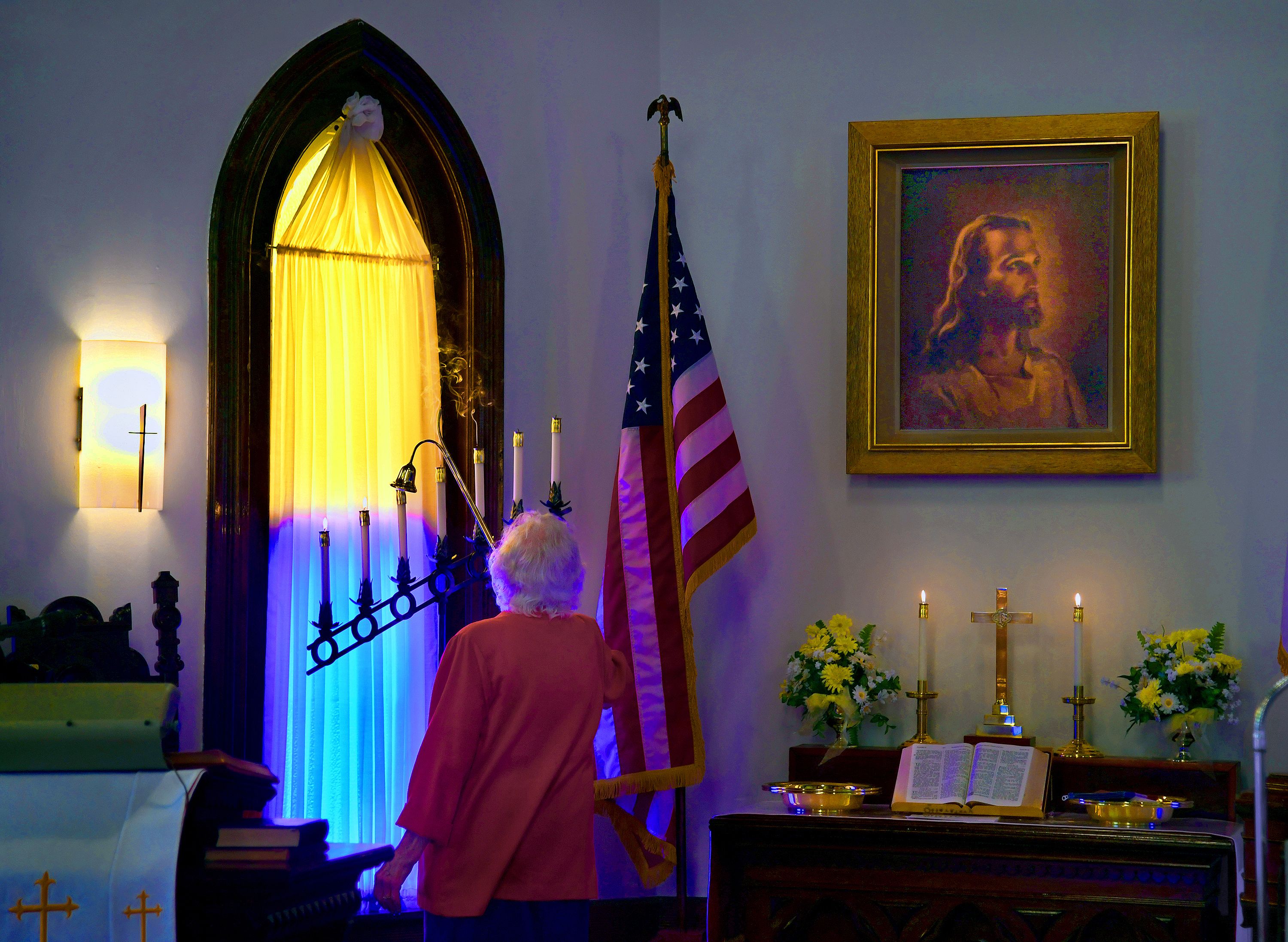
Helen Shrecongost extinguishes the candles after the Sunday service held at The United Church of Christ in South Bend Township, Pa. MUST CREDIT: Washington Post photo by Michael S. Williamson.
The Sell family says a prayer before a recent Sunday dinner in Omro, Wis. MUST CREDIT: Photo for The Washington Post by Lauren Justice
Terri Smith (left), an evangelist at Genesis of Good Samaritans Ministries, holds hands with her husband Pastor Leroy Smith and her granddaughter Yolanda Johnson, 8, as they say grace before eating lunch at the Family Affair Cafe & Catering Company on June 11, 2017 in Groveport, Ohio. MUST CREDIT: Photo for The Washington Post by Ty Wright
Pastor Tyus Nedd, pastor at the International Christian Center, holds his wife’s hand, Patricia Nedd, as they say grace before their Sunday dinner at their home in Columbus, Ohio. MUST CREDIT: Photo for The Washington Post by Ty Wright
Elly Sell, 10, sets the table for dinner in Omro, Wis. MUST CREDIT: Photo for The Washington Post by Lauren Justice
Helen Shrecongost extinguishes the candles after the Sunday service held at The United Church of Christ in South Bend Township, Pa. MUST CREDIT: Washington Post photo by Michael S. Williamson.
The Sell family says a prayer before a recent Sunday dinner in Omro, Wis. MUST CREDIT: Photo for The Washington Post by Lauren Justice
Terri Smith (left), an evangelist at Genesis of Good Samaritans Ministries, holds hands with her husband Pastor Leroy Smith and her granddaughter Yolanda Johnson, 8, as they say grace before eating lunch at the Family Affair Cafe & Catering Company on June 11, 2017 in Groveport, Ohio. MUST CREDIT: Photo for The Washington Post by Ty Wright
Pastor Tyus Nedd, pastor at the International Christian Center, holds his wife’s hand, Patricia Nedd, as they say grace before their Sunday dinner at their home in Columbus, Ohio. MUST CREDIT: Photo for The Washington Post by Ty Wright
Elly Sell, 10, sets the table for dinner in Omro, Wis. MUST CREDIT: Photo for The Washington Post by Lauren Justice