






US: Errant strike killed 18 allied Syrian forces
BEIRUT — A misdirected airstrike by the U.S.-led coalition earlier this week killed 18 allied fighters battling the Islamic State group in northern Syria, the U.S. military said Thursday.
U.S. Central Command said coalition aircraft were given the wrong coordinates by their partner forces, the predominantly-Kurdish Syrian Democratic Forces, for the strike on Tuesday that was intended to target IS militants south of their Tabqa stronghold, near the extremists’ de facto capital, Raqqa. The strike hit an SDF position instead.
Several nations have lent their air power to the U.S.-led coalition to defeat the Islamic State group, and it wasn’t clear which air force was behind the errant strike.
The SDF acknowledged the strike, saying a number of its fighters were killed and wounded. On Thursday, the group held funerals for 17 of its fighters in the border town of Tal al-Abyad, the SDF-linked Hawar news agency said, though it did not say whether they were killed in the friendly fire incident.
An activist-run group, Raqqa is Being Slaughtered Silently, said three days of mourning had been declared for the town. The Britain-based Syrian Observatory for Human Rights said 25 SDF fighters were killed in the last two days of battle.
The SDF, meanwhile, announced the launch of a new phase of its campaign to retake Raqqa. The Kurdish fighters, with U.S.-led air and ground support, have surrounded Tabqa, some 40 kilometers (25 miles) southwest of the city and are working to clear Islamic State militants out of Jalab Valley, north of Raqqa.
The SDF says it wants to isolate Raqqa before attacking it. Its closest position is less than eight kilometers (five miles) northeast of the city. But the countryside south of Raqqa is still under IS control.
Meanwhile, President Bashar Assad said a chemical weapons attack on a rebel-held town in northern Idlib province last week that was widely blamed on his forces was a “fabrication.”
“Our impression is that the West, mainly the United States, is hand-in-glove with the terrorists,” Assad told Agence France-Presse in his first comments since a U.S. missile strike on a Syrian air base in retaliation for the chemical attack.
“They fabricated the whole story in order to have a pretext” to attack the air base, Assad said in the interview, a video of which was released by his office.
In Washington, State Department spokesman Mark Toner called Assad’s comments “an attempt by him to throw up false flags, create confusion.”
“There can be little doubt that the recent attacks and the chemical weapons attack in Idlib was by the Syrian government, by the Syrian regime and that it wasn’t only a violation of the laws of war but it was, we believe, a war crime,” Toner said.
Syria strongly denies it was behind the April 4 chemical attack on the town of Khan Sheikhoun, which killed 87 people, including more than a dozen children. The government says Syrian warplanes struck an al-Qaida arms depot that contained chemical weapons.
The international chemical weapons watchdog is testing samples from the suspected nerve gas attack and could produce a report on the matter within three weeks, the British delegation to the commission said Thursday.
The Organization for the Prohibition of Chemical Weapons has a standing fact-finding mission on Syria to investigate alleged chemical weapons attacks, but does not apportion blame. During a meeting of its executive council called to discuss the Khan Sheikhoun attack, the U.S. ambassador, Kenneth D. Ward, said Syrian authorities “abetted by Russia’s continuing efforts to bury the truth” still possess and use banned chemical weapons.
On Wednesday, Russia vetoed a U.N. Security Council resolution demanding a speedy probe into the Khan Sheikhoun attack. U.S. Ambassador to the U.N. Nikki Haley said the veto left Moscow, a key ally of the Syrian government, with “a lot to prove.”
Meanwhile, preparations were underway for the planned evacuation of more than 10,000 residents from two pro-government Shiite villages in northern Syria, Foua and Kfarya, and the rebel-held towns of Madaya and Zabadani near Damascus.
Dozens of buses entered the areas Wednesday but by late Thursday people had not boarded them, according to opposition activists in the rebel-held towns.
If the evacuations go through, they would be the first in number of rounds stretching over two months to evacuate some 30,000 Syrians from besieged areas, in a deal struck by rebels and the government. It is unclear whether they will ever be able to return to their homes.
Civilians are being given the option to stay, but activists and doctors said it’s too dangerous for medical workers to do so. Since the beginning of the conflict, the government has targeted medical workers with detention, torture, and bombardment.
___
Associated Press writers Sylvia Hui in London and Vladimir Isachenkov in Moscow contributed to this report.
Syria President Bashar al-Assad addresses reporters following his meeting with French President Nicolas Sarkozy at the Elysee Palace in Paris, Thursday Dec. 9, 2010. (AP Photo/Remy de la Mauviniere)
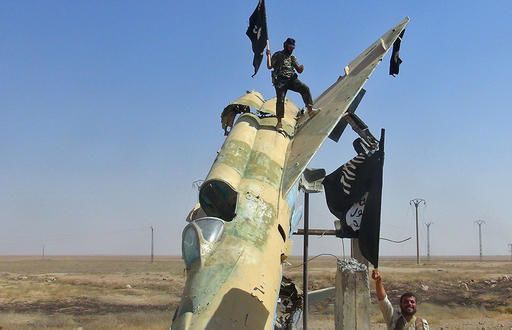
FILE – This undated file image posted by the Raqqa Media Center, in Islamic State group-held territory, on Wednesday, Aug. 27, 2014, which has been verified and is consistent with other AP reporting, fighters of the Islamic State wave the group’s flag from a damaged display of a government fighter jet following the battle for the Tabqa air base, in Raqqa, Syria. A U.S. missile attack on Friday, April 7, 2017 has caused heavy damage to one of Syria’s biggest and most strategic air bases, used to launch warplanes to strike opposition-held areas in central, northern and southern Syria. (Raqqa Media Center via AP, File)
FILE – In this April 20, 2014 file photo, released by the Syrian official news agency SANA, Syrian President Bashar Assad, left, talks to government soldiers during his visit to the Christian village of Maaloula, near Damascus, Syria. U.S. Secretary of State Rex Tillersonâs statement Tuesday, April 11, 2017, that the reign of President Bashar Assadâs family âis coming to an endâ suggests Washington is taking a much more aggressive approach about the Syrian leader. Taking him out of the equation without a clear transition plan would be a major gamble. (SANA via AP, File)
Syria President Bashar al-Assad addresses reporters following his meeting with French President Nicolas Sarkozy at the Elysee Palace in Paris, Thursday Dec. 9, 2010. (AP Photo/Remy de la Mauviniere)
FILE – This undated file image posted by the Raqqa Media Center, in Islamic State group-held territory, on Wednesday, Aug. 27, 2014, which has been verified and is consistent with other AP reporting, fighters of the Islamic State wave the group’s flag from a damaged display of a government fighter jet following the battle for the Tabqa air base, in Raqqa, Syria. A U.S. missile attack on Friday, April 7, 2017 has caused heavy damage to one of Syria’s biggest and most strategic air bases, used to launch warplanes to strike opposition-held areas in central, northern and southern Syria. (Raqqa Media Center via AP, File)
FILE – In this April 20, 2014 file photo, released by the Syrian official news agency SANA, Syrian President Bashar Assad, left, talks to government soldiers during his visit to the Christian village of Maaloula, near Damascus, Syria. U.S. Secretary of State Rex Tillersonâs statement Tuesday, April 11, 2017, that the reign of President Bashar Assadâs family âis coming to an endâ suggests Washington is taking a much more aggressive approach about the Syrian leader. Taking him out of the equation without a clear transition plan would be a major gamble. (SANA via AP, File)