






Westinghouse files for bankruptcy, in a blow to nuclear power industry
WASHINGTON – Westinghouse, one of the most storied names in the nuclear energy business, filed for bankruptcy on Wednesday, dealing a blow to the future of the nuclear power industry and leaving question marks about the future of four reactors currently under construction in the United States.
The filing also brings to an end the marriage of Westinghouse and Toshiba. When the Japanese giant – maker of everything from medical devices to home appliances – bought the Westinghouse nuclear business in October 2006, it declared “the dawn of a new era for nuclear energy.” Together the companies would make a “powerful combination,” Toshiba said.
A decade later, that combination has melted down. Toshiba has written off more than $6 billion in losses connected to its U.S. nuclear business, citing accounting problems, delays and cost overruns. And it has pulled back from new nuclear projects under discussion in India and Britain.
The bankruptcy filing Wednesday will trigger a host of legal questions about whether Toshiba remains responsible for losses at Westinghouse and whether the utilities that own the reactors under construction will have to eat more of the cost of completing them. That could mean higher rates for consumers in those areas. In seeking protection under chapter 11 of the bankruptcy act, Westinghouse could still finish building those plants.
Westinghouse said it has arranged $800 million in debtor-in-possession financing so that it can continue to service customers while restructuring its business.
The collapse of Westinghouse also reverberates through the global nuclear business. Westinghouse supplied the world’s first commercial pressurized water reactor 60 years ago and half the world’s 430 nuclear power reactors have Westinghouse technology.
Moreover, Westinghouse had claimed that its new AP1000 model reactor had passive technology and modular design that was safer, cheaper and faster to build. Many U.S. lawmakers and nuclear industry officials say the AP1000 could augur in a “nuclear renaissance” in the United States.
Westinghouse is currently in charge of construction of four of these new model reactors at two different sites. The first two are being built by SCANA at the Virgil C. Summer Nuclear Generating Station, a site about 20 miles northwest of Columbia, S.C. The other two, backed by Energy Department loan guarantees, are being built at the site of Southern Co.’s existing Vogtle facility.
Yet Westinghouse ran into trouble on both sites. Though the AP1000 was supposed to be a standard design, changes were made in South Carolina. Moreover, Westinghouse plans included modules built in Lake Charles, La. that were supposed to fit together “like pieces of Lego,” said a former regulator. But Nuclear Regulatory Commission files say that the Lake Charles plant was shipping faulty modules, forcing Westinghouse to reweld them at the reactor sites. An entire extra building was erected to do the welding because there was so much of it, according to one person familiar with the construction.
Angry over the delays and cost overruns, the owners of the nuclear plants filed claims against Westinghouse. A settlement was reached, but now the legal battles will begin again.
Both South Carolina and Georgia allow utilities to charge ratepayers for power plant construction still in progress. In most states ratepayers don’t pay until they’re getting some of the benefits. But the utilities must still get approval from their public service commissions, which have forced the utilities to absorb some of the costs.
The Westinghouse bankruptcy also ends a chapter of nuclear energy diplomacy. The U.S.-based Westinghouse, though owned by Toshiba, has won political backing in the United States in its efforts to win contracts abroad. Both the Bush and Obama administrations pressed the Indian government to buy reactors made by Toshiba-Westinghouse or Hitachi-General Electric. India was negotiating to buy half a dozen AP1000s.
But questions of liability in the event of an accident have blocked negotiations in India. And while Westinghouse is near completion of four reactors in China, it had hoped to capture a bigger share of the Chinese market. In China too, Westinghouse has struggled with alterations in its design, delays and cost overruns.
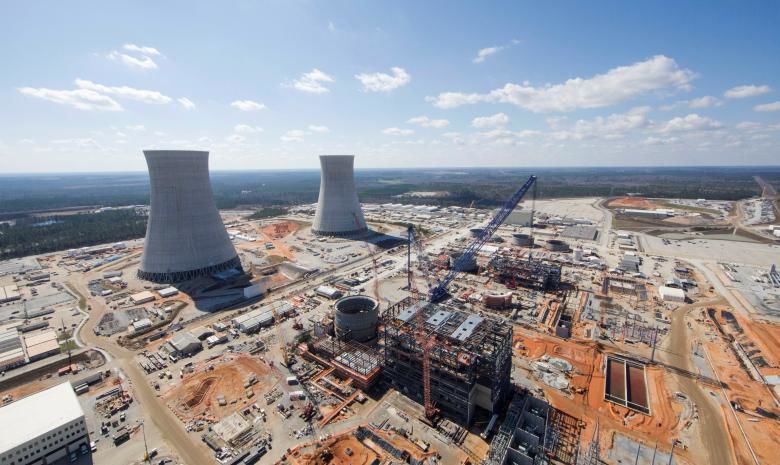
The Vogtle Unit 3 and 4 site, being constructed by primary contactor Westinghouse, a business unit of Toshiba, near Waynesboro, Georgia, U.S. is seen in an aerial photo taken February 2017. Georgia Power/Handout via REUTERS
The Vogtle Unit 3 and 4 site, being constructed by primary contactor Westinghouse, a business unit of Toshiba, near Waynesboro, Georgia, U.S. is seen in an aerial photo taken February 2017. Georgia Power/Handout via REUTERS