






TCA’s Brady Miller battles through brain surgery to return to gridiron
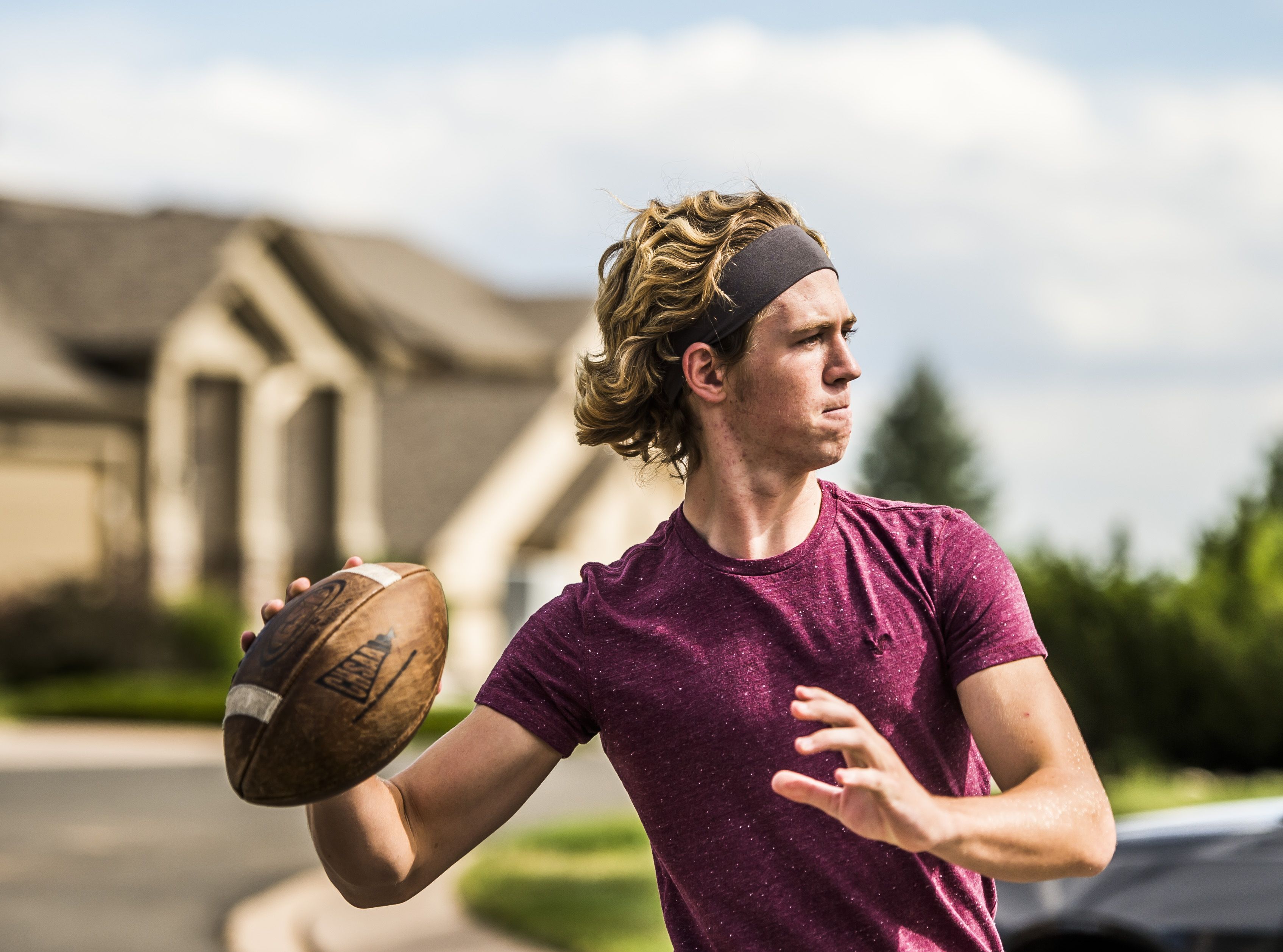
Six months ago, Brady Miller was nearly unrecognizable.
Wrapped tightly in a neck brace, a patch over one eye, Miller lay in a hospital bed awaiting brain surgery.
Look at him now: An athletic build, a new 6-inch scar on the back of his head, and he’s The Classical Academy’s starting tight end and outside linebacker in its home opener Friday.
“I feel like for sure I’m definitely in football shape,” said Brady, who spent 35 consecutive days at Children’s Hospital in Denver earlier in the year.
A CT scan in January revealed bleeding in Brady’s brain from a cavernous malformation – an irregular group of capillaries. Four months after having it removed during a 10-hour surgery, the TCA junior was cleared for all activity in June – including football.
Brady’s surgeon, Dr. Corbett Wilkinson, said returning to contact sports after this kind of surgery depends on how a certain individual recovers.
“You want to make sure the healing has gone appropriately well for both the bone window that was taken out and put back on, and the skin has healed up,” he said. “But if everything is going well there is not a specific rule that people can’t go back to playing contact sports.
“In fact, we’d like to get kids back doing whatever is important to them.”
The decision to allow Brady back on the field still wasn’t an easy one for mom Lisa and dad Chadd.
“As you can imagine there’s probably some people in our community that are questioning the wisdom of us allowing Brady to play football,” said Chadd, who is also the Titans’ defensive coordinator. “We certainly went through that and Brady feels strongly about it through the advice of the medical staff.”
Not feeling normal
Brady complained of dizziness on the third Friday of January – the same day he passed his driver’s license test.
The then-sophomore spent the next week in and out of the hospital before he was rushed from Penrose-St. Francis to the Denver hospital after a scan showed bleeding in his cerebellum.
“They actually sent us home hoping the steroids would help and within an hour he was worse than ever,” Lisa said. “The next day we were back up at Children’s, which kind of started our long journey there.”
Unable to move his head without severe nausea, Brady was placed in a neck brace and was given medication and steroids in his hospital bed. When his symptoms worsened from double vision, doctors rotated a patch between his eyes.
Weeks of nearly no movement had withered his 175-pound frame to 150.
“You can imagine what his body looked like,” said TCA coach David Bervig, one of many who visited Brady in the hospital. “Major atrophy, face swollen from the steroids, it didn’t look like Brady.”
Brady tried to stay upbeat. He comforted his mom, and even asked the doctor questions like, “When can I play football again?”
Eventually, though, the Miller family and Brady’s medical staff felt surgery was the best option. There was initial hesitance after doctors said surgery would be more difficult because of the location of the malformation.
Their hesitance turned to panic when the surgeon aborted the first attempt after Brady’s head slipped the vice – twice. Fortunately, the second try 10 days later was a success.
“There were obviously a lot of scary times,” Lisa said. “But there was a peace on him and I know that is from the hundreds of people who said they were praying for him.
“We are so blessed.”
Getting healthy
Brady underwent physical and speech therapy the next 10 days at the hospital. The two-sport athlete known for his strength was plagued with atrophy and tremors on the left side of his body. He could barely stand or walk.
Brady said his first task in physical therapy was to pick a bean bag up and place it back down on the table.
“It was really frustrating because mentally nothing had changed about me. It still felt like I was in my athletic-football-player body,” Brady said. “But I would tell my body to walk a certain way or move my head a certain way and it refused to.”
Brady returned home the last week of February and continued his therapy with neighborhood walks with his mom.
The first day he made it one house down, then two, then the entire block.
He slowly regained strength and returned to school three hours a day starting in March. A month after that, he took part in track and field on a limited basis. He threw the discus 82 feet, 1 inch in his first meet in Loveland – something TCA track coach Tim Daggett said in his weekly letter to parents, “felt like it was the distance from home to 225 and Colfax.”
Back on the gridiron
In June, Brady was cleared to play football.
“Brady asked the million-dollar question if he could play football, and Dr. Wilkinson said, ‘Yes, you are cleared for all activity,'” Lisa said. “My first response was joy for him, because I know how much he loves this. I’m glad it wasn’t taken from him.”
The TCA junior has rebuilt his athletic frame – he credits tireless hours in the weight room over the summer with his teammates.
As for the hits?
“There’s really no reason to be nervous,” Brady said.
His coaches – including Dad – are still getting comfortable with that idea.
“Am I at practice periodically watching to make sure he’s OK? Or watching when he’s involved in a play and he gets up a little slow? Absolutely,” Chadd said. “But I don’t fixate on that. I’m just a little more aware of it.”


