






Art exhibit review: “All New Women” exhibit at the FAC falls short of promise
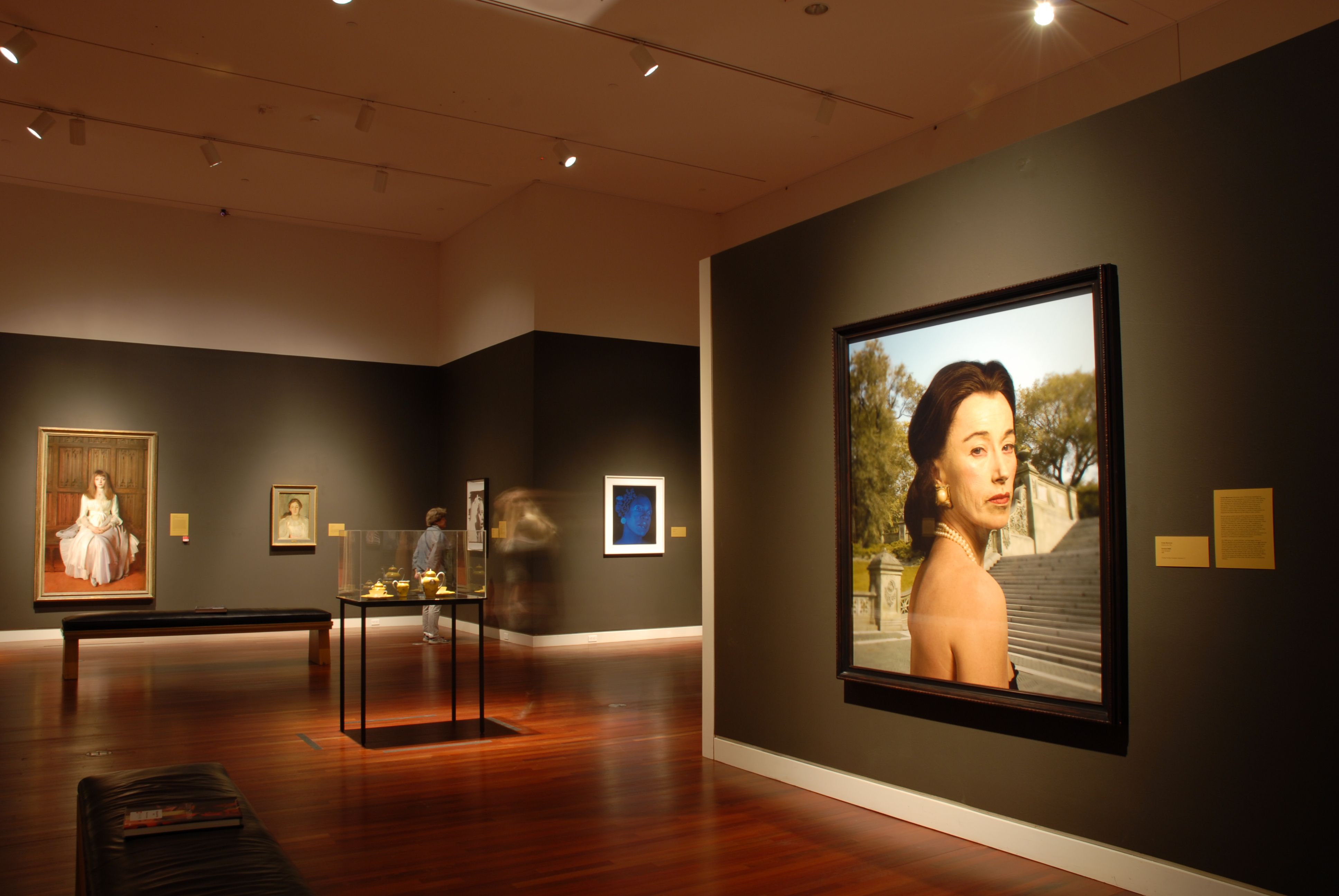
It was a brilliant idea, really: Pair superstar painter John Singer Sargent and superstar photographer Cindy Sherman in a Fine Art Center exhibition.
Separated by a century, they are a curious but thought-provoking match-up. One created exquisite portraits of the high-society darlings of the turn of the last century. The other, an explorer of mainstream notions of beauty and aging, gender and identity, all embodied by the artist herself. What kind of conversations could this work have?
“All New Women,” which runs through Sept. 18, wasn’t exactly what I expected.
Now a tribute to trailblazing women, curators Blake Milteer and Joy Armstrong developed an exhibition that includes only two of Sherman’s “Society Portraits,” a Limoges tea set designed by Sherman (“Madame Pompadour,” a recent addition to the FAC collection) and six relatively minor portraits of movers and shakers by Sargent. The balance: 11 paintings of Springs icons by Sara Ware Howsam and two prints by Lyle Ashton Harris, who portrays Billie Holiday there.
Ideas evolve, of course. Whatever the reason for the sea change, what remains is disappointing, an intellectual exercise supported by extensive wall text and subject matter that (mostly) fits a rather tired bill. Like the museum’s Georgia O’Keeffe-lite exhibition last summer, “All New Women” falls short of its delicious promise.
That said, there are some jewels here.
You may not know Sherman or her work, but she’s one of the most influential photographers of the past 40 years, beginning in the ’70s with her groundbreaking series “Film Stills.” In these vaguely familiar narratives from almost recognizable movies, Sherman, who always morphs herself into her subjects, creates a visual vocabulary of female identity as embedded in and telegraphed by pop culture.
Now in her 50s, Sherman drives deeper into that territory with “Society Portraits,” which examines our culture’s emphasis on youth and beauty, especially in the face of aging. In “Untitled 465” (2008), wrinkles bloom around the sitter’s tight mouth. She looks over her bare shoulder with a gaze that’s both appraising and full of regret. In the other, “Untitled 474” (2008), a petite dynamo stares at the viewer as if expecting a response. Her ample bosom sags against a sequined evening dress and her red lips broadcast plastic surgery.
Both images are powerful – confrontational and tender – but a little off: the odd backgrounds (which Sherman shoots elsewhere and pastes into final image), the thrift store earrings, the tatty wig and penciled-in eyebrows that arch fetchingly over real eyebrows concealed by makeup.
Women chase youth, the work seems to say, but does the artifice crush as well as conceal?
Not far away, Sargent’s portrait “Mary Elizabeth Garrett” (1904) shimmers with almost impressionistic brushstrokes, delicately conjuring evidence of life. Her hand in her lap, slim books on a table, a red rose and a diaphanous white shawl over a black Victorian dress. Amid of all those articulate smudges, Garrett’s face – luminous, questioning – comes into focus: Her personality seemingly transmitted in that visual instant.
It’s the best example of Sargent’s trademark style in “Women,” besides “Portrait of Miss Elsie Palmer (Lady in White)” (1889-90), which, as a pearl of the FAC collection, is typically on permanent view in another FAC gallery. Sadly absent: This sought-after portraitist’s playful full-length poses, his way with capturing not just fashion, but the way it inhabits space, and his flair for attitude and atmosphere.
The rest of the exhibition? While Harris’ self-portraits as Lady Day are provocative – a discussion of identity, femininity versus masculinity and even transgender issues – the inclusion of Springs painter Howsam’s work suggests filler. Armstrong says the artist’s “Dreaming Debutantes” (2015) inspired the soon-to-be museum director to expand the focus of the show. The portraits, which honor pioneering women in the community, are well intentioned, but the 11 falter in the face of the ideas and technique so palpable in “Women.”
The “All New Women” art installation at the Colorado Springs Fine Arts Center runs through Sept. 18.
John Singer Sargent’s”Mary Elizabeth Garrett” is part of the “All New Women” art installation at the Colorado Springs Fine Arts Center.
Tracy Mobley-Matinez Saturday December 13, 2014. Photo by Jeff Kearney
Portrait of Miss Elsie Palmer by John Singer Sargent. (Painting is also known as “Young Lady in White”) is part of the FAC’s “All New Women” exhibit.
The “All New Women” art installation at the Colorado Springs Fine Arts Center runs through Sept. 18.