






Eating out, eating safely a continuous day for El Paso County Public Health inspectors
The Airplane Restaurant is known as a place where air buffs can enjoy their meals in a 1953 Boeing KC-97 tanker, but on a recent day health inspector Melissa Lovato barely gives a second glance to the massive plane. She’s more interested in food temperatures.
Armed with a digital food thermometer, sanitizing wipes and chemical testing strips, Lovato is the first line of defense in helping keep restaurant-goers in El Paso County from coming down with food-borne illnesses.
It’s a big job. El Paso County Public Health is in charge of inspecting about 2,460 establishments, including school cafeterias, convenience stores, food trucks and traditional restaurants. In some places, there are no problems. In 2015, there were 754 restaurants where the health department found no violations it deemed critical – those that could potentially cause a foodborne illness. That number is an improvement from the year before, but it means that 70 percent of the establishments inspected by the health department had at least one critical violation. Some had many more.
The Gazette analyzed inspection data provided by the health department from mid-April 2014 through mid-April 2016. In the two-year time frame, The Gazette found:
– There were 168 establishments in the county that had racked up 10 or more critical violations in those two years. Of those, 21 establishments had more than 20 violations, and four had 30 or more violations.
– The most common critical violation was not holding cold food at a temperature of 41 degrees or less – any warmer for more than four hours, and illness-inducing bacteria can start to grow. El Paso County establishments racked up 1,065 of those violations.
– Other common violations included establishments not having soap or drying devices available for employees (648 violations); employees seen having unhygienic practices like blowing their nose or scratching their head before touching food (478 violations); or employees not washing their hands when needed (458 violations). Inspectors also noted evidence of insects or rodents 60 times in these establishments.
With 41 critical violations, The Ultimate Buffet, 3727 Bloomington St., was the worst violator in the county for the time period analyzed. In those two years, inspectors saw employees who weren’t washing their hands when needed; noted food that was not holding at hot or cold enough temperatures to stave off bacteria; and even noticed several dead roaches throughout the facility. In late 2014, the restaurant was fined $250 by the health department for not fixing repeat violations.
Michael Cheng, restaurant manager, said many of the restaurant’s violations stemmed from a change in health inspectors who were looking for different issues.
“We’ve been open, like, 10 years,” he said. “We’ve been doing things the same way and when we got a new inspector, she wanted things done differently. … The health inspector we have now, she’s on top of her game and she’s trying to make the restaurant safe. It just took us a while to get used to what she wanted.”
He pointed out that there were no violations in the restaurant’s most recent inspection in March. Cheng said managers took the health department’s food safety course, which is available online in several languages, and have been using that knowledge to train employees properly.
“That has definitely helped,” he said.
Other top violators in the county are:
– China Menu Restaurant, 5535 Powers Center Point, with 35 violations in two years. In that period, the restaurant has had a $500 fine for noncompliance.
– Heart of Jerusalem Cafe, 4587 Austin Bluffs Parkway, with 30 violations in two years. In that period, the restaurant has received a notice of noncompliance but has not been fined.
– Super China Buffet, 3835 N. Academy Blvd., with 30 violations in two years. In that period, the restaurant has received two separate noncompliance fines, one for $500 and another for $250.
Tom Gonzales, deputy director for El Paso County Public Health, said the department has recently changed the way it conducts health inspections. The department used to inspect each establishment twice a year no matter what. Now, the department focuses inspection more on places that have a track record of violations and those that are known to have menus that are more likely to cause illness – such as those with several fish or chicken items. This new practice means that the restaurants noted above are much more likely to get frequent health inspector visits than those with fewer violations.
“What I can tell you is that those places with a high number of violations – it will push them into the higher-risk frequency range, and we will have an inspector there four times a year minimum, rather than just twice,” he said. “We will have our staff in there much more likely than those places that are lower risk.”
Gonzales said it’s too early to measure how successful this approach has been, but anecdotally, inspectors say that more visits mean the staff at those places are becoming more knowledgeable about common food-safety practices.
Painstaking inspections
During The Airplane Restaurant’s recent inspection, owner Steve Kanatzar said his cooks all go through the health department’s class. He doesn’t mind a reporter and photographer are watching the inspection.
“Customers can come back here if they want to,” he said. “I don’t have any secrets.”
In two years, the restaurant had three critical violations, including an improperly labeled chemical bottle and an employee who forgot to wash his hands after taking off gloves used to load dirty dishes. During this recent inspection, Lovato starts her way in the back of the kitchen, slowing working her way up to the front.
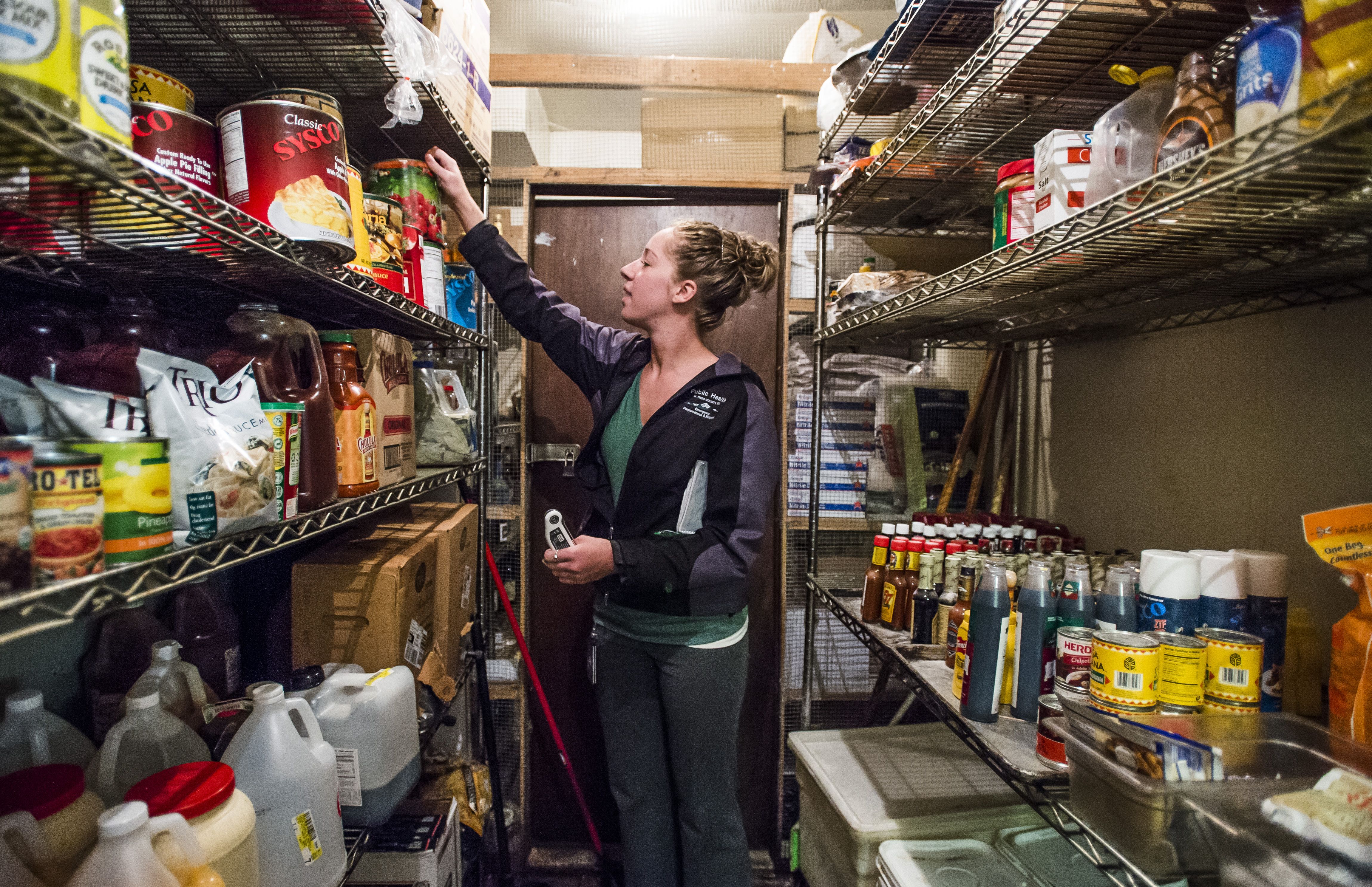
She checks in the freezer to make sure it’s cold enough and that food is stacked inside properly. In the pantry, Lovato spies a dented can of tomato sauce. Kanatzar quickly grabs it and sets it aside to be sent back to the manufacturer. She also notices that the to-go containers are facing up, toward the ceiling, rather than downward to prevent anything from potentially falling inside them and causing contamination.
“That was my fault,” Kanatzar said. “I was in a hurry and threw them in there and forgot.”
She turns them downward, fixing the problem. She moves through the kitchen, randomly taking food temperatures to make sure the food is cooked properly. At the dishwasher, she uses chemical testing strips to ensure that the dishes are properly sanitized. She checks outside near the Dumpster to make sure there is nothing on the ground that might attract pests and even looks inside the lid of the ice machine.
“What are you looking for there?” asks Kanatzar, when he notices she isn’t checking to make sure the ice scoop is kept separately from the ice.
“Mold can sometimes grow on the inside of the machines,” Lovato explains. “I like to have ice when I go out so by checking, I figure restaurants will be more likely to check themselves, and I’ll get better ice.”
“Good to know,” said Kanatzar.
Everything appears to be in order. What the employees might not know is that while she is taking temperatures or checking chemical balances, she is also subtly watching them. She is paying attention to how they cook food and making sure they are washing their hands or changing their gloves when required.
Watching through the corners of her eyes helps her accomplish two goals, Lovato said: First, she gets a clearer picture of how employees actually act than she does standing over someone’s shoulder. Secondly, she said, employees are less likely to make mistakes this way, she said.
“Once you start to watch them, they get nervous and make mistakes they wouldn’t otherwise,” she said.
Once Lovato makes her way through the kitchen, she quizzes Kanatzar on common foodborne illnesses and asks him about the types of food that are most likely to cause those illnesses. He knows almost everything she asks.
Lovato said education is as big a part of her job in conducting inspections. When it comes down to it, she said, the health department can only do so much to help ensure food safety. It’s up to restaurants to have the knowledge and keep food safe for their customers every day. An inspection a few times a year will never give a perfectly clear view of what is going on behind those kitchen doors.
“All we get is a glimpse into what they do.”
–
Contact Maria St. Louis-Sanchez: 636-0238
Twitter @mariastlouis
Facebook Gazette Maria St. Louis-Sanchez
Melissa Lovato, Environmental Health Specialist, inspects the dry storage at The Airplane Restaurant on Thursday, May 19, 2016. Photo by Stacie Scott, The Gazette
Melissa Lovato, Environmental Health Specialist, inspects a drink station at The Airplane Restaurant on Thursday, May 19, 2016. Photo by Stacie Scott, The Gazette
Melissa Lovato, Environmental Health Specialist, checks temperatures in the refrigerator during a health inspection at The Airplane Restaurant on Thursday, May 19, 2016. Photo by Stacie Scott, The Gazette