






Canadian officials hope to put “death grip” on fire
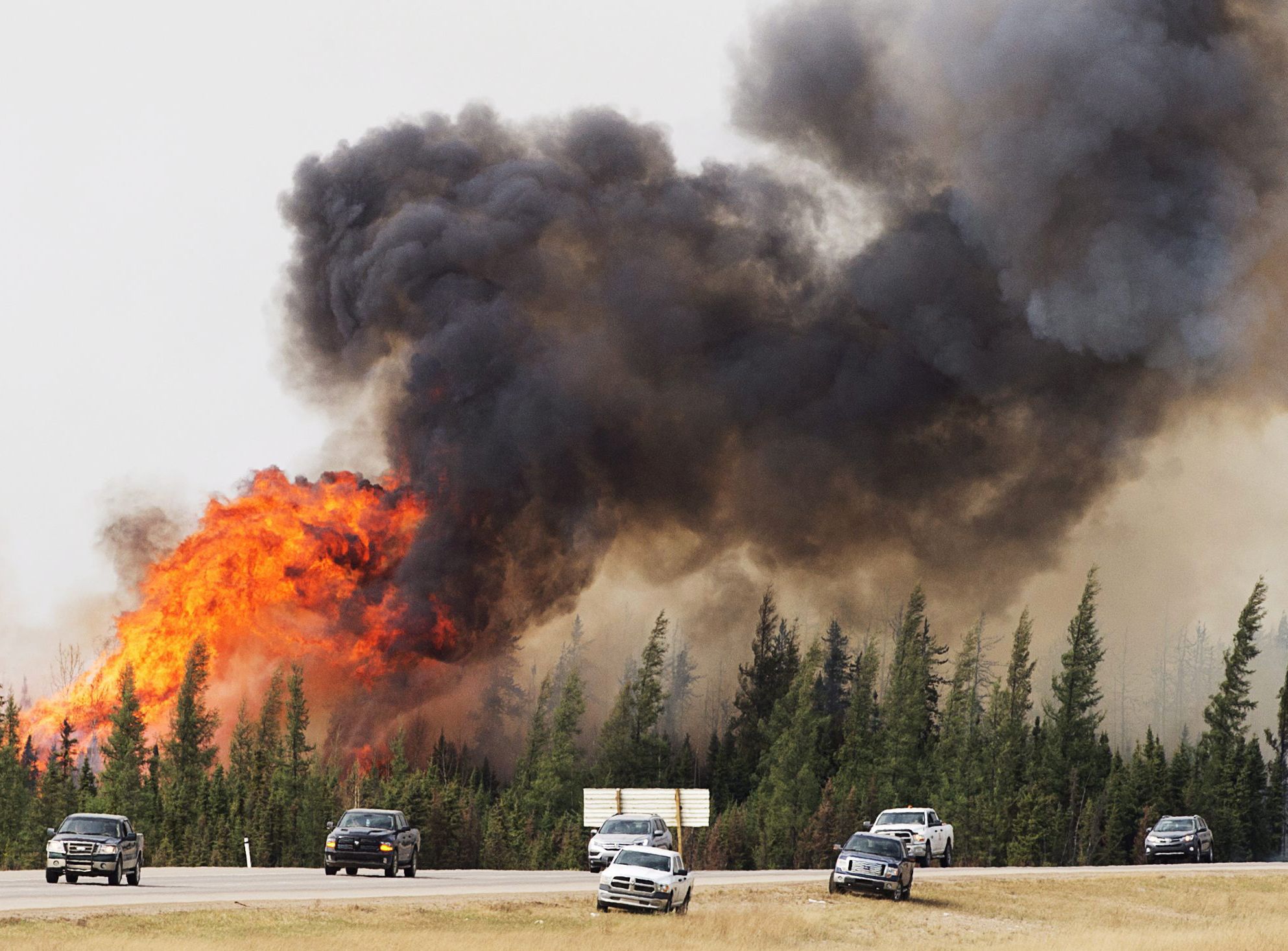
FORT MCMURRAY, Alberta — Officials said Sunday they reached a turning point in fighting an enormous wildfire, hoping to get a “death grip'” on the blaze that devastated Canada’s oil sands town of Fort McMurray amid cooler temperatures. Meanwhile, a massive evacuation of residents displaced by the blaze came to an end.
Chad Morrison of Alberta Wildfire said he’s “very happy” and called it great firefighting weather.
“We can really get in there and really get a handle on this fire and really get a death grip on it,” Morrison said.
Morrison said with cooler temperatures in the next three or four days, firefighters should be able to put out hot spots. Morrison said it allowed them to further protect fire-ravaged Fort McMurray
Alberta Premier Rachel Notley said the wildfire grew much more slowly than was feared and it is now 161,000 hectares (397,831 acres). She said the blaze is quite a bit smaller than was feared on Saturday, when officials expected the fire to double in size. She added the city is safe for first responders.
The fire remains west of the Saskatchewan border and Morrison said fire hasn’t reached the Suncor or Syncrude oil sands facilities north of Fort McMurray and that the mines north are not under threat.
Officials also completed the transport of 25,000 residents of out of work camps north of the city. Police and military oversaw a procession of thousands of vehicles Friday and Saturday, and a mass airlift of thousands of evacuees was also employed from the oil sands camps that usually house workers.
No deaths or injuries have been reported the fire itself. Notley, however, mentioned the two evacuees who died in traffic accident during the evacuation. Notley’s voiced cracked when talking about the two and noted it is Mother’s Day.
The images of Fort McMurray are one of devastation — scorched homes and virtually whole neighborhoods burned to the ground.
But it rained on Sunday. The Rural Municipality of Wood Buffalo, which includes Fort McMurray, tweeted a picture of the rainfall and wrote: “It was only for a few minutes but the sight of rain has never been so good.” Notley retweeted the picture and wrote “Here’s hoping for much more!”
More than 80,000 people have left Fort McMurray in the heart of Canada’ oil sands, where the fire has torched 1,600 homes and other buildings. Gas has been turned off, the power grid is damaged and water is not drinkable. Officials said there is no timeline to return residents to the city, but the Alberta government is sending in a team on Monday to do some preliminary planning.
The fire and mass evacuation has forced a quarter or more of Canada’s oil output offline and was expected to impact an economy already hurt by the fall in the price of oil. The Alberta oil sands have the third-largest reserves of oil in the world behind Saudi Arabia and Venezuela. Its workers largely live in Fort McMurray where some neighborhoods have been destroyed.
Notley said there will be a meeting with the energy industry on Tuesday and said topics will include the state of facilities and the impact on operations.
About 25,000 evacuees moved north in the hours after Tuesday’s mandatory evacuation, where oil sands work camps that usually house employees were used to house evacuees. Officials then moved everyone south Friday and Saturday.
Just over 30 kilometers (18 miles) south of Fort McMurray, the main highway into town is blocked off by barricades and police vehicles. More than a dozen media vehicles were parked near the barrier, along with a few volunteers who had trailers full of supplies.
One trailer had a sign on back that said “Fort Mac Bound.” It carried supplies like clothing, Gatorade and protein bars for firefighters and EMTs, said Steve Jeges, of Olds, Alberta. He said he and others accepted donations for four days in Olds before heading here.
“If our services are needed, we’re staying, he said.
Nearby, 22-year-old Sydney Robinson of Acme, Alberta stood near a trailer she had filled with clothing, water, food and about 20 kennels for animals. She came up on Thursday in hopes that she could help retrieve animals that were left behind in homes, but has not yet been able to get into Fort McMurray.
“I just want to help in any way I can,” she said.
Trailer trucks bringing three bulldozers passed through the barricade as did other authorized vehicles with supplies.
Fort McMurray Fire Chief Darby Allen asked for the patience of residents who are eager to find out if their home has been destroyed.
“We are really working hard on that, it’s a complicated process, what’s damaged, what’s left,” Allen said in a posted video. “We really will get that to you as soon as we possibly can. We care about all of you.”
Canadian Prime Minister Justin Trudeau had no immediate plans to visit the region. “We don’t want to distract from the important work right now,” Kate Purchase, a spokeswoman for Trudeau said.
Saskatchewan Emergency Management Commissioner Duane McKay said there is heavy smoke in south west Saskatchewan, but no imminent threat of fire to any communities in the province that neighbors Alberta. McKay said the fire remains 15 to 20 kilometers from the Saskatchewan border and 60 to 70 kilometers from any communities in the province. He said whether it crosses the border over depends on weather but they don’t see it happening Sunday.
Lac La Biche, Alberta, normally a sleepy town of 2,500 about 175 kilometers (109 miles) south of Fort McMurray, was helping thousands of evacuees, providing a place to sleep, food, donated clothes and even shelter for their pets.
Jihad Moghrabi, a spokesman for Lac La Biche County, said that 4,400 evacuees have come through The Bold Center, a sports facility in town. At the center, tables were piled with clothes, towels and other items. The center was offering three free meals a day and other services, including mental health services. A kennel housed people’s pets on site.
___
Gillies reported from Toronto.
A wildfire burns south of Fort McMurray, Alberta, near Highway 63 on Saturday, May 7, 2016. Canadian officials hoped to complete the mass evacuation of work camps north of Alberta’s main oil sands city of Fort McMurray on Saturday, fearing the growing wildfire could double in size and reach a major oil sands mine and even the neighboring province of Saskatchewan. (Ryan Remiorz/The Canadian Press via AP) MANDATORY CREDIT
Wild fires burn south of Fort McMurray, Alberta, seen from highway 63 Friday, May 6, 2016. Displaced residents at oil field camps north of Fort McMurray, Alberta, got a sobering drive-by view of their burned out city Friday in a convoy that moved evacuees south amid a massive wildfire that officials fear could double in size by the end of Saturday. As police and military oversaw the procession of hundreds of vehicles, a mass airlift of evacuees also resumed. (Jonathan Hayward/The Canadian Press via AP) MANDATORY CREDIT
A helicopter carrying Agriculture and Forestry firefighters returning from a patrol mission takes off after refueling at a helipad in Lac La Biche, Alberta, on Saturday, May 7, 2016. The firefighters in Lac La Biche are focusing on recent wildfires that have broken out since the one at Fort McMurray. (AP Photo/Rachel La Corte)
Wildfires burn in and around Fort McMurray, Alberta, Wednesday, May 4, 2016. The raging wildfire emptied Canada’s main oil sands city, destroying entire neighborhoods of Fort McMurray, where officials warned Wednesday that all efforts to suppress the fire have failed. (Jeff McIntosh/The Canadian Press via AP) MANDATORY CREDIT
Volunteers direct wildfire evacuees as they arrive at Edmonton International Airport, Friday, May 6, 2016, in Edmonton, Alberta. More than 300 flights carrying evacuees have arrived at the airport since Tuesday. (AP Photo/Rachel La Corte)
An evacuee, second from left, from the Fort McMurray wildfires speaks on a cell phone at the evacuation center in Edmonton, Canada on Thursday, May 5, 2016. Raging wildfires in the Canadian province of Alberta have moved south, forcing three more communities to evacuate and an emergency operations center to move again , taking it far from the devastated oil sands city of Fort McMurray. (Jeff McIntosh/The Canadian Press via AP) MANDATORY CREDIT
Volunteers hand out bottled water and direct wildfire evacuees as they arrive at Edmonton International Airport, Friday, May 6, 2016, in Edmonton, Alberta. More than 300 flights carrying evacuees have arrived at the airport since Tuesday. (AP Photo/Rachel La Corte)
Evacuees from the Fort McMurray wildfires look through donated supplies in Lac la Biche, Alberta, on Friday, May 6, 2016. More than 80,000 people have left Fort McMurray in the heart of Canada’ oil sands, where the fire has torched 1,600 homes and other buildings. (Ryan Remiorz/The Canadian Press via AP) MANDATORY CREDIT
An evacuee from the Fort McMurray wildfires looks for a pair of shoes at a shelter in Lac la Biche, Alberta, on Friday, May 6, 2016. More than 80,000 people have left Fort McMurray in the heart of Canada’ oil sands, where the fire has torched 1,600 homes and other buildings. (Ryan Remiorz/The Canadian Press via AP) MANDATORY CREDIT
Evacuees watch the wildfire near Fort McMurray, Alberta, on Wednesday, May 4, 2016. Alberta declared a state of emergency Wednesday as crews frantically held back wind-whipped wildfires. No injuries or fatalities have been reported. (Jason Franson/The Canadian Press via AP) MANDATORY CREDIT
A helicopter helping with the Fort McMurray wildfire takes off from a staging base near Conklin, Alberta, Saturday, May 7, 2016. Canadian officials feared the massive wildfire could double in size by the end of Saturday as they continue to evacuate residents of fire-ravaged Fort McMurray from work camps north of Alberta’s oil sands city. (Jeff McIntosh/The Canadian Press via AP) MANDATORY CREDIT
A flock of geese fly through smoke from the Fort McMurray wildfire above a helicopter staging base near Conklin, Alberta, Saturday, May 7, 2016. Canadian officials feared the massive wildfire could double in size by the end of Saturday as they continue to evacuate residents of fire-ravaged Fort McMurray from work camps north of Alberta’s oil sands city. (Jeff McIntosh/The Canadian Press via AP) MANDATORY CREDIT
Flames from a wildfire billow into the sky south of Fort McMurray, Alberta, on Highway 63 on Saturday, May 7, 2016. Canadian officials hoped to complete the mass evacuation of work camps north of Alberta’s main oil sands city of Fort McMurray on Saturday, fearing the growing wildfire could double in size and reach a major oil sands mine and even the neighboring province of Saskatchewan. (Jonathan Hayward /The Canadian Press via AP) MANDATORY CREDIT
A wildfire burns south of Fort McMurray, Alberta, near Highway 63 on Saturday, May 7, 2016. Canadian officials hoped to complete the mass evacuation of work camps north of Alberta’s main oil sands city of Fort McMurray on Saturday, fearing the growing wildfire could double in size and reach a major oil sands mine and even the neighboring province of Saskatchewan. (Jonathan Hayward /The Canadian Press via AP) MANDATORY CREDIT
A wildfire burns south of Fort McMurray, Alberta, near Highway 63 on Saturday, May 7, 2016. Canadian officials hoped to complete the mass evacuation of work camps north of Alberta’s main oil sands city of Fort McMurray on Saturday, fearing the growing wildfire could double in size and reach a major oil sands mine and even the neighboring province of Saskatchewan. (Ryan Remiorz/The Canadian Press via AP) MANDATORY CREDIT
Heat waves are seen as cars and trucks try and get past a wild fire 16 km south of Fort McMurray, Alberta, on highway 63, Friday, May 6, 2016. Chad Morrison, Alberta’s manager of wildfire prevention, said the cause of the fire hasn’t been determined, but that it started in a remote forested area and could have been ignited by lightning. (Jonathan Hayward/The Canadian Press via AP)
A water bomber drops its load on a wild fire south of Fort McMurray, Alberta, on highway 63, Friday, May 6, 2016. Chad Morrison, Alberta’s manager of wildfire prevention, said the cause of the fire hasn’t been determined, but that it started in a remote forested area and could have been ignited by lightning. (Jonathan Hayward/The Canadian Press via AP)
In this May 5, 2016 photo provided by the Royal Canadian Mounted Police Alberta, an RCMP officer surveys the damage on a street in fire-ravaged Fort McMurray, Alberta. More than 80,000 people have left Fort McMurray, in the heart of Canada’s oil sands as a wildfire that has devastated the area exploded in size. (Royal Canadian Mounted Police Alberta via The Canadian Press via AP) MANDATORY CREDIT
A wildfire burns south of Fort McMurray, Alberta, near Highway 63 on Saturday, May 7, 2016. Canadian officials hoped to complete the mass evacuation of work camps north of Alberta’s main oil sands city of Fort McMurray on Saturday, fearing the growing wildfire could double in size and reach a major oil sands mine and even the neighboring province of Saskatchewan. (Jonathan Hayward /The Canadian Press via AP) MANDATORY CREDIT