






Through vigil, discussion Colorado Springs community seeks to heal from shootings
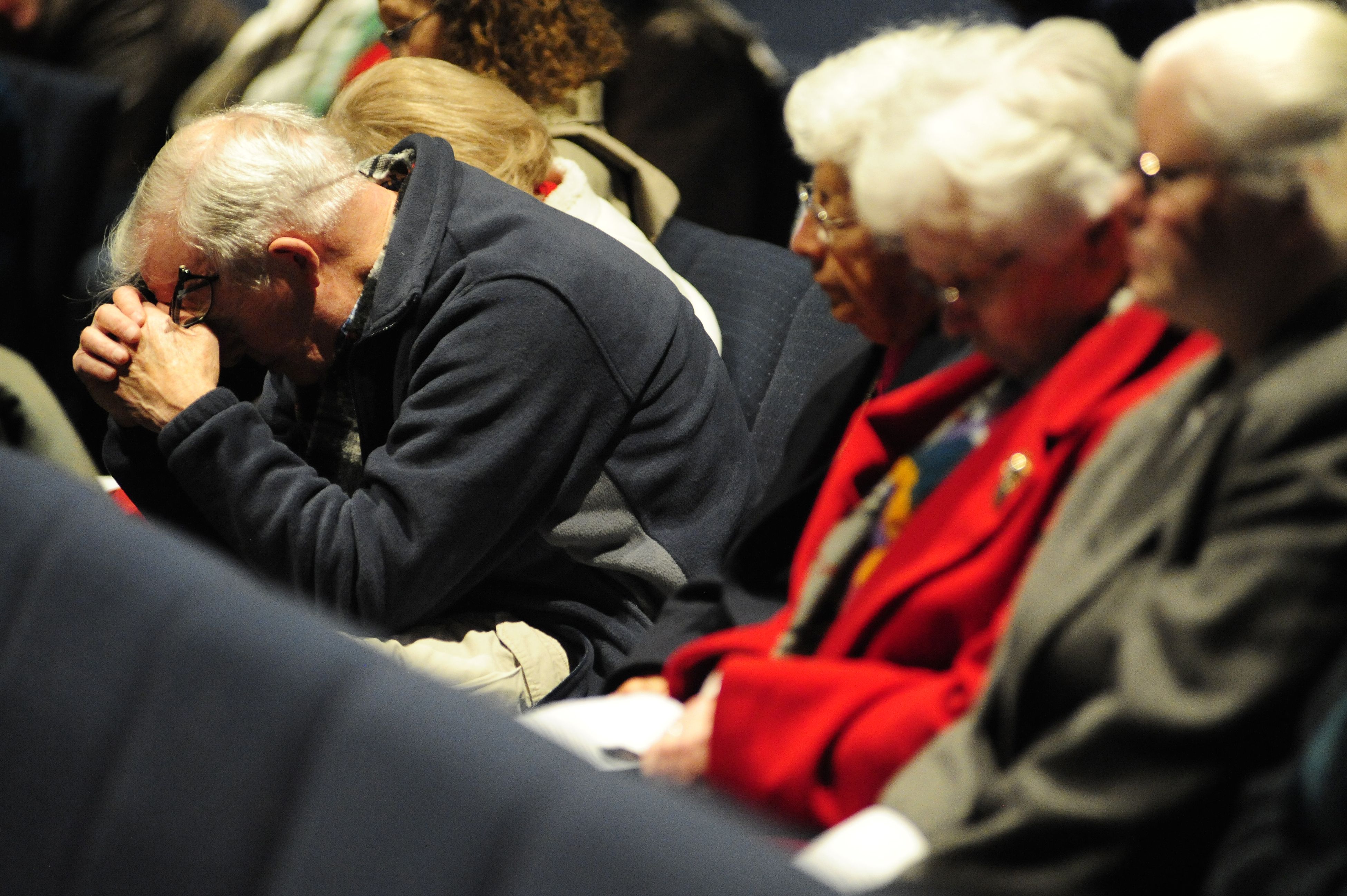
The shooting at Colorado Springs’ lone Planned Parenthood clinic left three dead and nine wounded, but also left a community of people of divergent opinions trying to heal together.
Members of anti-abortion activism groups, pastors, local artists and pro-gun control activists spent Sunday afternoon searching for ways to help Colorado Springs recover from the Nov. 27 shooting rampage, the city’s second mass shooting in less than a month. All were trying to set politics aside, but their conversations happened miles from each other, one at a vigil in an auditorium at Colorado Springs Christian Schools, the other in a gallery room at Cottonwood Center for the Arts downtown.
Both gatherings attracted people who were looking for a safe place in the wake of the shooting – a place for prayer, for talk or for finding a way forward.
Speaking at the vigil, Bishop Michael Sheridan of the Catholic Diocese of Colorado Springs enjoined the crowd to celebrate the community’s differences as a way to come together.
“The diversity of this community is your gift to us, Lord,” Sheridan said in prayer. “Let us turn it into pluralism.”
Along with Sheridan, five other religious leaders offered prayers and support for families of the shooting victims, Ke’Arre Stewart and Jennifer Markovsky, and for law enforcement officers and particularly the family of victim Garrett Swasey, a University of Colorado at Colorado Springs police officer.
The group of young artists, on the other hand, talked about a way to express their feelings about the shooting without getting overly political. It was a concern shared by their counterparts at the hourlong vigil, organized by the anti-abortion group Colorado Family Action, which sought to provide a space for community members to offer prayers unattached to politics, said Sarah Zagorski, the group’s policy director. The group hoped that the vigil would distance anti-abortion organizations from Robert Lewis Dear Jr., who surrendered to police after a five-hour standoff at the Planned Parenthood clinic. After Dear’s arrest, he reportedly told authorities “no more baby parts.” In court nearly two weeks later, Dear proclaimed himself to be “a warrior for the babies,” and later yelled out: “Kill the babies – that’s what Planned Parenthood does.”
For Zagorski, being pro-life is about respecting life. On the Colorado Family Action website, the group states that “senseless killing is never ‘pro-life’.”
“We want to show the community that he doesn’t represent the majority of pro-life people,” Zagorski said.
In between prayers, City Councilman Keith King led the services with Bible readings, and his wife, Sandi, jubilantly led the group of around 50 people in singing “God Bless the USA.”
Coming to the vigil was an important part of Stephanie Luck’s day. Luck, who is a member of a casual pro-life group called the City for Life Initiative, came to offer prayers to help Colorado Springs – “A small part that I can play,” she said.
“I think just that it’s important that the community has a place to come together,” she said of the vigil, echoing Sheridan.
Across town, a smaller group of people gathered to brainstorm other ways to help Colorado Springs residents grapple with the trauma of the shooting. Creating a place to come together – whether physical or spiritual – was the main goal of Sunday’s small gathering of artists, who have casually labeled their group the Colorado Springs Artists’ Collaboration around Gun Violence. The group of seven spent much of Sunday afternoon processing their last meeting, which attracted 40 people. It served as a sort of therapeutic discussion about the impacts of the shooting, said Han Sayles, who coordinated the meeting. The problem facing the group was a way to move forward that would not ostracize people of different beliefs. Laurie Works, who survived a shooting at New Life Church in 2007 that left two of her sisters dead, joined and offered her thoughts on how to attract people from outside groups, including other survivors of mass shootings.
The artists’ group hopes to organize a walk, possibly around downtown, that will feature interactive art installations that will offer healing – whether through sharing stories or building a memorial sculpture. While the plans were far from definite, the group settled on a kind of slogan, something invoking “common space, common stories.”
Despite the partisan intentions, the vigil and the artists’ meeting made their political concessions.
Many artists said that demands for more gun control should be a part of any movement they created. At the vigil, King introduced Pastor Scott Bottoms by saying he would offer prayers to foster a “deeper respect for life at all ages and stages.”
Joseph Martone Jr., a regular protester at the Planned Parenthood, attended the vigil carrying an anti-abortion sign. After the vigil, he talked with Rep. Gordon Klingenschmitt, R-Colorado Springs, whose incendiary comments about abortion got him temporarily removed from a House committee during the last session. In March, Klingenschmitt claimed that a recent attack on a pregnant woman was a “curse of God” meant to punish society for allowing abortion.
But ultimately Sunday, Klingenschmitt seemed to embrace the kind of accepting spirit that both gatherings were striving for. His only words were for uniting the community.
“We are all having to go through a time of healing,” he said. “Maybe the city can come together and celebrate Christmas.”
Local residents pray at a vigil held in the Colorado Springs Christian School auditorium on Sunday, Dec. 13, 2015 in honor of the victims of last month’s Planned Parenthood shooting. Photo by Daniel Owen
Father Phil Eberhart leads the attendees of the vigil held at the Colorado Springs Christian School auditorium in Colorado Springs, Colo., in a prayer to honor the victims of last month’s Planned Parenthood shooting; on Sunday, Dec. 13, 2015. Photo by Daniel Owen