






Researchers who studied Waldo Canyon fire say new firefighting approach needed
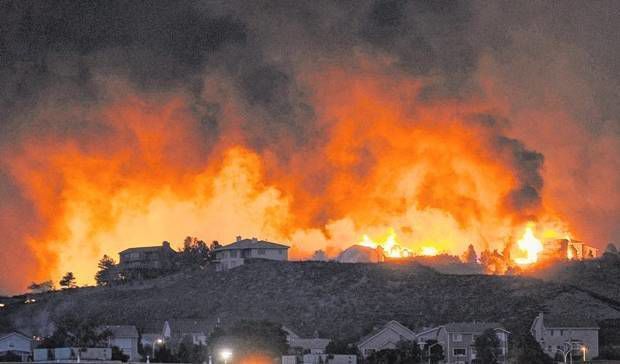
The American West needs a new kind of firefighter that fights fires that aren’t only wild or urban, but burn in the space between.
This was the main finding from a group of researchers who studied the 2012 Waldo Canyon fire, Colorado’s second most destructive wildfire and one that has come to epitomize the transformation of wildfires into massive urban disasters. The National Institute of Standards and Technology’s report on the fire, released Monday after two and half years of study, is a painstaking account of the efforts to save hundreds of homes during a firestorm June 26, 2012. While crews were enormously successful – and saved 75 percent of the homes that were burning – the report found that the country’s firefighters must be retrained to handle fires like Waldo, said Alex Maranghides, a lead researcher on the study.
“It’s a new approach to firefighting, it’s not a question of adapting,” said Maranghides on Monday, just after he addressed a White House summit on climate change and wildfires.
Firefighters and experts have talked about the ember storm that destroyed Mountain Shadows – a rain of billions of fiery particles that flew miles to slip into vents and land on wooden decks. Like many neighborhoods destroyed by so-called wildland urban interface fires, the homes in Mountain Shadows burned each other down, while the actual wildfire reached only the western edges of the neighborhood.
The story of Mountain Shadows’ destruction is familiar: the entire county watched on the afternoon of June 26 as a thunderstorm hovered over the fire, collapsing a pyrocumulous cloud and driving ember-filled gusts into the evacuated neighborhoods below. But Maranghides’ study offers an unprecedented glimpse into that day – nearly 100 burning homes were saved by firefighters who were scrambling to catch up when at least one home was igniting around them every minute. Reconstructing the burning timeline in Mountain Shadows involved interviewing hundreds of firefighters throughout the country who were there. The more than 200-page report offers the kind of detail that many residents who lost their homes were desperate to learn in the days after the fire.
“We interviewed 221 first responders,” said Maranghides. “We tracked every mutual aid apparatus that was in there during the first 48 hours. … We didn’t just go to Colorado Springs, we went all over. We were able to piece together the time, who was there, where they were and what really happened.”
The researchers discovered, for instance, that firefighters stationed around the inferno of Courtney Drive – which was destroyed – kept the fire from spreading elsewhere. They also confirmed that the fire poured down a drainage off Flying W Ranch to ignite homes on Majestic Drive in the Parkside subdivision. That neighborhood was decimated.
Yet, despite the loss of 347 homes and two lives, Maranghides has no doubt that firefighter efforts kept the catastrophic fire from destroying more. That success was due to well-trained crews who adapted – U.S. Forest Service crews trained to fight wildfires who protected structures, and urban firefighters who helped extinguish grassfires. “We have how-to books for fighting wildland fires, we have how-to books for fighting urban fires, but we don’t have how-to books for fighting wildland urban interface fires,” said Maranghides. “It’s really in its infancy.”
After an exhaustive analysis, Maranghides said there is really only one thing that could have been done differently during the fire – having crews trained specifically to handle a fire like Waldo. The firefight in Colorado Springs had a mix of federal wildland firefighters and local structure firefighters, with some firefighters who were trained in both. The dual-trained firefighters were the minority, Maranghides said. “We saw the spectrum of their knowledge and expectations in terms of how they saw this event,” he added. “And that was a very eye-opening experience that helped crystalize in our minds (the idea that) we are missing something.”
True wildfires burn slowly in remote areas, often smoldering for weeks or months. House fires in cities start and are over within seconds, or minutes. But fires such as the Waldo Canyon fire inhabit a space in between, fueled by weather and homes, demanding that firefighters decide which homes to save and which fires to merely prevent from spreading. It’s a kind of firefighting that has become all too common around the world as humans build in the wilderness, and drought and heat make wildfires more prevalent.
But it’s not a kind of firefighting that has a booklet, and it usually does not come with hazard maps to help firefighters chart their course. Structure firefighters have response times they must adhere to, but firefighters in the wildland urban interface usually have no more than the window of safety that chaos allows them.
Maranghides hopes the study will spur the creation of such standards – hazard maps for at-risk neighborhoods, response times, and crews trained to understand how interface fires move. What’s more, Maranghides believes the standards will work, given the example of the Waldo Canyon fire where firefighters were successful in containing an otherwise overwhelming situation.
“We are never going to have enough resources. We will always be overwhelmed,” he said. “But what is the most effective, safe and efficient way to fight (wildland urban interface) fires? Because they are completely different animals in terms of how they behave.”
See the full report at: 1.usa.gov/1QqxyC5.

