






Downtown stakeholders unhappy with expected power plan recommendation for Colorado Springs Utilities
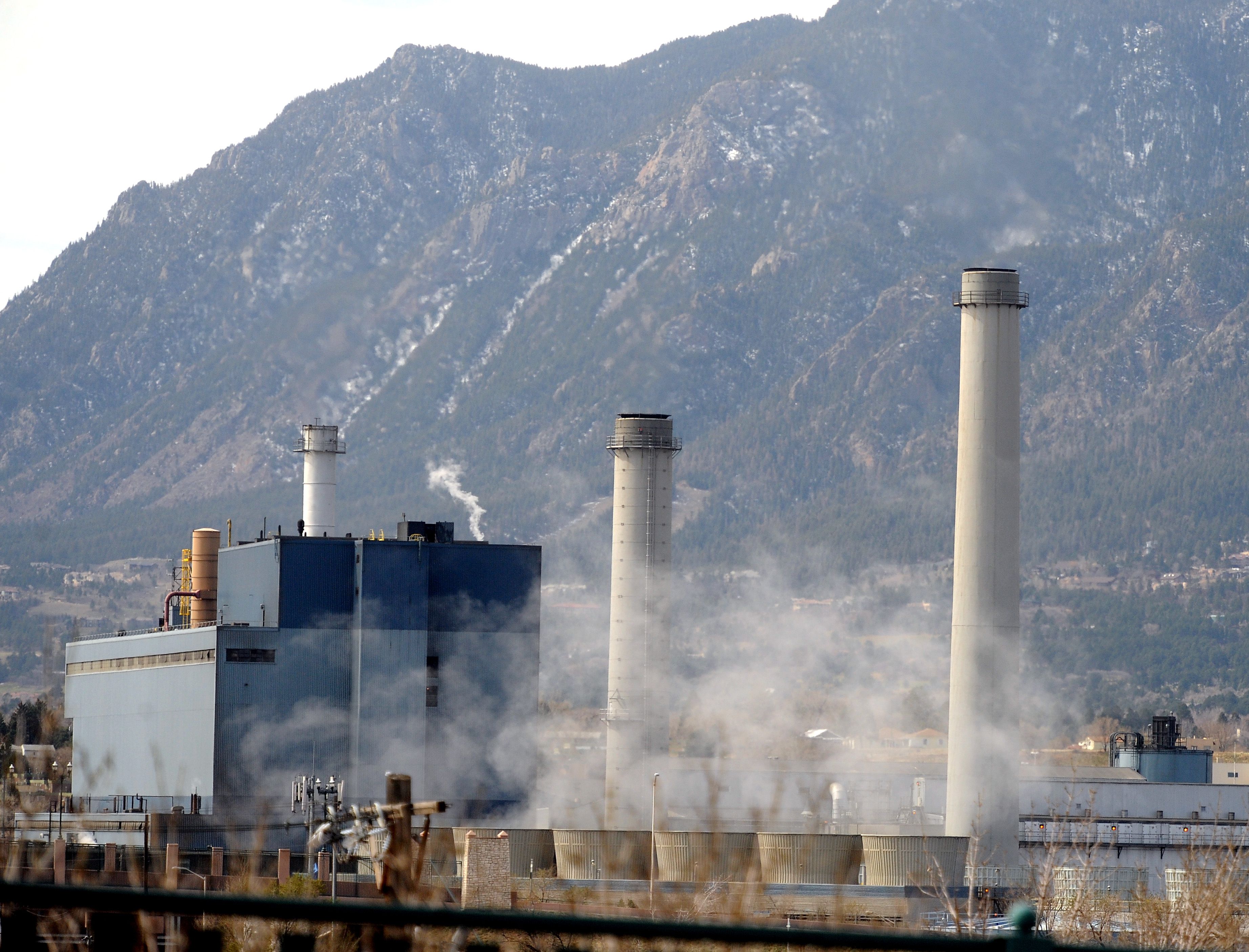
The Colorado Springs Utilities staff and customer advisory group have chosen a new energy plan, Portfolio D, that won’t close any coal-burning unit at the Martin Drake Power Plant until 2023.
They’ll inform the public during a hearing Tuesday night. But some downtown business owners already are dismayed by that choice.
The Downtown Partnership has decided that Portfolio H – not D – is the best choice, said President and CEO Susan Edmondson.
Portfolio H would decommission Drake Units 5, 6 and 7 in 2018, 2023 and 2029, respectively.
“However, we also feel a more aggressive approach toward decommissioning Drake should be considered,” Edmondson said. “The intangible costs to having this aging eyesore at the gateway to our city are very real. It’s an economic development issue.
“Primary employers aren’t just looking for cheap energy. They seek to attract and retain the best workforce. And these days, that desired workforce is made up of people who desire a great quality of life, a thriving urban core and an attractive city overall. Drake and what it represents don’t put our best face forward for our community.”
Drake sits in one of the city’s most beautiful locations and could be used to stimulate incredible economic vitality, said Sam Eppley, owner of Sparrow Hawk Cookware in the heart of downtown.
The Drake site alongside Fountain Creek could be developed to mirror the success at Denver’s Confluence Park, Eppley said. There, the once blighted intersection of the Platte River and Cherry Creek now features recreation for kayakers, cyclists, walkers and birders as well as apartments and restaurants galore.
Denver estimates that the $100 million investment there has yielded a $10 billion return.
At the Drake site, Eppley said, “I would like to see mixed use. Just about anything you can think of could be included into that, just as in Denver . That property went from absolute blight and an eyesore to (some of) the most expensive real estate in the state of Colorado.
“So they created an incredibly good thing from something that was flooded and disastrous. I believe you could have that same renaissance for that land with Drake being gone.”
Eppley also prefers Portfolio H.
“We could benefit in the region if Drake were not there, even though it might cost a few cents more for electricity,” he said. “However, if we went with more renewables, I believe in the long run that would pay off.”
That preference was echoed by Richard Skorman, who with wife Patricia Seator co-owns the downtown Poor Richard’s restaurant, Little Richard’s toy store, Poor Richard’s books and gifts and Rico’s café and wine bar.
“It would be a great gift to us, who have invested so heavily in downtown, to at least understand when we can say goodbye to the dinosaur,” said Skorman, a former city councilman and Utilities board member. “I’ve been lobbying for it to close with a date certain for more than a decade.
“The plan they’re recommending now is open-ended. But with a date certain, all the people investing in downtown would be able to plan for the future.”
The site long has been envisioned for residences but also could be used for a privately funded arena or a recreational site such as Denver’s, Skorman said.
“Then you have the real estate that looks upon it, such as Perry Sanders’ (planned) 100-story building. Look at the value of the view in the Pikes Peak region. It increases the value of all properties that look upon it.”
Portfolio H, by contrast, could eliminate the need for more pollution controls, Skorman said.
“They don’t know the impact the (new federal) Clean Power Plan is going to have on the plant. And they don’t know what these new ozone rules are going to do to the plant as well.”
People and groups with environmental and health concerns likewise prefer Portfolio H.
The nonprofit, nonpartisan Western Resource Advocates says that option for the new Electric Integrated Resource Plan would let CSU:
– Comply with the Clean Power Plan and pending ozone regulations;
– Avoid installing more pollution controls at Drake 5 in 2018 and Drake 6 in 2023;
– Improve air quality and thus public health and the environment;
– Provide a gradual transition toward cleaner energy.
Portfolio H would cost 0.5 percent more over 20 years, at $6.47 billion for those two decades instead of $6.44 billion with Portfolio D, advocates said.
Utilities staff and its 15-member Customer Advisory Group spent about a year discussing and studying nine possible EIRPs before deciding to recommend Portfolio D, with one change. The CAG prefers that Drake Unit 5 be mothballed for at least three years rather than getting a $2.5 million conversion to natural gas.
The staff also will present runners-up Portfolios F and H to the Utilities board, which will vote Nov. 18.
The Western Area Power Administration, which provides hydroelectric power to Utilities, requires a new EIRP to be submitted every five years. Utilities is providing its EIRP a couple of years early because of the Environmental Protection Agency’s Clean Power Plan, which was unveiled Aug. 3.
That plan calls for carbon dioxide emissions to be slashed 32 percent by 2030 from 2005 levels. Carbon is the predominant component of coal.
