






Fire marshal: Black Forest fire presented several challenges to fire crews
SNOWMASS – Firefighters faced more than a perfect storm of heat, wind and dry vegetation when the Black Forest fire exploded on June 11, 2013.
A collection of El Paso County fire districts walked into what they considered a hostile neighborhood long resistant to fire protections. And without maps, crews were forced to navigate an overgrown forest criss-crossed with dead-end roads.
At all corners, the odds were stacked against them.
For county fire crews, political and environmental factors made the Black Forest fire extremely hard to fight. But it also is a valuable lesson for fighting future wildfires, said Vernon Champlin, who gave a presentation on the fire during the Colorado Wildfire Conference in Snowmass on Friday.
Despite Champlin’s bleak portrayal of the area, Black Forest has managed to rebound and remedy some problems after the fire, which destroyed 488 homes and killed two people. Two years later, the newly formed nonprofit Black Forest Together focuses heavily on landscape restoration and fire mitigation. Slowly, more and more neighbors have bought into national fire mitigation programs.
The neighborhood has much work to do, however.
Many areas in the forest were left untouched by the fire and are still prime to burn. And though fire mitigation has caught on, it’s expensive and may now be dwarfed by the cost of removing thousands of burned trees.
For Champlin, one of the greatest shortcomings of the community – inadequate fire and land use codes – has not been rectified despite a push by local firefighters.
He maintains that Black Forest still harbors many of the dangers it posed to fire crews in two years ago.
Champlin, formerly a Falcon Fire Protection District battalion chief, fought in the Black Forest fire alongside crews from all over the state. On Friday, to a room of firefighters and fire mitigation experts, he delivered an overwhelming list of challenges crews faced as they fought the most destructive fire in Colorado history.
Now the fire marshal with the Northeast Teller County Fire District, Champlin painted a vivid but simple picture of Black Forest to set the stage for his recap of the fire. He showed a photo of sign nailed to a pine tree that crews encountered in the forest:
“No trespassing. Trespassing violators will be shot. Survivors will again be shot,” the weathered sign read.
Champlin described Black Forest as a bedroom community that prizes isolation and is not known for neighborhood cooperation.
“They don’t want to engage with anybody,” he said. “Any kind of regulation on any level is just really not welcome in this area.”
Black Forest also presented firefighters with environmental challenges far beyond neighborhood culture. Like many American forests, the neighborhood had an overwhelming fire deficit, with more than a century of tree growth unchecked by the natural process of fire.
While the neighborhood was vulnerable to severe fire, its layout and construction made navigation dangerous for crews, Champlin said. Area fire stations had no maps to help unfamiliar crews through a grid of dead-end, forested dirt roads. In some places, the road infrastructure was hazardous. Champlin recalled a couple of plastic culverts that melted and trapped at least two fire engines.
Like the Waldo Canyon fire in 2012, the Black Forest fire triggered an evacuation of thousands of people. Marc and Robin Herklotz died before they escaped their home.
But the time of year of the fire also posed a unique challenge to get people out, Champlin said. In more than one house, children on summer break were home alone while their parents were at work. Fire crews and law enforcement officers had to help get some children out after the neighborhood was closed.
The evacuation of some homeowners was delayed by a rush to rescue livestock with a shortage of trailers. In general, there seemed to be no evacuation plan for the neighborhood, Champlin said. His list of obstacles also covered the limited degree of fire mitigation, local political pressures for airtankers, limited training of local crews and lack of pre-planning to coordinate the firefighting effort.
Black Forest seemed to defy the model neighborhoods that this week’s conference in Snowmass was designed to promote – neighborhoods with extensive fire mitigation and preparedness plans, where crews stand a good chance of staying in front of a fire’s devastation.
Champlin urged firefighters in other counties to prepare their areas for big blazes by developing plans for radio communication, evacuations and response efforts. He particularly stressed creating what he called “tactical maps” of neighborhoods that can be distributed to out-of-area fire crews. Champlin said he is spearheading this effort in Teller County.
A few members of the audience asked Champlin what it would take to bring similar changes to El Paso County, particularly when it comes to fire codes.
“I don’t know that it will ever change,” he said. For his part, he gave up and moved on. “I finally got to the spot that I realized I’ll never change it.”
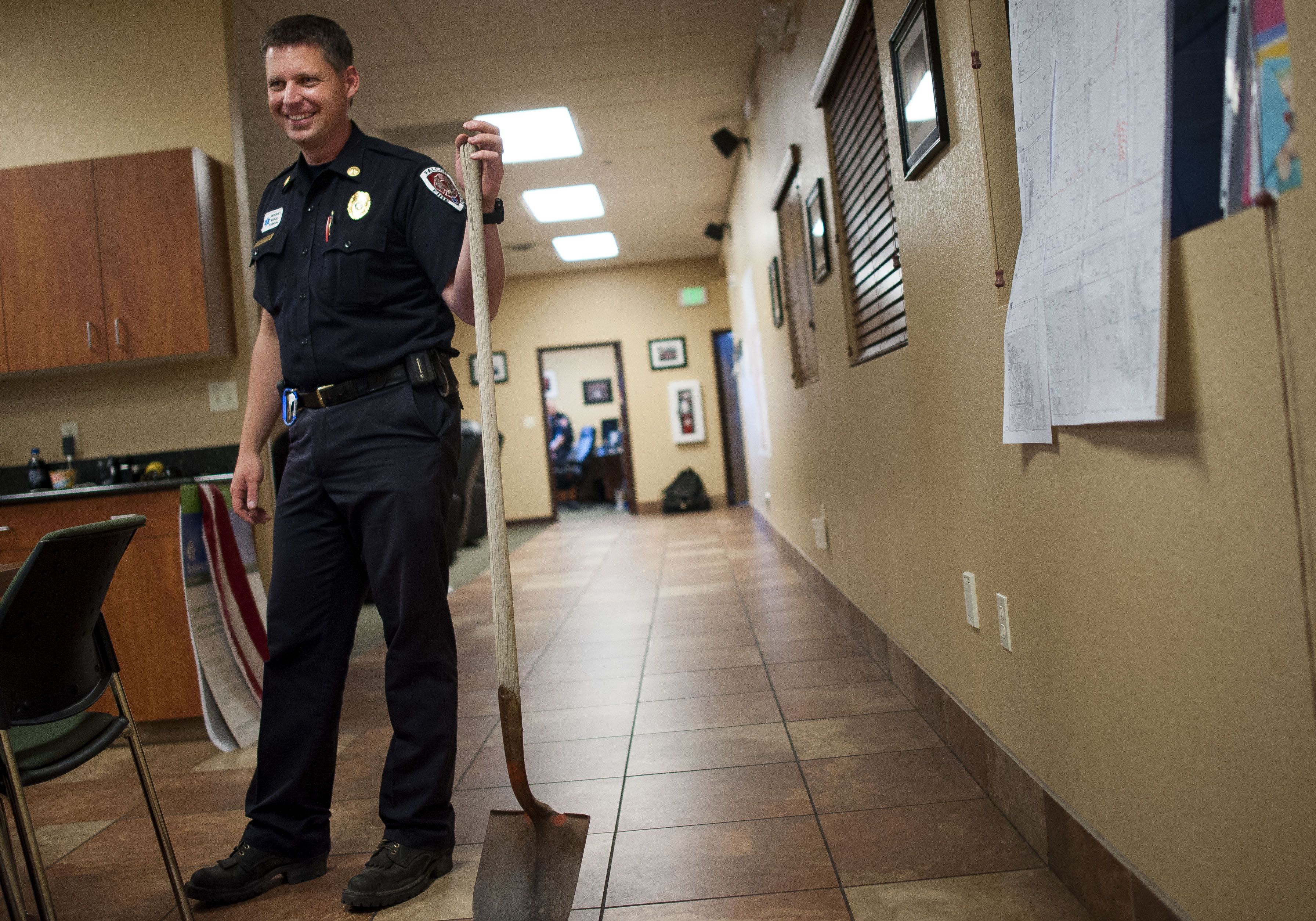
Falcon firefighter Vernon Champlin shows off a shovel he borrowed from the back porch of a house he was trying to save from the Black Forest fire. Champlin kept the shovel for the duration of the fire, using it to protect structures throughout Black Forest. The house he borrowed the shovel from survived and Champlin was planning to return it to the homeowners as he welcomed them back home. Michael Ciaglo/The Gazette
People line Old Ranch Road to cheer for the firefighters returning from a shift of fighting the Black Forest Fire Sunday morning, June 16, 2013, outside the fire camp at Pine Creek High School in Colorado Springs, Colo. The scars of last summer’s Waldo Canyon Fire can be seen in the background. (AP Photo/The Gazette, Christian Murdock)
Falcon Fire Department Battalion Chief Curtis Kauffman, right, and firefighter Vernon Champlin exchange war stories Tuesday, June 18, 2013 as they remember their experiences being some of the first firefighters on the scene of the Black Forest fire. Michael Ciaglo/The Gazette