






Boulder wildfire mitigation program could become template for state
SNOWMASS – A Boulder County wildfire protection program is quickly becoming a model for the state when it comes to incentivizing homeowners to bolster their homes from wildfire.
Boulder’s Wildfire Partners program, supported by the county and run on state and federal grants, guides western county residents through an intensive fire mitigation process. Through the program, properties are assessed for their wildfire danger and, hopefully, transformed into parcels that the county considers more resilient to fire.
But the program also comes with two unique benefits: a rebate of a few hundred dollars to help cover costs, as well as a certificate that a few insurance companies will accept as adequate proof of fire mitigation.
At the Colorado Wildland Fire Conference in Snowmass this week, Boulder’s program was showcased as an unusual and successful model that connects homeowners, fire prevention specialists and insurance companies. While wildfire mitigation programs for homeowners are nothing new, involving insurance companies is a rare piece that sets Boulder’s program apart.
Since the 2002 Hayman fire in Teller County, many insurance companies in Colorado require owners to mitigate their properties, a process that often involves cutting down trees and other vegetation. After massive wildfires burned around the state in 2012 and 2013, more homeowners find that they can’t get insurance unless they mitigate.
With Boulder’s new program, homeowners can present their certificate of fire mitigation as proof to an insurance company that they are doing their part.
While the program has yet to change insurance rates for the fewer than 200 property owners who have received certificates, it has helped those homes become more insurable, said Carole Walker, executive director of the Rocky Mountain Insurance Information Association.
“You still live in a high-risk area,” said Walker, who spoke about the program at the wildfire conference on Thursday. “If they are willing to take all these steps and do all the programs, this will help them keep their insurance.”
Boulder County is at the forefront when it comes to development regulations in wildfire zones. Following the Fourmile Canyon fire in 2010, the county passed new land use codes that applied to all development in so-called red zones, where wildfire potential is high. Started last year, the Wildfire Partners program is voluntary, but for those who apply it’s a rigorous journey to the final certificate.
Boulder County residents must first apply for the program before they get an assessment of their fire risk, said Jim Webster, the program director. At one point, the application involved an essay question that asked homeowners to look at an aerial photo of their home and say whether or not it could withstand a fire, Webster said.
Once an assessment is done, the homeowner is given a checklist of tasks to complete. Thus far, the program has done 672 assessments and awarded 172 certificates. Most homeowners have spent an entire year meeting all the criteria.
While the program has offered rebates to homeowners in the past, they covered only a fraction of the average cost of an extensive fire mitigation project. The average cost of the work per home has been $3,399, of which homeowners pay 80 percent, leaving the rest to be covered by the program.
Last year, a $300 rebate was offered to homeowners, but this year a $500 rebate will be offered only to contractors doing the work, Webster said.
Colorado has toyed with the idea of offering homeowners financial incentives to mitigate, although the idea, part of recommendations in a 2013 report represented Gov. John Hickenlooper, has not become policy.
Boulder’s approach, a program not necessarily tied to laws or ordinances, appeals to other wildfire-prone counties struggling with acres of unmitigated private land. Eagle County is considering adopting a similar program, Walker said. Keith Worley, the secretary of the Pikes Peak Wildfire Prevention Partners, is also compiling the basics for a program that could be used in El Paso County.
While property assessments of wildfire risk are commonly done, Boulder’s program – with check-ins, check lists, certifications, and rebates – takes the process to an entirely different level.
And homeowners like it, Webster said.
“Homeowners are finding great value (in it),” he said. “And we realized that it is a really big program.”
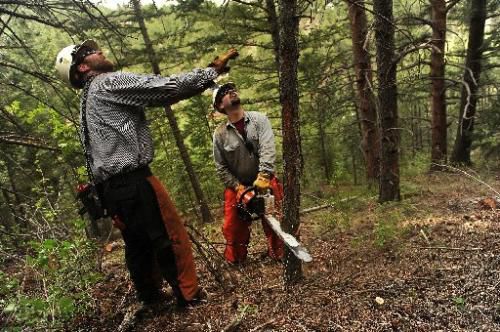
Firefighters Tim Borgman, left, and Weston Toll, right, with the Nature Conservancy, use a saw to cut trees on US Forest Service land near Jamestown, CO on May 28th, 2013. (Photo by Helen H. Richardson/The Denver Post)