






State request for proof of stormwater basins’ compliance could set tricky precedent
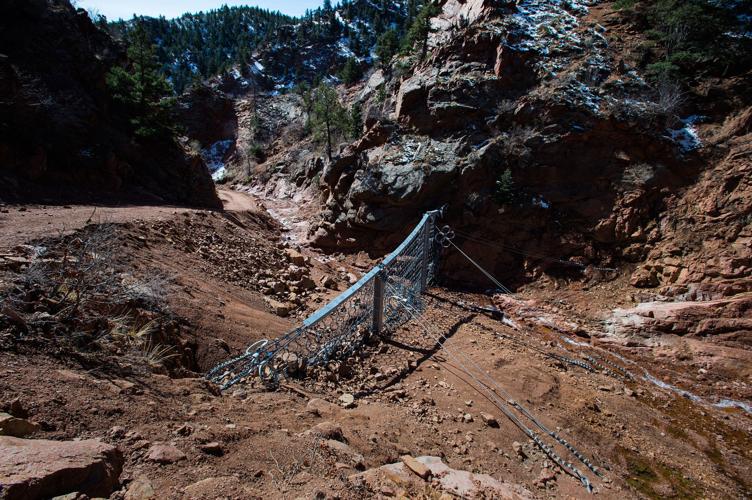
CHRISTIAN MURDOCK, THE GAZETTE
Months after the state Legislature declared a network of El Paso County debris basins legal, state engineers have sent letters to El Paso County agencies requiring proof, a move that could set dangerous precedent for future flood mitigation projects, local officials say.
Thanks to a new law, debris basins, considered crucial to protection from flooding, are exempt from state stormwater and water rights regulations. As long as the basins are built in post-fire zones and are temporary, they are legal, the law declared. But local officials contend that the law says nothing about providing the state with proof that the basins are legal, a requirement they fear will inhibit the use of the crucial structures.
In a July 20 letter, the Colorado Division of Water Resources asked a group of local agencies to prove that 30 flood mitigation projects were constructed according to Senate Bill 212, which requires that flood basins be temporary structures for wildfire mitigation only, and that agencies have a plan for removing them when they are no longer needed.
Local officials are concerned that the state engineer’s office is overreaching by asking for details, said Mark Shea, the watershed planning supervisor for Colorado Springs Utilities.
“We are concerned about setting a precedent through the state that will make it really hard to use these debris basins,” he said.
Shea discussed the letter on Monday at a Waldo Canyon fire recovery meeting with local nonprofits, the Colorado Department of Transportation, and city and county officials. All were concerned that the burden of proof would make the debris basins – which reduce major flooding off the burn scar – impossible to use.
“The Legislature understood that these things are lifesaving,” Shea said Monday. “They were very clear that these are supposed to be completely exempt.”
The basins are considered key to stemming the tide of debris and water that comes coursing off the Waldo Canyon burn scar after a heavy rain. The network of basins scattered throughout the burn scar hold back boulders and sediment that have poured onto U.S. 24. Millions of federal and state dollars were put into building the basins, which will be key to managing post-fire flooding for years to come.
The law also requires that the basins be built near non-perennial streams. Steve Witte, the state engineer who sent the letter, could not be reached for comment Wednesday.
In a response letter sent on Aug. 4, members of the recovery group assured state engineers that the basins were constructed within the parameters of the law. The group intends to send another letter explaining the specifics of the basins’ compliance.
Nonetheless, the recovery group hopes to preserve future projects from being bogged down by data agencies aren’t legally bound to provide, Shea said. As long as the basins were engineered to be temporary bulwarks against wildfire flooding, that should be enough for the state, he said.
In January, the group of organizations that manages the basins was shocked to learn the projects violated state water laws. A letter from the Colorado Division of Water Resources informed the organizations that the basins infringed on water rights far downstream in the Lower Arkansas Valley. At the time, state regulations of basins holding water were vague, and junior water rights holders, who rely on runoff and excess water to fulfill their water right, argued that flood mitigation held back water they would otherwise receive.
But the amount of water the debris basins hold back is infinitesimal, advocates for the basins argued. Advocates also said complaints about the basin stemmed from infrequent users of a water right who do not understand hydrology.
“The Arkansas River Basin is over-appropriated,” Shea said. “There are more rights out there than there is water.”
Ultimately, the Legislature sided with the debris basin supporters and passed Senate Bill 212. The law proposed that post-fire flood mitigation basins not be subject to stormwater permits, and that similar stormwater projects can hold water for up to 72 hours. Most importantly, the bill states that none of those projects can infringe on water rights.
