






El Paso County studying a change to district boundaries.
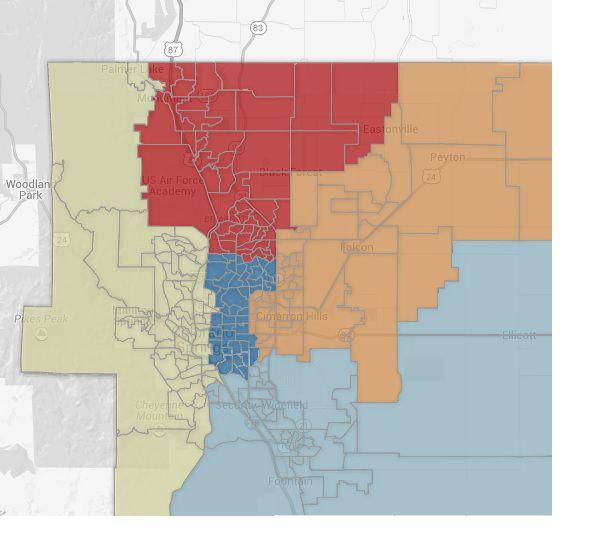
Three options could change the Board of El Paso County Commissioner districts for many county residents.
The proposed districts, announced at a May 12 commissioners meeting, are intended to help the growing county population be equitable across the districts while preserving the key areas and features of each district, said Ryan Parsell, spokesman for the El Paso County Clerk and Recorder’s Office. Before creating the options, the office consulted with county commissioners and representatives from the major political parties.
– El Paso County precincts and commissioner districts –
“Their goals were such that we couldn’t create one plan,” Parsell said. “Each option has different strengths and weaknesses.”
The biggest potential changes would impact districts one and four, in the eastern part of the county. As requested by some voters, two options would split that area into two districts, Parsell said.
Residents have until June 11 to give input about the proposed districts to the clerk and recorder’s office.
The new districts will be built within new precinct lines adopted by the county commissioners at the May 12 meeting. Those changes added 43 precincts, bringing the total county precincts to 242. The new precinct lines were necessary because some of them had grown large and were above the legal maximum of 2,000 registered voters, Parsell said.
No matter the outcome, Republicans will remain the majority party in all districts, making it difficult for Democrats to win a seat.
For the most part, new precinct lines won’t change the way the county votes, Parsell said. State and federal voting districts will remain the same, and since the state has moved from precinct voting to favor mail-in ballots and regional voting centers, most people will continue to vote the way they have for years.
“The individual precinct is still foundational, but nowhere near the importance it would have been 10 to 15 years ago,” Parsell said.
Daniel Cole,executive director of the El Paso County Republican Party, said that more precincts are better for politics in general.
“It gives us the opportunity to get more Republicans involved in an official capacity, and of course that’s the same for Democrats. But overall, it’s good for civic engagement,” he said.
As for the redistricting process, Cole said El Paso Republicans would be fine with any of the proposed districts.
For Democrats, there’s more at stake in redistricting. The county is so predominantly Republican that it would be nearly impossible for Democrats to hold a majority. Even winning one seat would be a surprise, because no Democrat has been on the board since 1975, when Stan Johnson vacated his District 1 position.
The county Democrats’ goal is to have a “competitive chance” in at least one district, said Kathleen Ricker, chair of the El Paso County Democratic Party. She said El Paso Democrats are studying the options and plan to give County Clerk Chuck Broerman their recommendations.
“We will definitely be putting in input. All three proposals are not equal,” Ricker said. “We’re still evaluating it to see where our registered voters are. We’re hoping that we can evaluate it and have at least one district where there would be competitiveness in the election.”
But that will prove tough for Democrats. At most, Democrats would have 25 percent of the registered voter population in either District 3 or District 5, according to data released by the county clerk’s office.
The main goal of the commissioners seems to be keeping key features that make their districts unique. District 1 Commissioner Darryl Glenn made it clear that he expects the Air Force Academy to remain in his district in the north-central part of the county.
“I can tell you that I am not giving up the Air Force Academy,” he said. “Not while they have a graduate as their commissioner. That was a fall-on-my-sword issue for me.”
All three options keep the academy in the district.
Sallie Clark in District 3 wants her district on the west side of the county to continue to represent residents who live along the wildland urban interface.
“Keeping the wildland interface in District 3 makes sense because that district has similar kinds of constituencies,” she said. She added that she’s been able to forge relationships with the forest service because it’s in the interest of many of her constituents.
For the most part, District 3 remains mostly the same, although two options put Palmer Lake in District 3. Clark said the move makes sense because Palmer Lake has many of the same urban interface issues as the rest of her district.
Central Colorado Springs, represented by Peggy Littleton in District 5, won’t change much, she said. She’s trying to learn more so she can vote for the best options for the rest of the board.
“I’m talking to my colleagues,” she said. “What I’d like for us to do is to see that everyone is happy with their redistricting. My goal is to make sure that they are OK with any shift in lines.”
–
Contact Maria St. Louis-Sanchez: 636-0238
Twitter @mariastlouis
Facebook Gazette Maria St. Louis-Sanchez
Betty Sexton