






Colorado Springs’ pothole problem isn’t getting better anytime soon
Rich Normandie drives strategically along North Union Boulevard to his daughter’s school like a NASCAR driver. He’s discovered that most of the potholes are closest to the medians or sidewalks, so he tries to stay in a middle lane.
“And if I stay on certain tracks, I know I can avoid two in one lane or one in another,” the Colorado Springs resident said.
The strategy doesn’t always work. About two months ago, Normandie hit a big pothole, flattened a tire and had to buy a new rim.
“I wish I could use expletives to describe it,” he said of the city’s pothole problem. “It’s probably the most frustrating thing I’ve had to deal with in a long time. Every day I have to avoid driving through 10 to 15 big potholes, and they sit there day after day.”
MORE: Colorado Springs mountain biker hospitalized after hitting pothole.
The weekend weather made the problem worse.
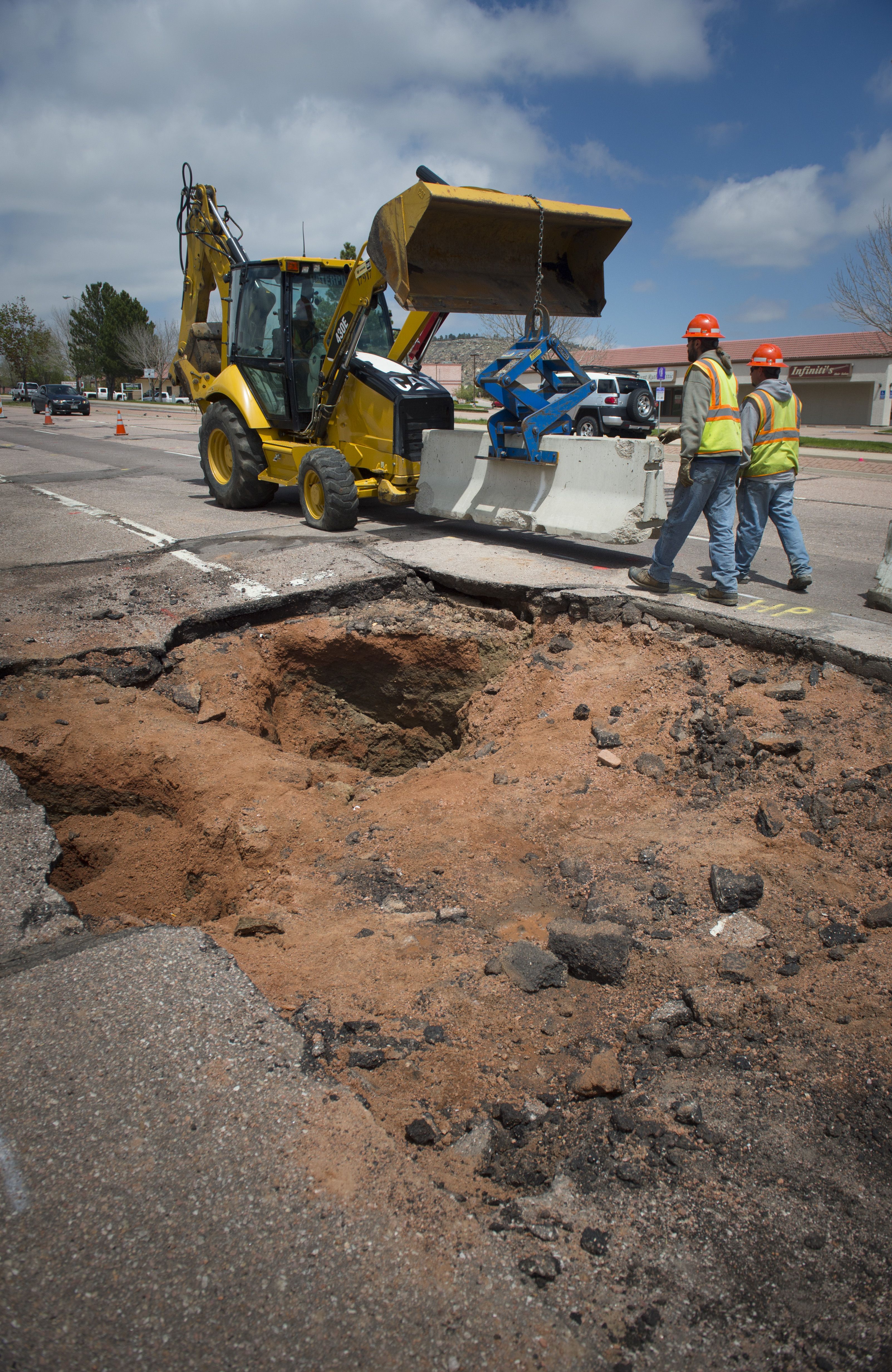
Moisture from the weekend’s rain, hail and snow caused new potholes to appear and recently filled ones to reopen, city officials said Monday. The city is investigating reports of at least five sinkholes caused by failed infrastructure beneath the roads.
“We’ll be making the repairs as quickly as we can with the resources we have available,” said Corey Farkas, street division manager.
As of Friday, the city had more than 400 potholes listed on its repair list, but for every one reported, several more exist, he said. In recent months, the city has fixed more than 5,000 potholes, but those were quick fills, rather than long-term solutions, Farkas said.
Recent storms have reopened many of those temporary repairs.
Farkas said the pothole problem is the result of miles of city roads that have been ignored for at least a decade, and filling potholes won’t do much to solve the over-arching problem of deteriorating roads.
“Filling potholes doesn’t fix the pothole issues,” Farkas said. “Paving roads fixes the pothole issue.”
This year, the city estimates that 158.1 miles of road will be resurfaced – 35 percent less than in 2005.
The recession definitely hurt progress on street repairs, with just 80 miles of city streets repaved in 2008, but even after the economy began to recover and the number of miles of resurfaced roads started to increase, repairs fell again in 2013.
“You look at these numbers, and there is no excuse to explain 2012 being (183 resurfaced miles) and 2013 being 109,” Councilman Bill Murray said. “I’m watching a lot of the same (refilled) potholes come up. The street comes up too. We can’t do Band-Aids.”
The city is so backed up on street repairs, Farkas said, that even if there were no more street problems, it would take 67 years to get the roads where they need to be. But the problems continue to mount. The older roads get, the faster they deteriorate, he said.
“At a certain point, they start to nosedive,” Farkas said. “That’s where we are at.”
The sheer volume of necessary work means the potholes that crews get to are filled, rather than fully repaired, Farkas said.
When crews fill a pothole, they use a mix of cold asphalt and try to flatten it out as best they can. During a repair, crews use hot asphalt along with a jackhammer to try to square up the sides of a hole as best they can. Repairs take much longer than fills, Farkas said.
Many potholes that were filled since winter did not hold up during recent rains.
“The moisture gets in there,” Farkas said Friday. “I was checking on holes that had mix in them earlier in the week and opened back up and are now holding water. The traffic going over it disintegrates it and all of a sudden, that pothole reopens.”
For now, Farkas said, crews will continue their resurfacing work and try to fill as many potholes as quickly as they can.
Crews can’t fix the roads fast enough for Justin Gray. He recently turned off Academy Boulevard onto Powers Boulevard when he hit an enormous pothole that ripped a hole in the sidewall of his tire.
He was forced to pull over and change a tire on the onramp, with cars speeding by and his 1-year-old daughter crying in the back seat.
“I really didn’t like that. It was super unsafe,” Gray said. “Anymore, it’s like trying to drive through a minefield.”
To help guide him through the streets, Gray uses a mobile app called Waze that warns drivers of potential traffic or hazards.
He said Colorado Springs drivers are great at reporting potholes and he’s dodged several with the help of Waze. But the app too can be frustrating at times.
“It’s hard,” he said. “Almost constantly, every half mile, it says ‘pothole.'”
–
Gazette reporter Billie Stanton Anleu contributed to this report
Colorado Springs Street Department workers move concrete barriers as they prepare to repair a sinkhole that closed one lane of Centennial Boulevard just south of Garden of the Gods Rd. Monday, May 11, 2015. Photo by Mark Reis, The Gazette
Caution tape warns of the danger of a sinkhole on Centennial Boulevard Monday, May 12, 2015. Photo by Mark Reis, The Gazette